



How Odisha Chased a ₹500-Crore Jackpot After PUCC Fines; When Yogi’s UP Didn’t: Why New BJP Govt Took 2 Years To Do A Turnaround| Special Report
Key Points
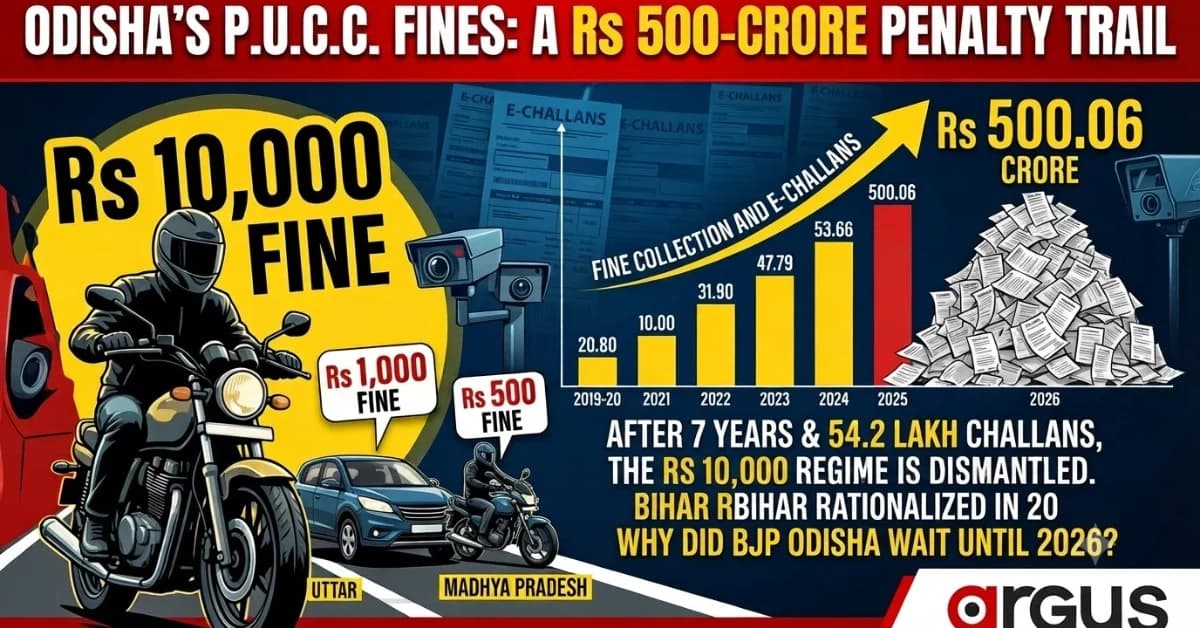
Bhubaneswar: What began in Odisha in 2019 as an aggressive push for cleaner vehicles eventually turned into something far bigger: a Rs500.06-crore penalty trail involving 54.2 lakh e-challans.
For seven years, the state persisted with the maximum Rs10,000 penalty for driving without a valid Pollution Under Control Certificate (PUCC), even as other BJP-ruled states such as Uttar Pradesh and Madhya Pradesh chose a substantially softer route.
The contrast is striking.
While Uttar Pradesh under Chief Minister Yogi Adityanath kept the compoundable PUCC penalty at around Rs1,000, Odisha continued with the Rs10,000 regime inherited from the 2019 Motor Vehicles Amendment framework. Bihar, another state that initially adopted the higher penalty, eventually rationalised its rates in September 2024.

📱 Get Argus News App
✨Odisha waited until September 2026.
The result was a curious governance paradox: the state built increasingly sophisticated digital enforcement around vehicle compliance, but a large part of the resulting challan mountain remained unpaid. At the same time, the state's vehicle population continued to carry another major compliance gap – around 40 lakh of nearly 80 lakh active vehicles were estimated to be uninsured.
The question, therefore, is not merely why Odisha cut the PUCC fine by up to 90%.
The bigger question is: why did it take the new BJP government more than two years after coming to power to dismantle a penalty architecture that neighbouring states had already begun reconsidering?
Circa 2019 – When Odisha Chose the Maximum Fine
The Motor Vehicles (Amendment) Act, 2019 fundamentally changed the penalty architecture for several traffic and vehicle-related violations.
For pollution-related violations under Section 190(2), the maximum penalty could go up to Rs10,000.
States, however, retained considerable room in determining how offences would be compounded under Section 200.
That created two distinct approaches.
Uttar Pradesh and Madhya Pradesh chose moderation.
UP settled around a Rs1,000 first-offence PUCC penalty, while Madhya Pradesh adopted an even lower first-offence rate of around Rs500.
Odisha went the other way.
The then Naveen Patnaik government retained the Rs10,000 flat penalty, irrespective of whether the vehicle was a two-wheeler, a private car or a heavy vehicle.
That distinction mattered.
For a large commercial vehicle, a Rs10,000 penalty could be absorbed as a compliance cost. For a low-income two-wheeler owner riding a Rs40,000-Rs60,000 motorcycle, it could represent a substantial share of the vehicle's value.
And Odisha quickly demonstrated how powerful the new enforcement architecture could become.
In the first four days of September 2019 alone, the transport department reportedly collected Rs88.90 lakh through 4,080 challans.
The message was unmistakable: Odisha was not merely adopting the law; it was building an aggressive enforcement ecosystem around it.
The ₹500-Crore Jackpot Lucre
Over the next seven years, technology multiplied the reach of enforcement.
Digital vehicle records, e-challans, automated detection and toll-plaza surveillance increasingly brought vehicle-document compliance into the same enforcement ecosystem.
The numbers tell the story.
Odisha's PUCC/Traffic Fine Trail
|
Financial Year |
Fine Collection |
|---|---|
|
FY 2019-20 |
₹42.50 crore |
|
FY 2020-21 |
₹31.10 crore |
|
FY 2021-22 |
₹64.80 crore |
|
FY 2022-23 |
₹91.40 crore |
|
FY 2023-24 |
₹112.76 crore |
|
FY 2024-25 |
₹89.30 crore |
|
FY 2025-26 |
₹51.20 crore |
|
FY 2026* |
₹17.00 crore |
|
Total |
₹500.06 crore |
*As per the available data.
The peak came in FY 2023-24, when collections touched ₹112.76 crore.
Across the period, the enforcement system generated 54.2 lakh e-challans.
On paper, this looked like an enforcement success.
But underneath the collection numbers was a more uncomfortable question:
How much of the penalty system was actually improving compliance,and how much was simply creating an ever-growing stock of unpaid liabilities?
By late 2024, the unpaid PUCC challan burden was reportedly running into tens of crores.
The problem was compounded by another ground-level reality: enforcement capacity was growing faster than compliance infrastructure.
If a driver was detected without a valid PUCC but could not easily obtain a new certificate because of limited testing capacity, long queues or database delays, the enforcement cycle could become self-reinforcing.
A vehicle remained non-compliant.
The camera detected it.
A challan was generated.
The driver tried to regularise the vehicle.
The testing infrastructure became the bottleneck.
And another automated detection could potentially follow.
That is where technology-first enforcement began to collide with citizen-first governance.
The Insurance Numbers Expose a Bigger Compliance Crisis
There is another number that makes Odisha's PUCC experience particularly revealing.
Around 40 lakh of nearly 80 lakh active vehicles in Odisha are estimated to be uninsured – roughly a 50% active uninsured rate.
This is not an Odisha-only phenomenon.
Data presented before the Supreme Court from the Ministry of Road Transport and Highways put the national uninsured-vehicle problem at roughly 54%-56%, equivalent to around 16.54 crore vehicles.
The state comparison is revealing.
|
State |
Approx. Uninsured Vehicles |
Approx. Uninsured Rate |
|---|---|---|
|
Uttar Pradesh |
2.10 crore+ |
~54% |
|
Maharashtra |
1.60 crore+ |
~50% |
|
Tamil Nadu |
1.27 crore+ |
~49% |
|
Gujarat |
1.03 crore+ |
~48% |
|
Andhra Pradesh |
77.10 lakh+ |
~53% |
|
Odisha |
~40 lakh active |
~50% |
|
National |
~16.54 crore |
~55% |
The implication is important.
Odisha's problem is not necessarily that its citizens are uniquely non-compliant.
Its 50% uninsured rate sits broadly within the national pattern.
The bigger problem is what happens when governments respond to widespread non-compliance with increasingly punitive automated enforcement.
India's two-wheeler problem is particularly acute. Across the states compared, two-wheelers account for a disproportionately large share of uninsured vehicles, with many owners failing to renew insurance after the initial mandatory policy period.
That raises a fundamental policy question:
If half the vehicle fleet is struggling with basic insurance compliance, can a Rs10,000 PUCC penalty realistically produce better environmental compliance- or merely generate more unpaid challans?
Yogi's UP Took A Different Road
This is where Uttar Pradesh provides an important counterpoint.
UP did not simply replicate the maximum Rs10,000 penalty.
Instead, it used the state's compounding powers to retain a significantly lower PUCC penalty.
The first-offence rate was around Rs1,000, with repeat violations attracting a higher but still substantially lower penalty.
Madhya Pradesh followed an even softer approach, with a first-offence penalty around Rs500.
The philosophy was different.
The objective was not necessarily to make enforcement technologically weaker.
It was to make the cost of compliance manageable enough for people to actually comply.
Technology could still be used for visible traffic offences, ANPR and integrated traffic management.
But the critical distinction was the degree to which highway toll infrastructure was turned into an automated document-enforcement mechanism.
This distinction matters because highways are not just enforcement zones.
They are also economic arteries.
A truck, bus, taxi or private vehicle travelling across states cannot realistically be subjected to a system where every database mismatch immediately becomes a high-value penalty or operational blockage.
UP and MP, in effect, retained a greater role for physical enforcement, local traffic management and compliance-linked administrative checks rather than making every highway movement a potential automated document violation.
Bihar Showed Odisha What A Course Correction Could Look Like
Bihar provides an even more direct comparison.
Like Odisha, Bihar initially adopted the Rs10,000 PUCC penalty.
But the state eventually reconsidered.
In September 2024, Bihar shifted towards a graded structure, bringing the first-offence penalty for two-wheelers down to around Rs1,000, while reserving higher penalties for larger vehicles and repeat violations.
The lesson was visible by then:
A penalty can be legally valid and technologically enforceable, yet still be administratively counterproductive.
Bihar's experience demonstrated that a government could move away from a uniform Rs10,000 penalty without abandoning enforcement.
Odisha, however, continued with the old architecture for another two years.
Why Did Odisha's BJP Government Take Two Years?
The Mohan Charan Majhi government inherited the system when it assumed office in 2024.
But changing a bureaucratic enforcement architecture is considerably harder than announcing a new policy.
The system was already embedded into digital databases, e-challan processes and automated enforcement mechanisms.
There was also a powerful administrative argument behind retaining strict penalties: deterrence.
But deterrence has a limit.
When the penalty becomes disproportionately high compared with the economic capacity of the person being penalised, the system can begin producing the opposite outcome.
People delay payment.
Vehicles remain technically non-compliant.
Challans accumulate.
And enforcement becomes increasingly dependent on software blockades rather than actual behavioural change.
That is essentially the dilemma Odisha's new government faced.
For nearly two years, the BJP government did not immediately dismantle the inherited Rs10,000 framework.
Then came the political breaking point.
‘No PUCC, No Fuel’ Became The Trigger
The proposed "No PUCC, No Fuel" enforcement mechanism transformed what had largely been a transport-department issue into a mass public concern.
The possibility of a vehicle being denied fuel because of an electronic compliance status brought the consequences of digital enforcement directly to the ordinary citizen.
A database error was no longer just a database error.
An expired PUCC was no longer simply a fine.
It could potentially affect the ability to keep a vehicle running.
That changed the political equation.
The government eventually chose relief.
On September 2, 2026, Transport Minister Bibhuti Bhushan Jena announced the restructuring of PUCC penalties, with reductions of up to 90%.
The new structure became vehicle-specific:
Two/three-wheelers: Rs1,000 for first offence; Rs2,000 for repeat offence
Cars/Jeeps: Rs2,000 for first offence; Rs5,000 for repeat offence
Heavy vehicles: Rs3,000 for first offence; Rs6,000 for repeat offence
The flat Rs10,000 regime was effectively gone.
Odisha Has Lowered The Fine But Not Lowered The Enforcement Pressure
There is an important catch.
Odisha has not moved completely towards the softer MP-UP philosophy.
Instead, it appears to be pursuing a lower-fine, harder-digital-enforcement model.
The revised system reportedly retains a stringent compliance mechanism: an e-challan remaining unpaid for more than 90 days can block the issuance of a fresh PUCC.
That means the government has changed the economics of the penalty without abandoning the digital enforcement architecture.
This is a crucial distinction.
UP/MP: Lower financial penalty + comparatively lower-friction enforcement.
Bihar: Lower, graded penalty after abandoning the flat ₹10,000 model.
Odisha: Lower, graded penalty + continued digital compliance lockouts.
In other words, Odisha has not dismantled the machine.
It has changed the price of being caught by it.
The ₹500-Crore Question
The most striking part of Odisha's seven-year experiment is therefore not the Rs10,000 fine itself.
It is the Rs500.06-crore cumulative collection.
That figure creates an uncomfortable perception: when a regulatory penalty generates hundreds of crores, the state must constantly guard against the appearance that enforcement has become a revenue instrument.
The government says the new structure is aimed at improving compliance and reducing the burden on citizens.
That is the correct test.
Not how many challans can be generated.
Not how many crores can be collected.
But whether more vehicles actually become compliant.
The insurance numbers provide a warning.
If roughly half of Odisha's active vehicles can remain uninsured in an environment of increasingly sophisticated digital enforcement, then punishment alone clearly has limits.
The same lesson applies to PUCC.
A Rs10,000 fine may look powerful in a government notification.
But a Rs1,000 fine that is actually paid, and followed by immediate compliance, could ultimately be far more effective.
The Larger Governance Lesson
Odisha's PUCC story is ultimately a story about the limits of automation.
The previous regime demonstrated that Odisha could build an impressive digital enforcement architecture.
The problem was that the technology became more sophisticated than the ecosystem supporting compliance.
The new BJP government has now begun correcting that imbalance.
But it took more than two years after taking power, and nearly seven years after the original penalty regime was introduced,to make the decisive change.
That delay is itself the story.
Bihar had already moved in 2024.
UP had avoided the Rs10,000 trap.
MP had gone even lower.
Odisha continued chasing the enforcement jackpot until the political cost of the system became impossible to ignore.
The state's Rs500-crore PUCC fine trail is therefore less a story about how much money Odisha collected than about what it took to realise that maximum punishment does not automatically produce maximum compliance.
The next test for the Majhi government is straightforward:
Can Odisha convert its new Rs1,000-Rs6,000 graded penalties into higher compliance without turning its digital infrastructure into another automated source of citizen distress?
That
will determine whether September 2026 marks merely a reduction in the
price of a violation – or the beginning of a genuine change in the
state's philosophy of enforcement.
Also Read: Odisha Road Safety Overdrive: Record Challans Expose Big Chinks in State Transport Authority’s Enforcement Armour| Special Report