



Viksit Odisha / Here's How Odisha’s New Coastal Highway Could Cut Rameswar-Paradip Travel Time By 2.5 Hours
·3 weeks ago·4 min read
Key Points
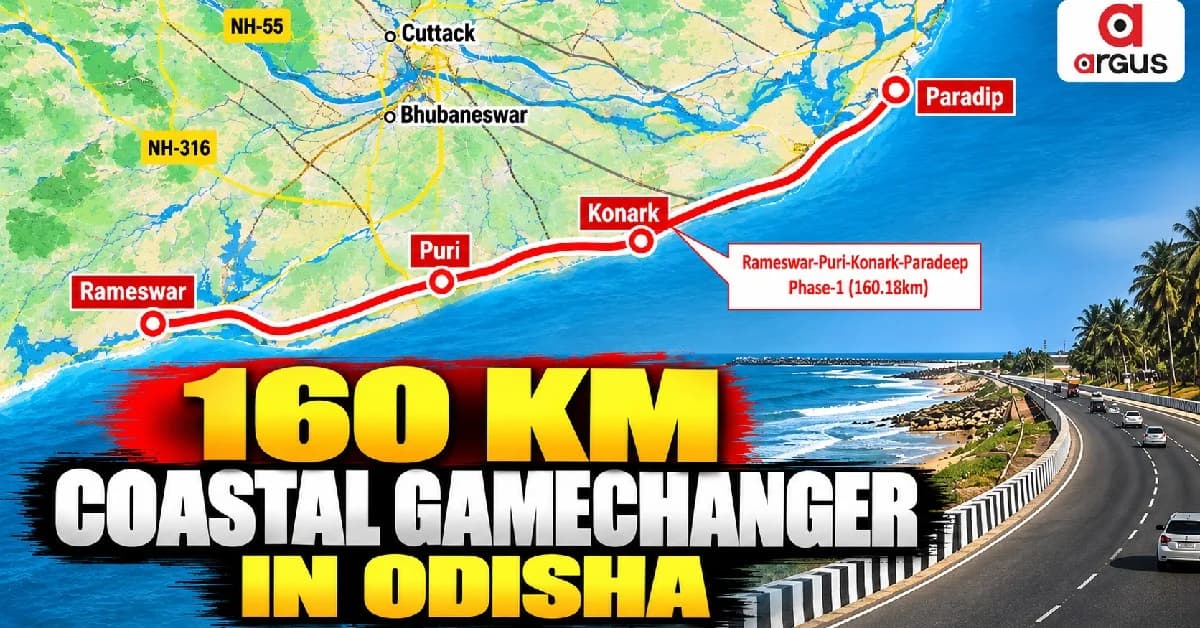
The proposed 160.18-km Rameswar-Paradip Coastal Highway, approved at Rs 8,300.79 crore, is designed to cut the existing journey by around 2.5 hours.
Bhubaneswar, Sep 26: What if a journey across Odisha’s coast could become nearly two-and-a-half hours shorter?
That is the kind of change the Union Government expects from the proposed 160.18-km Rameswar-Paradip Coastal Highway, a new corridor planned across Khordha, Puri, Kendrapada and Jagatsinghpur districts.
Approved by the Cabinet Committee on Economic Affairs in June this year at a capital cost of Rs 8,300.79 crore, the project is designed to provide an alternative route to existing NH-16 and NH-316 while creating faster links between some of Odisha’s biggest tourism, port and economic centres.
The government estimates that the Rameswar-Paradip journey could be shortened by around 2 hours and 30 minutes once the highway becomes operational.
That is the kind of change the Union Government expects from the proposed 160.18-km Rameswar-Paradip Coastal Highway, a new corridor planned across Khordha, Puri, Kendrapada and Jagatsinghpur districts.
Approved by the Cabinet Committee on Economic Affairs in June this year at a capital cost of Rs 8,300.79 crore, the project is designed to provide an alternative route to existing NH-16 and NH-316 while creating faster links between some of Odisha’s biggest tourism, port and economic centres.
The government estimates that the Rameswar-Paradip journey could be shortened by around 2 hours and 30 minutes once the highway becomes operational.

📱 Get Argus News App
✨📰 60 Word News🎬 Argus Podcast📺 Live TV and Breaking News🔔 Free Notification Alerts
Download Free:
But the significance of the project goes beyond saving time on one journey. The proposed road could alter how tourists, freight, fishing communities and businesses move along one of Odisha’s most important stretches of coastline.
A New Road Along Odisha’s Development Corridor
The highway will be developed in two sections.
The 79.4-km Rameswar-Konark section will be a four-lane, access-controlled highway, while the 80.78-km Konark-Paradip section will be a two-lane highway with paved shoulders. Both sections have a design speed of 100 kmph.
At the design speed, the 160-km corridor would theoretically take about 1 hour and 36 minutes to cover. However, actual travel time will depend on traffic, junctions, vehicle speeds, weather and access to the highway. The more meaningful benchmark is therefore the government's estimate of a 2.5-hour reduction in the existing Rameswar-Paradip journey.
The project will be implemented under the Hybrid Annuity Model (HAM).
Why Odisha Needs Another Coastal Link?
The project is intended to address a very practical problem: existing roads along parts of the coast serve both local traffic and long-distance travellers.
The Centre has pointed to substantial ribbon development and commuter movement on stretches of the existing Puri-Satapada and Puri-Konark corridors. Such conditions can slow long-distance traffic and make uninterrupted movement difficult.
A New Road Along Odisha’s Development Corridor
The highway will be developed in two sections.
The 79.4-km Rameswar-Konark section will be a four-lane, access-controlled highway, while the 80.78-km Konark-Paradip section will be a two-lane highway with paved shoulders. Both sections have a design speed of 100 kmph.
At the design speed, the 160-km corridor would theoretically take about 1 hour and 36 minutes to cover. However, actual travel time will depend on traffic, junctions, vehicle speeds, weather and access to the highway. The more meaningful benchmark is therefore the government's estimate of a 2.5-hour reduction in the existing Rameswar-Paradip journey.
The project will be implemented under the Hybrid Annuity Model (HAM).
Why Odisha Needs Another Coastal Link?
The project is intended to address a very practical problem: existing roads along parts of the coast serve both local traffic and long-distance travellers.
The Centre has pointed to substantial ribbon development and commuter movement on stretches of the existing Puri-Satapada and Puri-Konark corridors. Such conditions can slow long-distance traffic and make uninterrupted movement difficult.
The new highway is therefore being planned as an alternative route for NH-16 and NH-316, allowing longer-distance passenger and freight traffic to move more efficiently.
That could be particularly important as economic and tourism activity expands along Odisha's coast.
What Will Change For Tourists?
For travellers, the most visible benefit could be easier movement between Puri, Konark and Paradip.
Puri's Jagannath Temple and beach, Konark's Sun Temple and other coastal destinations could become part of a more connected tourism circuit rather than being treated as separate stops.
The corridor will also improve access to coastal and ecological destinations, including areas associated with Gahirmatha's famous olive ridley turtle nesting grounds.
That creates possibilities for more than conventional sightseeing. Beach tourism, heritage tourism, eco-tourism and nature-based travel could all benefit from improved road access.
But better connectivity alone does not guarantee sustainable tourism. The coastal belt contains environmentally sensitive areas, making the management of visitor pressure and development equally important.
From Temples And Beaches To Ports
Under the PM GatiShakti framework, the project is planned to connect nine economic nodes and five logistics nodes.
It will improve connectivity to important facilities including Paradip Port, Puri Railway Station, the upcoming Puri International Airport, Astarang and other emerging port infrastructure.
This gives the highway a dual role.
One side connects tourists with temples, beaches and heritage sites. The other connects businesses, fishing clusters, logistics facilities and ports with markets.
For a state with a long coastline and a growing port-led economy, that connection could be significant.
What Could It Mean For Coastal Communities?
Villages and smaller destinations along the corridor could potentially see greater demand for homestays, hotels, restaurants, local transport, handicrafts and other tourism-related services.
The project is also expected to improve access to fishing clusters across areas including Paradip, Konark, Jagatsinghpur, Puri and Kendrapada.
During construction itself, the government estimates the project could generate approximately 53.61 lakh direct man-days and 67.01 lakh indirect man-days of employment.
The longer-term question will be whether the improved connectivity produces sustained local employment rather than simply allowing travellers to pass through these communities more quickly.
Also Read: From Malkangiri To Rayagada, Here's How Odisha’s Rail Map Is Slowly Getting Bigger
The Project Has Entered The Bidding Stage
The highway has already moved beyond the approval stage.
The Rameswar-Konark package received 10 bids, while the Konark-Paradip package received seven bids, indicating strong participation in the tendering process.
The two packages are expected to be awarded under the Hybrid Annuity Model.
That puts the project closer to construction and makes the proposed transformation of Odisha's coastal connectivity increasingly tangible.
That could be particularly important as economic and tourism activity expands along Odisha's coast.
What Will Change For Tourists?
For travellers, the most visible benefit could be easier movement between Puri, Konark and Paradip.
Puri's Jagannath Temple and beach, Konark's Sun Temple and other coastal destinations could become part of a more connected tourism circuit rather than being treated as separate stops.
The corridor will also improve access to coastal and ecological destinations, including areas associated with Gahirmatha's famous olive ridley turtle nesting grounds.
That creates possibilities for more than conventional sightseeing. Beach tourism, heritage tourism, eco-tourism and nature-based travel could all benefit from improved road access.
But better connectivity alone does not guarantee sustainable tourism. The coastal belt contains environmentally sensitive areas, making the management of visitor pressure and development equally important.
From Temples And Beaches To Ports
Under the PM GatiShakti framework, the project is planned to connect nine economic nodes and five logistics nodes.
It will improve connectivity to important facilities including Paradip Port, Puri Railway Station, the upcoming Puri International Airport, Astarang and other emerging port infrastructure.
This gives the highway a dual role.
One side connects tourists with temples, beaches and heritage sites. The other connects businesses, fishing clusters, logistics facilities and ports with markets.
For a state with a long coastline and a growing port-led economy, that connection could be significant.
What Could It Mean For Coastal Communities?
Villages and smaller destinations along the corridor could potentially see greater demand for homestays, hotels, restaurants, local transport, handicrafts and other tourism-related services.
The project is also expected to improve access to fishing clusters across areas including Paradip, Konark, Jagatsinghpur, Puri and Kendrapada.
During construction itself, the government estimates the project could generate approximately 53.61 lakh direct man-days and 67.01 lakh indirect man-days of employment.
The longer-term question will be whether the improved connectivity produces sustained local employment rather than simply allowing travellers to pass through these communities more quickly.
Also Read: From Malkangiri To Rayagada, Here's How Odisha’s Rail Map Is Slowly Getting Bigger
The Project Has Entered The Bidding Stage
The highway has already moved beyond the approval stage.
The Rameswar-Konark package received 10 bids, while the Konark-Paradip package received seven bids, indicating strong participation in the tendering process.
The two packages are expected to be awarded under the Hybrid Annuity Model.
That puts the project closer to construction and makes the proposed transformation of Odisha's coastal connectivity increasingly tangible.
Related Topics
Explore more stories