



From Soap to Sambalpuri Sarees: GST Reforms to Benefit Odisha, Says Dharmendra Pradhan
Key Points
GST 2.0 simplifies tax slabs and reduces rates on essentials, benefiting common citizens and small businesses.
India’s economy projected to reach $7 trillion, with GST reforms driving formalization and growth. Odisha’s kendu leaf and textile sectors to gain from reduced GST rates; Sambalpuri branding proposed.
Sambalpur, Sep 12: Union Education Minister Dharmendra Pradhan hailed the Prime Minister Narendra Modi-led government’s historic decision to implement GST 2.0, calling it a transformative step toward economic growth and simplified taxation.
Speaking at the “GST Reforms 2.0 – Form 2025” convention organized by Sambalpur Chambers of Commerce, Union Minister Pradhan emphasized that the reforms will benefit citizens across rural and urban India. He stated that the simplification of the GST process under GST 2.0 marks an unprecedented shift in India’s economic landscape, especially benefiting Odisha.

📱 Get Argus News App
✨Pradhan recalled that after PM Modi assumed office in 2014, the GST regime was introduced in 2017. “Despite initial criticism from economists and intellectuals, the “One Nation, One Tax” model was eventually welcomed across all sections of society,” he added. The new reforms aim to accelerate economic growth and usher in a new era of simplified living.
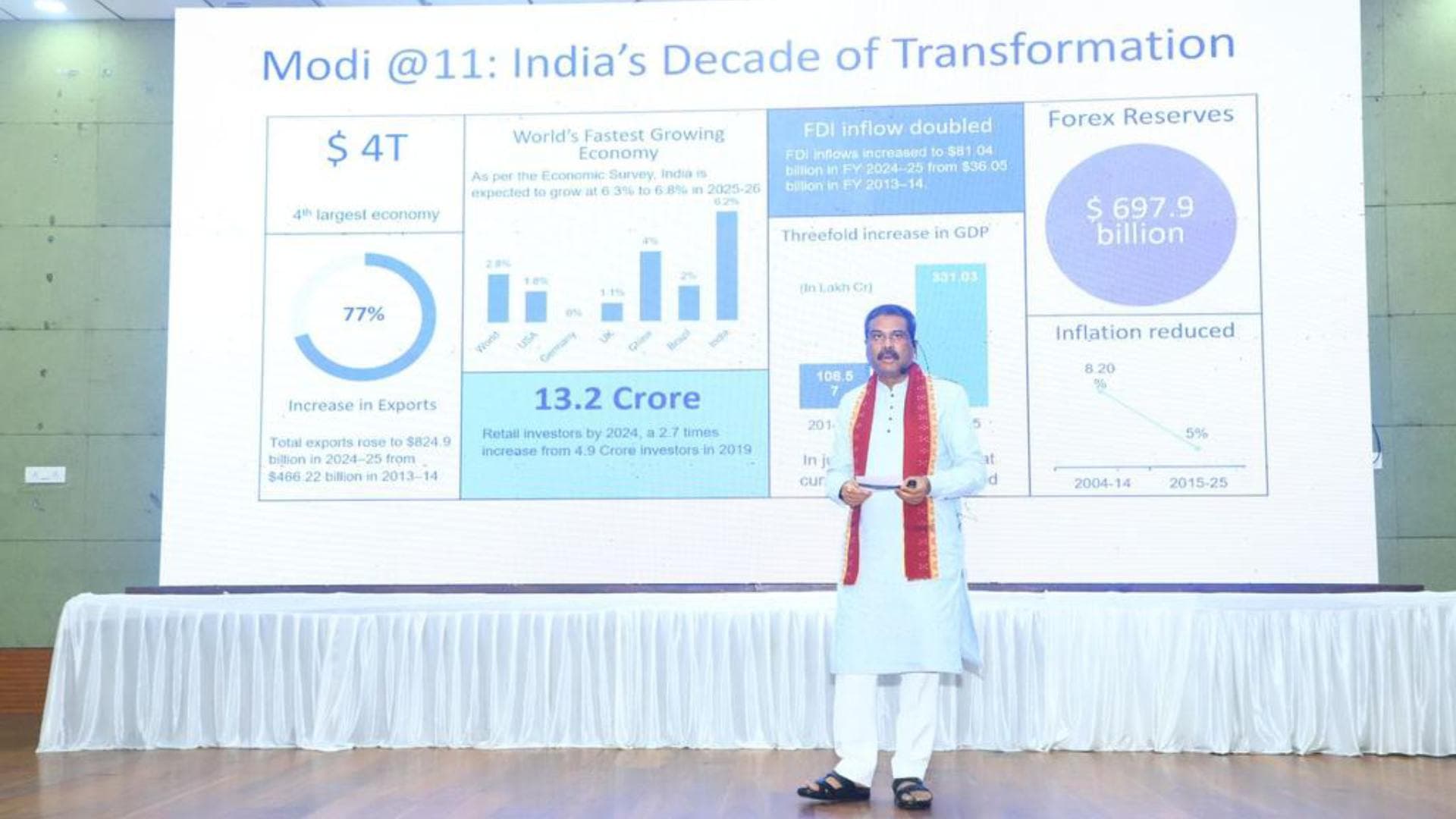
The Union Education Minister noted that India has surpassed Germany to become the world’s fourth-largest economy with a GDP of $4.2 trillion and is projected to reach $7 trillion in the next 2–3 years, becoming the third-largest economy globally. “Export volumes have increased by 77% since 2013–14, and the number of investors has tripled in five years — from 4.9 crore to 13.2 crore — highlighting GST’s success,” he asserted.
Speaking on Foreign Direct Investment (FDI), Union Minister Pradhan highlighted that the FDI has doubled from $36.05 billion in 2013–14 to $81.04 billion. “India’s GDP has tripled from ₹106.57 lakh crore in 2014–15 to ₹331.03 lakh crore. Forex reserves have grown to $697.9 billion, and inflation is under control. Monthly GST collections now average ₹2 lakh crore, with credit going to consumers and businesses,” he shared.
He also shared the survey report of Deloitte, saying: “The report revealed that 85% of MSMEs and large businesses expressed satisfaction with GST implementation. The number of GST-registered businesses has grown from 67 lakh in 2017 to 1.5 crore in 2025, formalizing the economy and driving structural reforms.”
Pradhan highlighted that GST 2.0 will make daily essentials like soap and toothpaste cheaper. Students, farmers, MSMEs, women, and youth will benefit.
Notably, GST on kendu leaves has been reduced from 18% to 5%, aiding over 15 lakh workers. Yarn GST dropped from 12% to 5%, benefiting Odisha’s western weavers. Coal GST increased to 18%, which will benefit Odisha.
“As an agrarian state, Odisha will gain from reduced GST on agricultural tools, tractors, and fertilizers. Registration for small and start-up businesses will be simplified,” Pradhan stated, adding: “Health and life insurance services will be tax-exempt. Medicines, dairy products, and other essentials will see reduced or zero GST.”
“Education services, books, and learning aids are now GST-free, promoting growth and controlling inflation. Circular economy initiatives will gain momentum,” he added further. Pradhan expressed gratitude to the PM Modi, Finance Minister Nirmala Sitharaman, and GST Council for these historic reforms.
He also emphasized Odisha’s record rice production and the need to create export markets. He proposed branding Sambalpuri textiles and agricultural products under a “Sambalpuri Brand” to promote local enterprise and integrate Sambalpur into the new-age economy.
The event was attended by Odisha Panchayati Raj and Drinking
Water Minister Rabi Narayan Naik and Sambalpur MLA Jayanarayan Mishra, among
others.