



EXCLUSIVE| Odisha DGP Row: How SG Tushar Mehta’s New SC Note Dismantled Amicus Raju Ramchandran, P Chidambaram Objections
Key Points
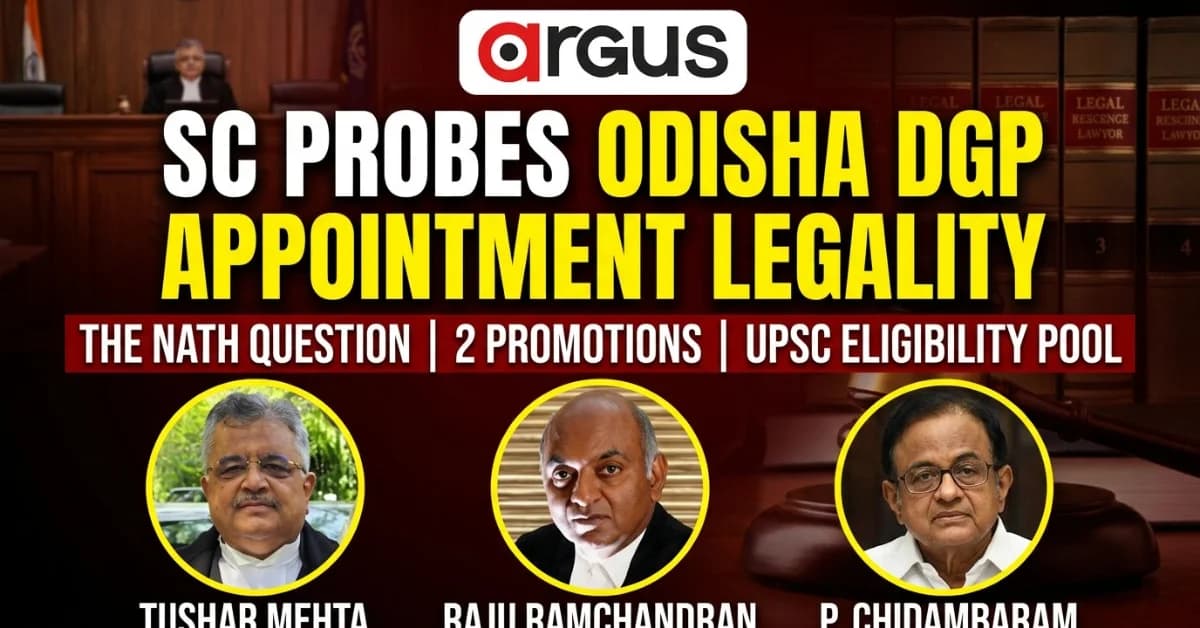
The Supreme Court has begun hearing the legal battle over the Odisha Director General of Police (DGP) appointment row, focusing on what constitutes a legally valid eligible pool of officers for the UPSC.
Central issues involve the exclusion of senior IPS officer Sushant Kumar Nath due to pending CBI proceedings, the withholding of his integrity certificate, and the subsequent mid-process promotion of two additional officers.
Represented by Solicitor General Tushar Mehta, the State defended its actions under the IPS Cadre Rules, 1954, arguing that seniority must be backed by valid eligibility and integrity clearances.
Bhubaneswar: Hearings in the Supreme Court over Odisha DGP appointment row have finally began on Tuesday, after repeated defferments. As the hearing started, the points before the top bench of the apex court headed by CJI Surya Kant have become crystal clear.
The legal battle over Odisha’s next Director General of Police has now narrowed to a question that goes beyond who should occupy the post: what constitutes a legally valid “eligible” pool of officers for the UPSC to consider?
At the heart of the proceedings before the Supreme Court are three interconnected issues – the exclusion of senior IPS officer Sushant Kumar Nath, the withholding of an integrity certificate, and the subsequent elevation of two Additional DG-rank officers to DGP rank after the original eligibility proposal had already been forwarded to the Union Public Service Commission (UPSC).
The State, however, has sought to turn the challenge on its head.

📱 Get Argus News App
✨Represented by Solicitor General Tushar Mehta, Odisha has maintained that the controversy proceeds from a “mistaken understanding” of the applicable service rules. Its case is that officers cannot be treated as eligible merely because they occupy a particular position in the seniority list if they do not satisfy the applicable integrity and vigilance requirements.
The amicus curiae, earlier, has questioned whether those very administrative decisions were properly taken, supported by reasons and consistent with the Supreme Court’s framework governing appointment of state police chiefs.
The Supreme Court is therefore examining not merely the final list but the legality of the administrative steps that produced that list.
THE THREE LEGAL FLASHPOINTS
|
Issue |
Question before the court |
State’s position |
|---|
Sushant Kumar Nath
Could a senior officer be excluded because an integrity/vigilance clearance was not available?
Active CBI proceedings prevented a clean integrity certificate
Two later promotions
Could two officers be promoted to DG rank and subsequently enter the consideration zone?
Cadre rules permit creation of temporary ex-cadre posts with requisite approval
UPSC eligibility pool
Which list should form the basis of empanelment?
Only legally eligible DG-rank officers with requisite clearances should form the pool
The controversy assumes importance because the 2006 Prakash Singh framework requires the UPSC to prepare a panel of senior eligible officers for appointment as DGP. Recent proceedings have focused specifically on whether Odisha’s changes to its eligibility pool remained within that framework.
1. THE NATH QUESTION: SENIORITY VERSUS ELIGIBILITY
The first major legal issue concerns senior IPS officer Sushant Kumar Nath.
The State’s case, as recorded in its submissions, is that Nath’s eligibility was affected by an ongoing CBI inquiry. According to the State, Odisha sought an updated status from the CBI in May 2026 and was informed that the investigation remained active and that Nath could be required for examination.
That becomes significant because the State argues that a seniority position does not, by itself, establish eligibility for empanelment.
Its submission is based on the requirement of a vigilance clearance and integrity certificate for consideration for a top-level appointment.
The legal question therefore is narrower than whether Nath is senior.
It is:
Can an officer otherwise senior enough for consideration be included in the UPSC zone when the State says it cannot certify his integrity because of a pending investigation?
The amicus has approached the issue from the opposite procedural direction. His submissions ear;ier questioned whether the withholding of an integrity certificate was supported by cogent reasons and whether the relevant material had actually been considered.
That distinction is crucial.
The dispute is not simply “senior officer versus junior officer.”
It is “senior officer versus senior eligible officer.”
2. THE TWO PROMOTIONS THAT CHANGED THE EQUATION
The second legal flashpoint concerns two officers who were promoted to DGP rank after the original proposal had been sent to the UPSC.
Reports of the proceedings indicate that the State initially forwarded an eligibility list to the UPSC on May 14, 2026. A subsequent list reflected promotions made on August 10, bringing two additional officers into the DGP-rank pool.
This is where the State relies upon the IPS (Cadre) Rules, 1954.
According to the State’s written defence, Rule 4 permits the cadre structure to be altered and temporary ex-cadre posts carrying duties of a similar nature to be created, subject to the prescribed conditions and Central Government approval where required. Odisha says the Ministry of Home Affairs approved the structural expansion and that the subsequent promotions therefore followed a lawful administrative route.
The State's legal proposition is consequently straightforward:
If the officers were lawfully promoted to DGP rank before the UPSC empanelment process was completed, their entry into the eligible pool could not automatically be treated as impermissible.
But the amicus had, earlier, identified the chronology itself as a matter requiring judicial scrutiny.
The question before the court is therefore whether the August promotions were simply an exercise of a power available to the State under the cadre rules – or whether their timing had the legal effect of altering the zone of consideration after the selection process had already commenced.
The court does not necessarily have to accept either characterization in full. It can examine the statutory authority, chronology, approvals and purpose behind the administrative steps independently.
3. WHAT DOES “SENIOR-MOST ELIGIBLE” ACTUALLY MEAN?
This is perhaps the central legal question.
The petitioners rely on the Prakash Singh framework, under which the UPSC is required to prepare a panel from among the senior-most eligible officers.
The State's answer is that the phrase cannot be read as absolute seniority detached from eligibility.
Its written submissions invoke the broader principle of merit-cum-seniority applicable to selection posts. The State argues that eligibility changes when an officer loses the necessary integrity/vigilance clearance or when officers lawfully enter the relevant DG-rank cadre pool.
That produces two competing legal constructions:
Petitioners/amicus
approach:
First
identify the legally relevant senior officers; the selection process
cannot subsequently be reshaped by administrative changes without
adequate justification.
State's
approach:
First
determine who is legally eligible; seniority operates within that
eligible pool, not independently of it.
The distinction could determine whether the original May list or the later updated list should govern the UPSC's exercise.
4. THE STATE'S DEFENCE: “THE PREMISE IS MISCONCEIVED”
The State has mounted a comprehensive defence rather than treating the dispute as a narrow technical objection.
According to SC live transcript, Solicitor General Tushar Mehta placed a fresh comprehensive note before the Bench explaining the State's position on the eligibility timeline, promotions and the handling of Nath's documentation.
He also challenged the conclusions earlier placed before the court by amicus curiae Raju Ramachandran.
The State's central submission was that the challenge was based on an incorrect understanding of ordinary cadre-management and service rules. The material records the Solicitor General describing the foundational premise of the challenge as “little misconceived.”
In legal terms, the State is asking the court to examine the administrative legality of each individual step, rather than infer illegality from the eventual composition of the list.
That distinction could prove important.
A decision does not become legally invalid merely because it changes the eventual pool of candidates. The court would have to determine whether the power exercised existed, whether the prescribed procedure was followed, whether relevant considerations were taken into account and whether the action was consistent with the governing Supreme Court directions.
5. THE COURT'S REAL TEST: POWER, TIMING AND REASON
The case can consequently be reduced to three legal tests.
POWER
Did Odisha possess the statutory/service-rule authority to create the additional DGP-rank posts and promote the two officers?
The State says yes, relying on Rule 4 of the IPS Cadre Rules and the requisite Central approval.
TIMING
Even if the State possessed that power, could it exercise it after the original eligibility list had already gone to the UPSC and thereby alter the consideration zone?
This is one of the principal concerns identified in the amicus submissions.
REASON
Even if the State could withhold an integrity certificate, did it do so for demonstrable and legally relevant reasons based on the material before it?
The amicus has specifically sought judicial scrutiny on this question.
These three questions potentially separate a lawful administrative exercise from an impermissible alteration of the DGP selection process.
6. WHY THE PRakash SINGH FRAMEWORK MATTERS
The DGP appointment process is not an ordinary State-level posting.
The Supreme Court's 2006 directions in Prakash Singh v Union of India created a structured mechanism intended to insulate the appointment of the police chief from external pressures. The present litigation is testing the application of that framework against the actual mechanics of cadre management and eligibility determination in Odisha.
The legal tension is therefore between two institutional principles:
police leadership selection must follow the Supreme Court's safeguards;
and
the State retains administrative powers over its cadre, subject to law.
Neither proposition automatically answers the other.
The court has to determine where the boundary lies in the particular sequence of events before it.
7. SEPTEMBER 23 NOW BECOMES IMPORTANT
The hearing has been carried forward to September 23, as the State has submitted a detailed position before the Bench, and want the Bench to go through it. The Courtroom live trabscript shows the Solicitor General asking for the court to give a detailed look on the issues.
The next stage is therefore likely to centre on the State's documentary explanation of:
the eligibility status of the senior officers;
the basis for withholding or not issuing the integrity certificate;
the legal authority for creating the additional posts;
the timing and approval of the two promotions;
and the basis on which the updated list was placed before the UPSC.
The petitioners and amicus would then have the opportunity to respond.
THE LEGAL QUESTION BEFORE THE BENCH
The Odisha DGP dispute has thus moved beyond the simple question of who is senior enough to become DGP.
The Supreme Court is effectively being asked to examine whether the administrative route used to define the eligible pool itself complied with the governing legal framework.
If the State establishes that the exclusions were compelled by legitimate integrity/vigilance considerations, that the additional posts and promotions were validly authorised, and that the resulting pool remained within the Prakash Singh framework, its defence would rest on the legality of each administrative step.
If, on the other hand, the court finds that the eligibility pool was altered without adequate legal justification or that the relevant safeguards were not properly applied, the validity of the subsequent empanelment process could come under question.
For now, the critical issue remains unresolved.
The Supreme Court is not merely examining the names on Odisha's DGP list. It is examining the legal chain by which those names came to be there.
And
it seems the vexed legal issue may take 2 or 3 hearings more before
the CJI led Bench delivers its final Judgement.
Also Read: EXCLUSIVE| Odisha DGP Row: Why Supreme Court Deferred Hearing To September 22; Intervenor Turns Odisha’s Police Chief Selection Into A National Legal Test
Related Topics
Explore more stories