



EXCLUSIVE EXPLAINER| Odisha’s ₹6 Minimum Wage Hike vs. Other States: Big Win or Crumbs?
Key Points
A flat-rate VDA adjustment means all skill tiers received the exact same ₹6 bump, raising concerns about specialized labor incentives.
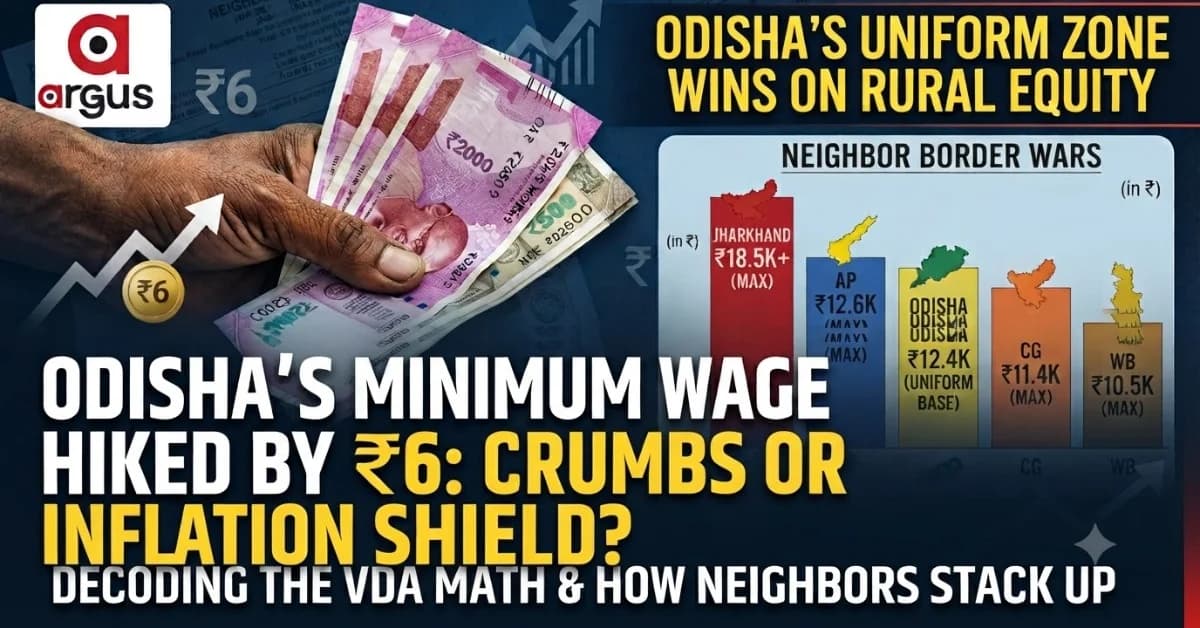
While neighboring states like Jharkhand and Andhra Pradesh boast higher maximum caps, they enforce geographic pay discrimination unlike Odisha.
Bhubaneswar: For Gen Z, government documents hardly ever matter. The usual refrain when faced with one is a swift, "Yeah, I’m not reading all that." And honestly? You’re not alone.
Bureaucracy loves using 50-word sentences when five would do. But behind the dense, legal walls of these official notifications lies something that directly dictates real-world survival: cold, hard cash.
The Office of the Labour Commissioner in Odisha, Bhubaneswar dropped a new wage notification. The internet saw the numbers and immediately started questioning the math.
The headline? A Rs6 per day hike.

📱 Get Argus News App
✨Yes, you read that right. Six rupees. In a world where a decent cold brew costs upwards of Rs250 and your streaming subscriptions keep creeping up, a Rs6 daily raise feels less like an inflation cushion and more like literal crumbs.
But before we start a group chat roast of the labor department, we need to zoom out. This isn’t a standard base salary revision; it’s a Variable Dearness Allowance (VDA) adjustment.
To understand whether Odisha’s unorganized workforce is getting played or actually winning, we have to unpack the economics, break down the math, and see how Odisha stacks up against its regional rivals: West Bengal, Andhra Pradesh, Chhattisgarh, and Jharkhand.
Decoding the Terms: Base Wage vs. The VDA
To understand the Rs6 situation, you have to realize that a minimum wage check isn’t just one big lump sum. It is split into two distinct layers:
1. The Base Minimum Wage: This is the foundational floor price of human labor set by the state government. It doesn’t change often. It is updated every few years after massive legislative debates and committee reviews.
2. The Variable Dearness Allowance (VDA): This is the dynamic layer. Think of the VDA as a financial shield against inflation. Because the cost of milk, veggies, public transport, and rent keeps rising, the government tweaks the VDA twice a year (on April 1st and October 1st) so workers don’t lose purchasing power.
When the notification states wages are going up by Rs6 a day, it means the VDA shield was extended by Rs6, pushing the total daily rate to a new baseline.
The Hard Math: What Workers Actually Take Home
When we translate daily rates into standard monthly salaries (calculated over 26 working days, factoring in unpaid weekly rest days), the final numbers for Odisha look like this:
- Unskilled Workers: Moving from ₹472 to ₹478/day → ₹12,428 per month. (Think domestic help, loaders, entry-level cleaners).
- Semi-Skilled Workers: Moving from ₹522 to ₹528/day → ₹13,728 per month. (Think security guards, assistant cooks, bricklayers).
- Skilled Workers: Moving from ₹572 to ₹578/day → ₹15,028 per month. (Think experienced drivers, electricians, masons).
- Highly Skilled Workers: Moving from ₹622 to ₹628/day → ₹16,328 per month. (Think head chefs, complex machine operators, specialized technicians).
The Plot Twist: The "Flat-Rate" Catch
Here is where the math gets slightly unhinged. Notice how every single tier – from an unskilled worker to a highly skilled specialist – received the exact same ₹6 increase?
In economics, this is called a flat-rate adjustment, and it has a hidden flaw.
When inflation hits a market, a highly skilled worker faces a steeper rise in absolute living costs than an unskilled worker because their baseline consumption pattern is higher.
By giving everyone a flat Rs6, the state effectively dilutes the incentive to upskill. Over time, inflation eats away at the premium value of specialized labor.
Why is the hike so low?
The formula is rigid. The government looks at the Consumer Price Index (CPI) for industrial workers. Over the last six months, the index moved up by a tiny 2.30 points (from 147.50 to 149.80). The state multiplies this point growth by a fixed rate of Rs2.60 per point.
2.30 points X ₹2.60 = ₹5.98
The system rounds it up to ₹6. It’s pure, cold math, unaffected by how expensive things actually feel when you walk into a local market.
Border Wars: How Odisha Stacks Up Against the Neighbors
To see if Odisha’s workers are actually getting a raw deal, we have to look across state lines. Let’s see how Odisha fares against its neighbors.
State-wise Data Table
|
State |
Range / Value (₹) |
|
Odisha |
₹12,428 |
|
Andhra Pradesh |
₹12,317 – ₹12,647 |
|
Jharkhand |
₹12,155 – ₹13,385 |
|
Chhattisgarh |
₹10,882 – ₹11,402 |
|
West Bengal |
₹9,760 – ₹10,558 |
1. West Bengal (The Clear Laggard)
West Bengal is lagging behind significantly. Its unskilled minimum wage floors sit between ₹9,760 and ₹10,558. Odisha beats West Bengal by thousands of rupees every single month. Furthermore, West Bengal missed this dynamic adjustment cycle entirely, leaving its workers with a ₹0 inflation cushion while Odisha at least pushed the needle forward.
2. Chhattisgarh (Low Ceiling)
Chhattisgarh divides its pay scales into geographic tiers, but even its premium industrial hubs max out around ₹10,882 to ₹11,402 for unskilled tasks. Odisha’s uniform baseline completely outclasses Chhattisgarh's best-performing zones.
3. Andhra Pradesh & Jharkhand (The Premium Challengers)
This is where Odisha faces real competition.
- Andhra Pradesh utilizes a complex zonal framework where urban centers offer up to ₹12,647 for unskilled workers. Its recent VDA adjustment added a punchy ₹8.61 per day, easily outpacing Odisha’s sluggish ₹6 adjustment speed.
- Jharkhand plays a high-stakes game. Its top-tier industrial zones offer scaling minimums that reach up to ₹13,385 for unskilled work and jump to an impressive ₹18,504 for highly skilled roles.
The Ultimate Boss Move: Odisha’s Single-Zone Rule
While states like Jharkhand and Andhra Pradesh boast higher maximum caps, they come with a catch: Geographic Discrimination. In those states, if you work in a rural village, your legal minimum wage is slashed compared to someone doing the exact same job in a metropolitan hub.
Odisha rejects this entirely. The state enforces a flat, uniform single-zone mandate. Whether an unorganized laborer is working at a high-tech facility in the heart of Bhubaneswar or executing a project in a remote village in Malkangiri, they are legally entitled to the exact same ₹12,428 baseline. This serves as a massive win for rural equity, ensuring workers aren't financially penalized based on their zip code.
The Reality Check
While these rules look great on paper, the unorganized sector is notoriously difficult to regulate. If a worker is hired casually by a local shop or a small household, enforcement is rare, and pay is usually settled in cash without paperwork.
However, if a worker is hired through a registered contractor, a digital manpower agency, or a mid-sized commercial enterprise, these numbers become absolute law. In those formal environments, employers are legally required to provide additional benefits like EPF (Provident Fund) and ESI (Medical Insurance) on top of these baselines, building a genuine safety net.
Odisha’s latest update might look like
lowkey crumbs at first glance, but its uniform structural baseline ensures its
workforce remains far more protected than those in neighboring states.
Also Read: EXCLUSIVE| INSIDE THE CMO: Why CM Majhi Brought in Dr. Maheswar Swain as His Fourth Pillar
Related Topics
Explore more stories