



DMF Money, Misplaced Priorities and the Cost of Poor Governance
Key Points
The CAG audit reveals Odisha’s DMF funds misused, with ₹983 crore spent in non‑mining villages while 584 mining‑hit villages received nothing, exposing poor prioritisation and incomplete, non‑functional projects.
Bhubaneswar, Oct 1: The latest CAG report on Odisha’s District Mineral Foundation (DMF) is not merely an audit of numbers. It raises a larger question about how the previous Naveen Patnaik government planned and spent money that was specifically meant to repair the social and economic damage caused by mining.
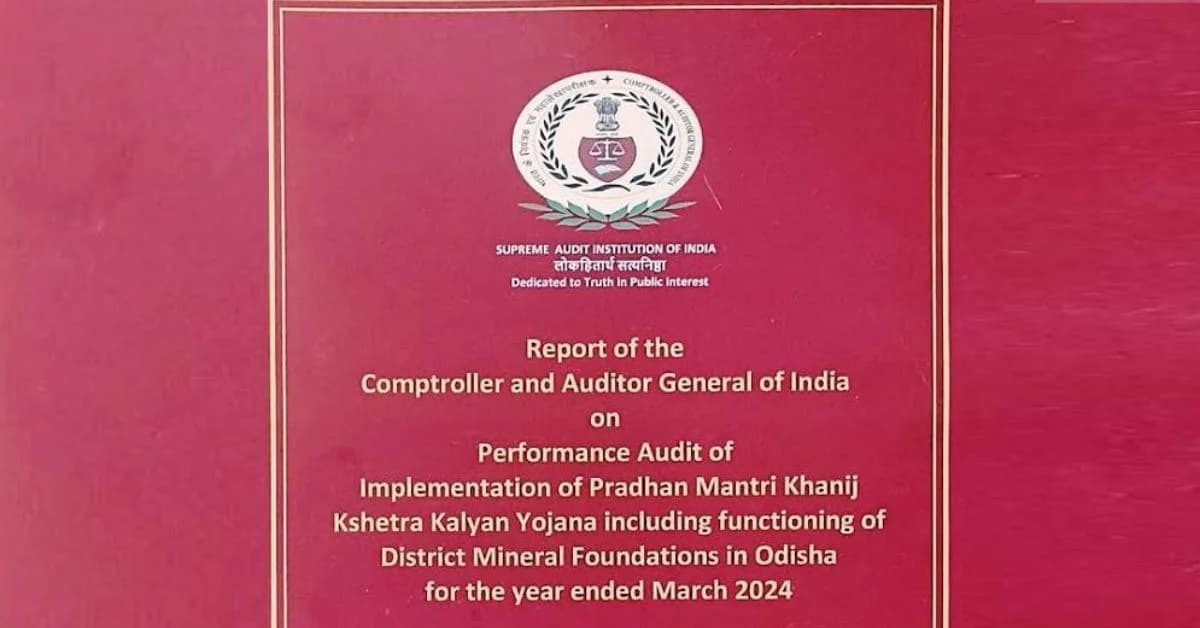
The most striking finding is that Rs 983.32 crore was spent on projects in 976 villages that were neither directly nor indirectly affected by mining, while 584 mining-affected villages received no DMF-funded project. The CAG’s performance audit covered implementation of the Pradhan Mantri Khanij Kshetra Kalyan Yojana and functioning of DMFs up to March 2024. The report was tabled in the Odisha Assembly on September 28.
This is where the previous government’s approach to DMF spending deserves serious scrutiny. DMF is not an ordinary pool of government money available for distributing development projects across districts. Its fundamental purpose is to benefit communities and areas affected by mining. When hundreds of mining-hit villages are left out while nearly Rs 1,000 crore is spent elsewhere, the issue goes beyond accounting compliance. It points to a failure of prioritisation.
The problem becomes more troubling when expenditure is examined alongside the quality and utility of the assets created.

📱 Get Argus News App
✨At Koida in Sundaragada, a 1,000-bed workers’ rest house taken up with DMF money remained incomplete years after its scheduled completion. In Jajpur, the Rs 113-crore Science Academy at Sathipur remained non-functional, with questions over its operational and maintenance arrangements.
These examples expose an old weakness in government spending: the emphasis on sanctioning and constructing assets without equal attention to whether they will actually function and serve people. A building cannot by itself be counted as development. Its utility begins only when it is completed, operational and accessible to the intended beneficiaries.
The CAG itself says its findings are intended to enable the executive to take corrective action and improve financial management. That responsibility now falls on the present government.
The Mohan Charan Majhi government therefore has an opportunity to go beyond simply citing the CAG report as evidence against its predecessor. It should identify every project sanctioned outside the prescribed mining-impact areas, examine the reasons for their selection, fix responsibility for abandoned or non-functional assets and publish a district-wise status of DMF projects.
The larger lesson is clear: mining-affected communities should
not have to watch development money being spent around them while their own
needs remain unmet. DMF was created precisely to prevent that contradiction.
Related Topics
Explore more stories