



Delhi’s Satya Niketan Collapse: Odisha Sitting on a Building-Safety Blind Spot?| Exclusive
Key Points
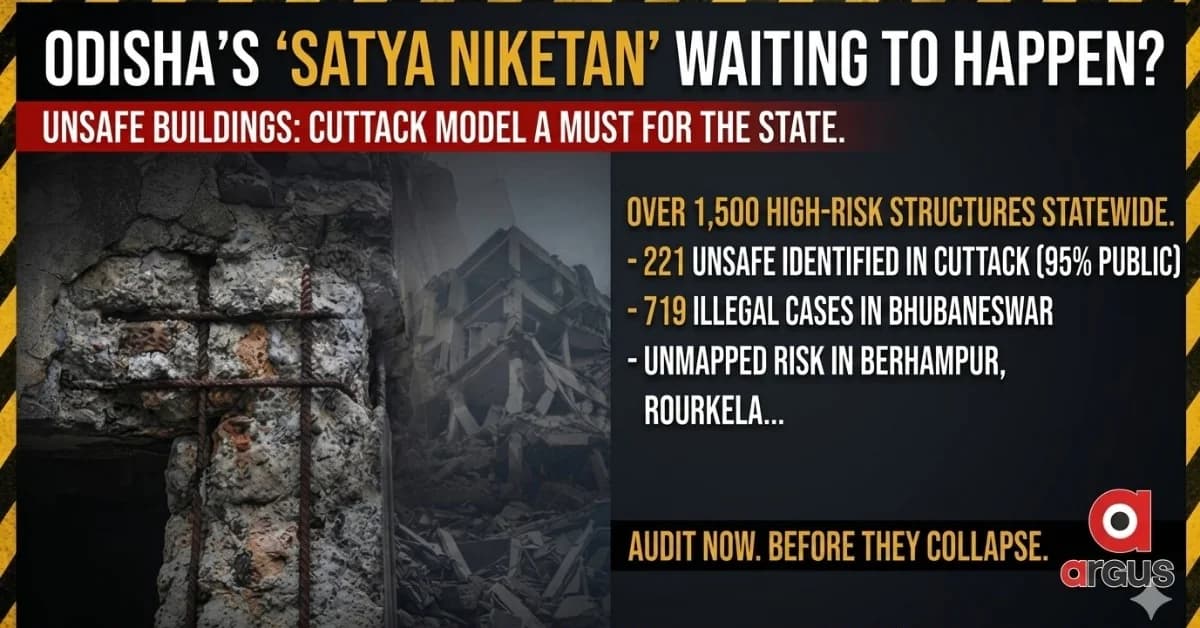
Over 1,500 to 2,500 legacy public and private buildings are estimated to be high-risk across Odisha.
The Cuttack High Court-led exercise identified 221 unsafe structures, with 95% belonging to public authorities.
Unauthorised constructions and aging government colonies face severe risks from unmapped structural decay and illegal modifications.
Bhubaneswar: Six lives were lost after a five-storey student PG building collapsed at Delhi’s Satya Niketan.
Now, the tragedy raises a disturbing question for Odisha: how many potentially dangerous buildings are escaping the state’s safety net simply because no comprehensive city-by-city structural audit has been carried out?
The Satya Niketan disaster is a warning against treating building collapses as isolated accidents. The five-storey structure, nearly five decades old and being used as a student accommodation, collapsed while construction work was reportedly under way in its basement. Six people have died and the incident has triggered fresh scrutiny of illegal construction, structural monitoring and municipal enforcement.
For Odisha, the warning becomes more serious when read alongside what the Orissa High Court’s intervention in Cuttack has already uncovered.

📱 Get Argus News App
✨The High Court-directed exercise identified 221 unsafe buildings in Cuttack alone. More strikingly, 219 of them belonged to eight public authorities, while only two were privately owned. The Court subsequently sought a time-bound account of their vacation, removal and demolition.
That Cuttack experience offers Odisha a template: identify, structurally assess, classify, evacuate and demolish or rehabilitate buildings before they collapse – not after lives are lost.
Cuttack's 221-building warning
The Cuttack data is particularly significant because these are not estimates based merely on the age of buildings. They emerged from an administrative identification exercise undertaken after the High Court took cognisance of reports about unsafe structures.
According to the court record, a committee constituted under the Sub-Collector, Sadar, Cuttack identified 221 unsafe buildings. Of these, 219 belonged to eight public authorities and two to private individuals. Fifteen cases were initiated under Section 152 of the BNSS to secure vacation and further action.
The message is clear: a building can remain occupied and operational for years even after its structural condition has become a public-safety concern.
And that is precisely where Odisha needs to look beyond Cuttack.
Statewide Vulnerability Outlook:
When we apply the HC SOP of identifying the unsafe buildings in Cuttack and that need emergent evacuation, on the whole of the State, the following details emerge.
The HC SOP:
Primary Warning Indicator: Concrete spalling ("concrete cancer") and internal rebar rust, where oxidizing steel expands up to seven times its volume and cracks surrounding concrete from within
Estimation Methodology & Core Risk Factors as per Orissa HC
|
Risk Factor |
Evaluation Criteria |
|
Building Age (>30–50 Years) |
Structures built during the 1960s, 1970s, and 1980s that pre-date modern earthquake-resistant codes and high-grade reinforced concrete standards. |
|
Urban Density & Narrow Access |
Traditional market cores and congested lanes where routine maintenance is restricted and heavy commercial usage (godowns, multi-family occupancy) exceeds original load designs. |
|
Public vs. Private Ratio |
State and public authorities own over 95% of officially cataloged dangerous quarters, making aging government staff colonies a reliable baseline metric for structural decay. |
The Outcome: Regional High-Risk Concentrations in Odisha
|
City / Region |
Estimated High-Risk Zones & Legacy Hubs |
Structure Risk Profile |
|
Bhubaneswar |
Old Town (Lingaraj area), Unit-I & Unit-II market areas, aging public complexes like Sahidnagar and CRP Square. |
500 – 700 structures (includes 1960s–70s government quarters, aging commercial markets, and early BDA multi-story blocks showing concrete spalling). |
|
Berhampur |
Old Gopalpur road, Bada Bazar, and old commercial trading lanes. |
300 – 400 structures (dense merchant housing with compromised mortar and unverified structural loads). |
|
Sambalpur |
Ainthapali, Modipara, and historical pockets near the Mahanadi riverbank. |
200 – 300 structures (primarily weathered residential units and old municipal commercial lines). |
|
Rourkela |
Early steel township sectors (Sector 1 to 6) and old industrial cooperative colonies. |
300 – 400 structures (aging public sector housing blocks and neglected institutional/school buildings). |
|
Balasore & Puri |
Old town heritage corridors, sea-facing saline-damaged brickwork, and old railway/PWD quarters. |
200 – 300 structures (vulnerable to high humidity, rust-accelerated rebar decay, and cyclone stress). |
What the Odisha Govt data tells us
A separate government survey has identified 120 unsafe buildings across 18 districts of Odisha.
* Another Angle: Unauthorised Buildings
The state also has a much larger universe of buildings facing regulatory violations. In 2024, the Housing and Urban Development Minister informed the Assembly that proceedings had been initiated against 719 illegal apartments/complexes across Odisha, including 689 in Bhubaneswar alone, under Sections 90, 91 and 92 of the Odisha Development Authorities Act.
An illegal building is not automatically a structurally unsafe building. But the overlap between unauthorised construction, additional floors, altered load-bearing arrangements, ageing structures and inadequate structural certification is precisely what makes systematic inspection essential.
Odisha's documented building-safety picture
|
Indicator |
Number / Finding |
What it tells us |
|---|---|---|
|
Unsafe buildings identified across Odisha |
120 |
Government survey found unsafe structures in 18 districts |
|
Unsafe buildings identified in Cuttack |
221 |
High Court-directed exercise exposed a concentrated structural-safety problem |
|
Cuttack unsafe buildings owned by public authorities |
219 |
Nearly the entire Cuttack list involved government/public authorities |
|
Cuttack privately owned unsafe buildings |
2 |
Private structures formed a very small portion of the identified list |
|
Illegal apartments/complexes facing proceedings in Odisha |
719 |
Statewide enforcement action over violations |
|
Illegal apartments/complexes in Bhubaneswar |
689 |
Nearly 96% of the 719 cases were concentrated in the capital |
|
BDA cases among unauthorised-building proceedings |
491 |
Significant enforcement burden within the BDA area |
|
Demolition orders finalised in those BDA cases |
191 |
Shows that identification does not automatically mean immediate removal |
Important: these figures represent different categories and different exercises. They should not be added to produce a single “unsafe building” total.
Why the Cuttack model matters
The most important lesson from Cuttack is methodological.
The High Court did not rely simply on the age of buildings. A committee was created to identify unsafe structures, after which the administration was required to report on vacation, removal and demolition. The Court has continued to monitor compliance.
For
Odisha's other urban centres, a similar exercise could expose a much
wider risk landscape.
Also Read:
The obvious targets are the old cores of Bhubaneswar, Berhampur, Sambalpur, Balasore, Puri and Rourkela, particularly where ageing buildings have undergone repeated additions, commercial conversion or structural alterations.
The real danger: ageing plus alteration
The Satya Niketan collapse carries another lesson for Odisha.
An old building does not necessarily mean an unsafe building. Conversely, a building that has stood for decades without incident is not automatically safe.
Risk can rise sharply when an ageing structure undergoes:
unauthorised additional floors;
conversion from residential use to PG/hostel or commercial use;
basement excavation;
removal or alteration of structural walls;
overloading through commercial storage;
prolonged water seepage;
corrosion of reinforcement;
major renovation without structural assessment.
This is why a one-time visual survey is not enough.
Odisha needs a statewide building-risk register
The next step should be a statewide Building Safety Risk Register, with urban local bodies and development authorities mapping structures into categories such as:
Red – Immediate danger: evacuate and demolish/repair under expert supervision.
Amber – Structural concern: mandatory structural audit and time-bound rectification.
Yellow – Ageing/vulnerable: periodic inspection and structural certification.
Green – Certified safe: continue routine monitoring.
Such a system would bring the Cuttack model to the rest of Odisha.
The question after Satya Niketan
Delhi's Satya Niketan collapse has once again demonstrated the danger of discovering structural failure after the building comes down.
For Odisha, the question is therefore not simply:
“How many buildings are unsafe?”
The more important question is:
“How many buildings have never been structurally assessed at all?”
The available government numbers already establish that Odisha has unsafe structures, illegal constructions and ageing public buildings. What remains unclear is the size of the unmapped risk.
And that is precisely the gap the state should close before the next collapse forces another emergency audit.
The Cuttack experience has already shown what a systematic exercise can reveal.
The
lesson from Satya Niketan for Odisha is stark: buildings must be
identified as dangerous while they are still standing, not after they
become piles of rubble.
Also Read: Buidling Collapse / Delhi Building Collapse: Six Dead, 11 Rescued; Magisterial Inquiry Ordered, FIR Against Owner
Related Topics
Explore more stories