



Cleaning Up the Mess: How Odisha Govt Inquiry Committee’s 14-Point Roadmap Aims to Rebuild SCERT After Odisha's Textbook Crisis | Special Report
Key Points
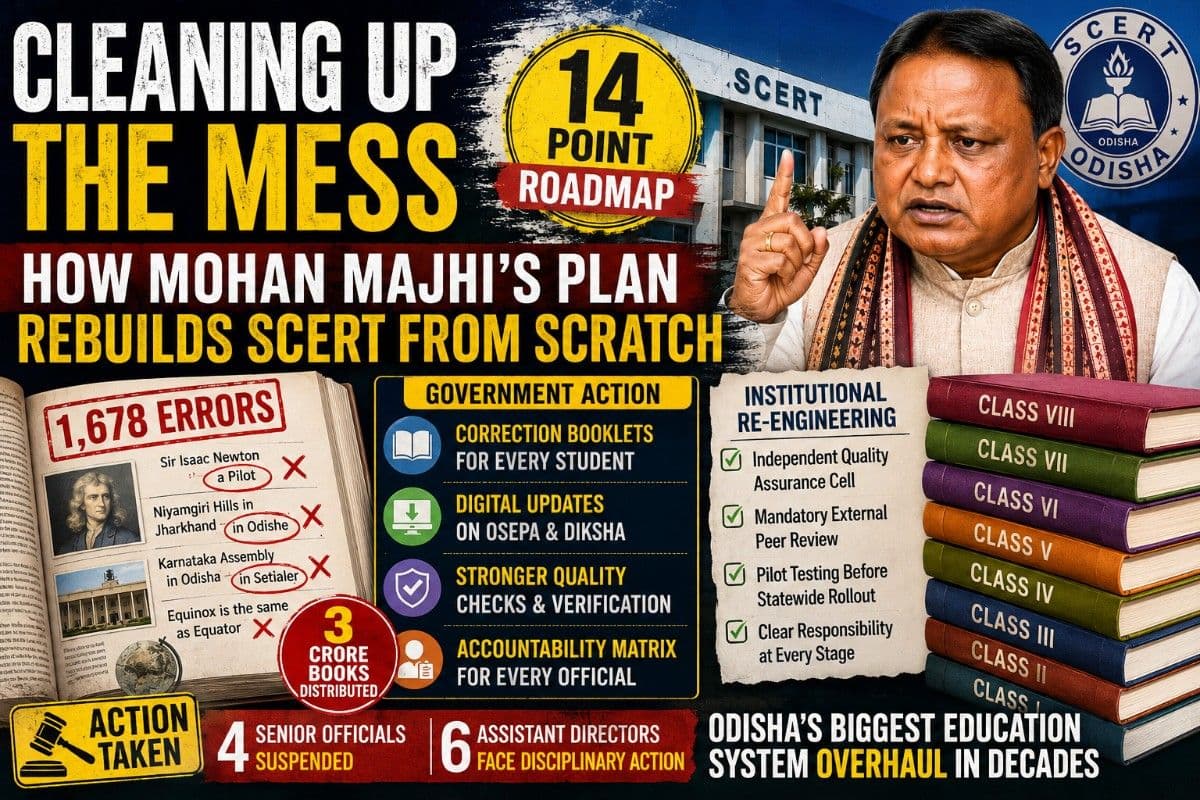
* Correction booklets, digital updates and stronger quality checks aim to prevent future textbook blunders.
* Suspensions, disciplinary action and institutional reforms mark Odisha's biggest education governance reset in decades.
Bhubaneswar: The discovery of 1,678 errors in newly introduced Class I to VIII textbooks has triggered one of the biggest administrative crises in Odisha's education sector in recent years. But instead of limiting its response to suspensions and disciplinary action, the Mohan Charan Majhi government has opted for something far more ambitious – a comprehensive restructuring of the State Council of Educational Research and Training (SCERT).
Following the submission of the high-level inquiry report by the three-member committee headed by the Development Commissioner, the Chief Minister has accepted all 14 structural recommendations aimed at overhauling the state's textbook preparation mechanism.
The reforms come alongside the suspension of four senior SCERT officials, including the former Director of Teachers' Training and SCERT, while disciplinary proceedings have been initiated against six Assistant Directors.
The government's message is unmistakable: fixing the immediate mistakes is only the first step; rebuilding institutional credibility is the larger objective.

📱 Get Argus News App
✨First Priority: Correcting the Books Already in Students' Hands
The government faces an immediate logistical challenge.
Nearly three crore textbooks have already been printed and distributed across Odisha's schools. With the academic session underway, recalling and reprinting every book would severely disrupt classroom teaching.
The inquiry committee has therefore recommended immediate corrective measures to minimize academic disruption while ensuring students are not taught incorrect information.
SCERT has been directed to prepare a comprehensive catalogue of every identified error – whether factual, scientific, geographical, graphical or grammatical.
Based on this master error register, correction booklets will be supplied to schools so teachers can guide students through the necessary amendments chapter by chapter.
Simultaneously, corrected digital editions of the textbooks are expected to replace the flawed versions available on official online learning platforms, ensuring students and teachers have access to verified content.
These emergency measures are intended to protect the current academic year while longer-term reforms are implemented.
Repairing the System That Failed
While correcting textbooks addresses the immediate problem, the inquiry committee concluded that the larger failure lay in SCERT's internal processes.
The investigation found that several mandatory verification stages either functioned inadequately or were bypassed altogether during textbook preparation.
The accepted recommendations therefore focus on strengthening quality assurance throughout the entire publication cycle.
One of the central proposals is the creation of a more robust quality-control mechanism with clearly defined responsibilities at every stage – from manuscript preparation and language editing to technical verification before printing.
The reforms also seek to reinforce the role of independent academic scrutiny so that manuscripts undergo rigorous external review before receiving final approval.
The objective is to ensure that no single institution or group of officials effectively ends up reviewing its own work without outside evaluation.
Strengthening Editorial Standards
The inquiry highlighted how compressed timelines and inadequate editorial scrutiny contributed to many of the mistakes.
Scientific concepts were mistranslated, factual references were altered and graphical errors escaped detection before books went to press.
To address these weaknesses, the reforms emphasise stricter editorial verification, improved translation protocols and multiple rounds of content validation before printing.
The committee has also stressed the importance of ensuring that language adaptation, technical editing and subject verification are handled through clearly defined procedures rather than being compressed into overlapping exercises under deadline pressure.
Education officials believe these changes will substantially reduce the risk of factual and conceptual errors reaching classrooms.
Greater Accountability Inside SCERT
Perhaps the most significant aspect of the reform package is its emphasis on accountability.
The textbook controversy exposed how responsibility became diffused across multiple departments, making it difficult to identify where individual failures occurred.
The new framework seeks to establish clearer responsibility for every stage of textbook preparation.
Each level of manuscript verification – from drafting and editing to final technical approval – is expected to carry documented institutional responsibility, making it easier to determine where lapses occur.
Officials involved in the process will no longer be able to rely on collective decision-making as a shield against accountability.
This marks a significant departure from previous practices, where responsibility often remained scattered across multiple offices.
Beyond Punishment
The suspension of four senior officials and disciplinary proceedings against six Assistant Directors represent the government's immediate administrative response.
However, the acceptance of all 14 recommendations suggests that the government views the textbook controversy as a structural governance failure rather than merely an instance of individual negligence.
The reforms seek to institutionalise stronger checks, improve transparency and restore confidence in Odisha's textbook preparation system.
For a state that undertook one of its largest curriculum transitions under the National Education Policy (NEP) 2020, rebuilding credibility is now as important as correcting printed mistakes.
A Defining Test for Educational Governance
The textbook crisis has highlighted how failures at multiple administrative levels can ultimately affect millions of students.
For the Mohan Majhi government, implementing the 14-point roadmap will be the real test.
Correcting 1,678 errors is an administrative exercise.
Ensuring that such a breakdown never recurs will require sustained institutional discipline, stronger academic oversight and strict adherence to established procedures.
If
implemented effectively, the reforms could become one of the most significant
overhauls of Odisha's textbook preparation system in decades – transforming a
major educational embarrassment into an opportunity to rebuild public
confidence in the state's education administration.
Also Read: Not Just 1,678 Errors, CM Mohan Majhi Sees a Conspiracy: Read the Anatomy of Sabotage| Exclusive
Related Topics
Explore more stories