



Pradhan Mantri Awas Yojana / BJP Government Slashes Red Tape: Double-Engine Shift in Odisha Drastically Cuts PMAY-G Housing Delays| Exclusive

Key Points
Bhubaneswar: With “Housing for All” target year 2029 is a couple of years out, the central government Thursday released over Rs10,021 crore to 12 states to meet the target.
However, in the 12 states that received the Mother Sanction Thursday, Odisha didn’t figure.
It needs mentioning here is the Mother Sanctions are issued dynamically based on a state's current housing targets, their utilization of previously released funds, and their compliance with scheme guidelines.
Since delays in house construction led to delay in utilisation of the PMAY-G funds, this factor seems to have played a role in Odisha not listed in the 12 states that received PMAY fund today.

📱 Get Argus News App
✨Odisha Red Tape: How ‘Double Engine’ Power Cut it Short
Odisha had
the dubious distinction of figuring in the laggard states in PMAY-G scheme for taking
more than the average time-period set for completion of houses under the
scheme.
The 2024-25 data however recorded a twist.
Interestingly, with the arrival of the BJP government in Odisha, it seems the state priorities have completely aligned with the Centre. This newly powered "double-engine" system has cleared away old roadblocks, causing a historic and drastic drop in housing delays during the 2024-25 period.
Slashing the Red Tape: Historic Drop in Waiting Times
In the past,
poor families in Odsha had to wait years for a safe home due to political
friction and slow paperwork. The data shows that administrative delays have
completely shrunk over the last decade, with a sharp drop seen since 2024-2025.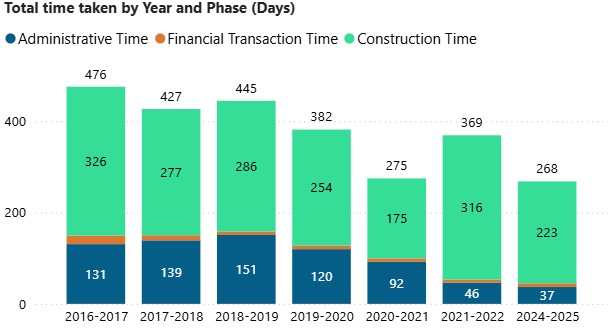
- Fewer Waiting Days: In 2016-2017, it took an average of 476 days to complete a house.
- Fast Progress: By 2024-2025, that number dropped sharply to just 268 days.
- Slashing Paperwork: Administrative processing used to take 131 days. Today, under streamlined systems, it takes only 37 days.
- Even, the previous govt had come under fire for allegedly demanding commission in clearing the paper works and delaying sanctions, which had also been an election issue in 2024.
Because the government cut down on red tape, building starts much sooner. Today, 67% of all houses are finished in less than 10 months. Another 7% are done within a year. This means nearly three-quarters of all families get their keys in under 12 months.
Average Days to Complete a PMAY-G House:
2016-2017: 476 Days
2024-2025: 268 Days
Social Change: Power to Women and Transgender Owners
This housing
push is not just fast. It is also bringing social justice to rural areas. The
data shows that the scheme gives real power to women and minority groups.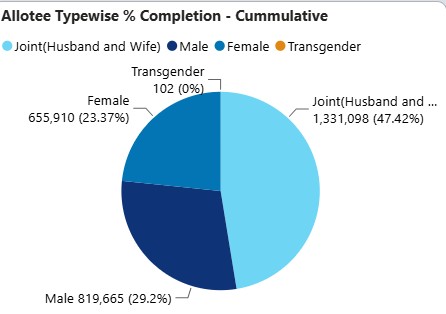
- Joint Ownership: Over 47% of homes (1.33 million) are owned jointly by husbands and wives.
- Women in Charge: More than 23% of homes (655,910) are owned solely by women.
- Transgender Inclusion: The program has also given homes to 102 transgender individuals, making sure no one is left behind.
In total, about 75% of all houses belong to women or are under joint ownership. This gives rural women a strong sense of pride, safety, and financial security.
Overcoming Tough Terrains
Geography
brings different challenges. Building a house on a flat plain is very different
from building on a steep hill. Still, the program is finding great success in
tough places.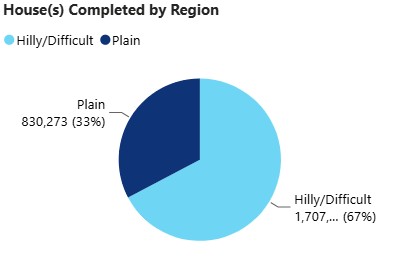
- Hilly and Difficult Areas: A massive 1.70 million houses (67%) have been built in mountains and tough terrains.
- Plain Areas: Around 830,273 houses (33%) have been completed on flat land.
Even with bad weather and poor roads in the hills, workers are finishing their jobs on time.
The Big Picture: Closing in on the Target
The ultimate goal of the Ministry of Rural Development (MoRD) is historic in size.
- The Goal: The target is to build 41.45 million houses.
- The Progress: So far, 39.13 million houses have been approved.
- The Wins: More than 30.55 million houses are fully built and complete.
That means 73.7% of the total target is already done. With more money flowing and fewer administrative delays, rural families are moving into safe, permanent homes faster than ever before.
Related Topics
Explore more stories