



Odisha Politics / BJD’s 30-Minute U-Turn: Naveen’s Politics Of Equidistance Under Test
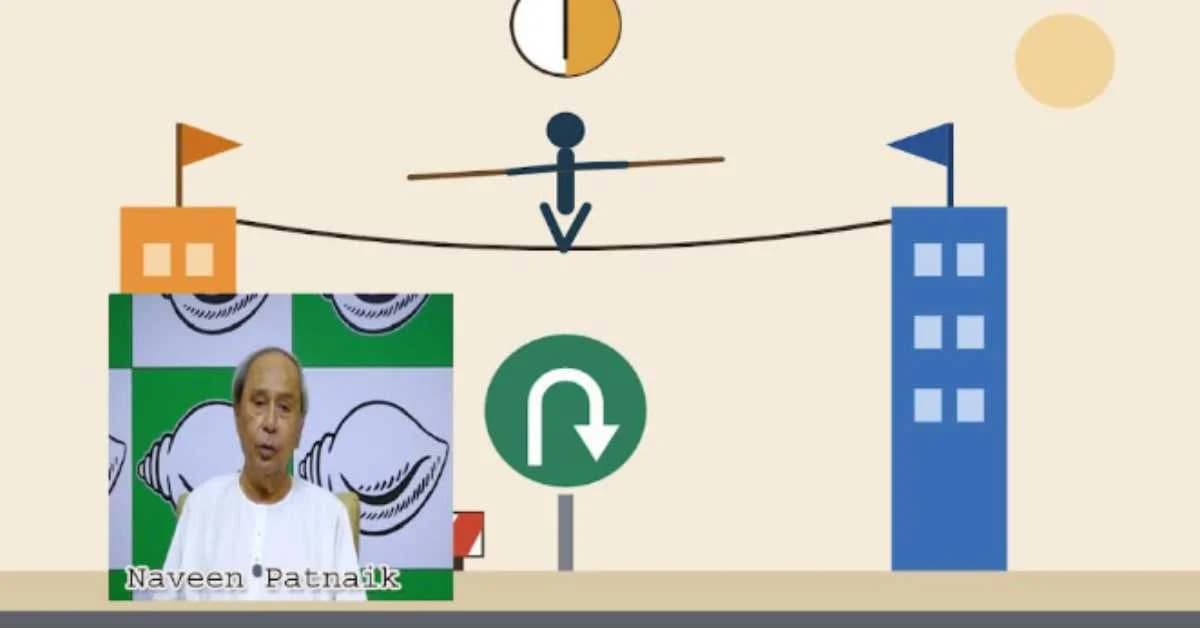
Key Points
The bandh reversal exposes the regional party’s dilemma: how to take on the BJP without allowing the Congress to occupy the Opposition space it considers its own
Bhubaneswar, Oct 9: Thirty minutes were enough for the Biju Janata Dal (BJD) to expose a larger political dilemma. The party first announced support for the Congress-led Opposition’s October 8 bandh in Odisha, only to withdraw it almost immediately. The stated reason was that other parties had failed to support the BJD’s agitation in Sundargarh. But the speed of the reversal has raised a more consequential question: was this merely a dispute over political reciprocity, or did Naveen Patnaik’s party fear that standing alongside the Congress would blur its independent identity?
The distinction matters. The BJD wants to challenge the BJP government without allowing the Congress to claim leadership of the Opposition. It wants to cooperate where interests converge, but resist any impression that it is becoming dependent on a national party for political relevance. The bandh episode has brought that contradiction into sharp focus.
The reversal does not, by itself, establish the BJD’s actual motive. But it offers a revealing glimpse into the calculations confronting a regional party that lost power in 2024 after 24 years in government.
Opposition unity, on the BJD’s terms

📱 Get Argus News App
✨The timing made the U-turn particularly striking. On October 6, BJD Rajya Sabha members participated in the INDIA bloc’s protest march in New Delhi over the Special Intensive Revision of electoral rolls and demands concerning Chief Election Commissioner Gyanesh Kumar. The BJD has not formally joined the INDIA bloc, but its participation indicated a willingness to cooperate with the wider Opposition on a specific issue.
Two days later, however, the party refused to support the Congress-led bandh in Odisha.
The apparent contradiction may be explained by a distinction the BJD is keen to maintain: issue-based cooperation is not the same as political alignment. A protest in Delhi allowed the party to register its position on electoral issues without entering a formal arrangement with the Congress. Supporting a statewide bandh led by the Congress, on the other hand, risked reinforcing the impression that the BJD was following the national party’s political lead.
That may be one reason for the reversal, although the leadership has not publicly confirmed it.
The Sundargarh explanation, meanwhile, raises its own question. If the BJD expected reciprocal support from other Opposition parties, why did it announce its backing before securing that support or resolving the differences? The reversal suggests either inadequate coordination or a reassessment of the political consequences of the announcement.
Neither possibility reflects a settled Opposition strategy.
The arithmetic that cannot be ignored
The BJD’s dilemma is rooted partly in the electoral arithmetic of 2024. The BJP won 78 of Odisha’s 147 Assembly seats, the BJD 51 and the Congress 14. Yet, in vote share, the BJD secured 40.22 per cent, marginally ahead of the BJP’s 40.07 per cent. The Congress polled 13.26 per cent.
Combined, the BJD and Congress secured 53.48 per cent of the votes.
That figure is politically significant, but it is not a ready-made coalition. Votes do not automatically transfer between parties, and local rivalries, candidate selection and constituency-level calculations can substantially alter electoral outcomes.
Nevertheless, the arithmetic explains why the possibility of a future understanding cannot be dismissed. The BJD knows that cooperation with the Congress could become relevant in a future electoral contest. The Congress, too, has reasons to consider how its relationship with the regional party might affect its position in Odisha.
But any such arrangement would involve a difficult question of political hierarchy. Would the Congress accept a secondary role in a state where it is seeking to rebuild its organisation? Would the BJD risk surrendering the independent political space it has cultivated for decades?
For now, neither party has demonstrated that it is ready to resolve these questions.
Naveen’s old playbook, new circumstances
Naveen Patnaik has considerable experience in keeping political options open. The BJD governed Odisha in alliance with the BJP from 2000 until the partnership broke down in 2009. After the separation, it pursued a policy of equidistance from the BJP and the Congress, while cooperating with national parties on selected parliamentary and political questions.
The policy was never synonymous with refusing all cooperation. In the 2012 presidential election, the BJD backed P. A. Sangma against the UPA’s candidate, Pranab Mukherjee. At other times, the party’s parliamentary decisions reflected issue-specific calculations rather than permanent loyalty to either national formation.
The present situation, however, is different. The BJP is now the ruling party in Odisha, while the BJD must establish its credibility as the principal Opposition force. The Congress, despite its smaller Assembly strength, remains a national political organisation with its own ambitions in the state.
The BJD therefore faces a two-front political challenge. It must hold the BJP government accountable while preventing the Congress from gaining an advantage in the competition to represent anti-BJP voters.
The bandh reversal fits this context. By withdrawing support, the BJD has signalled that cooperation with the Congress will not be automatic. Whether the decision was carefully calibrated or hastily improvised remains open to question.
Is a future BJD-Congress understanding possible?
The possibility of a pre-poll or post-poll understanding cannot be ruled out, but it would be premature to treat the latest episode as evidence that such an arrangement is being prepared.
The BJD’s immediate interest may be to preserve maximum flexibility. It can oppose the BJP on selected issues, cooperate with the Congress when necessary and retain the freedom to make a different calculation later. Such a strategy allows the party to avoid premature commitments while it assesses the changing political landscape.
But equidistance also has limitations. If the BJD cooperates with the Congress on one issue and distances itself from it on another, voters may question the consistency of its Opposition politics. Conversely, an overt understanding with the Congress could create tensions among BJD supporters who prefer the party to maintain a distinct regional identity.
The challenge is not simply choosing between the BJP and Congress. It is deciding how the BJD intends to define its role in Odisha politics after losing power.
Panchayat polls: The next political indicator
The forthcoming panchayat elections could offer important clues. The results will help parties assess their grassroots strength and the effectiveness of their organisational networks. They may also indicate whether local-level cooperation between the BJD and Congress is politically feasible.
Until then, the BJD is likely to guard its room for manoeuvre. The bandh U-turn suggests that it is unwilling to let a single episode of Opposition cooperation be interpreted as a broader political commitment.
The central question is whether Naveen Patnaik can maintain equidistance while making the BJD an effective Opposition party. The 30-minute reversal has not answered that question. Instead, it has made the dilemma harder to ignore.
For the BJD, the immediate task is to oppose the BJP without becoming politically dependent on the Congress. Whether that balancing act remains sustainable—or eventually gives way to a new political arrangement—will become clearer as Odisha moves towards the next electoral cycle.
Related Topics
Explore more stories