



Conference / BMS' 21st All India Conference Begins In Puri
Key Points
- BMS emphasizes national interest, industrial growth, and workers’ welfare as interconnected pillars.
- Job security, work culture, and fair wages remain key concerns, with BMS pushing for a living wage system.
- BMS focuses on informal sector workers, youth participation, and women’s leadership in trade unions.
Puri, Feb 5: The Bharatiya Mazdoor Sangh (BMS) is hosting its 21st All India Conference in Puri from February 6 to February 8.
Around 2500 selected delegations from all over India, representing 28 States, 4 Union Territories and 42 Industrial Federations will participate in the conference.
BMS holds its national conference every three years. After the 2023 edition, the 21st conference will take place in 2026 at Puri, the sacred land of Lord Jagannath. The first conference was held in 1967.
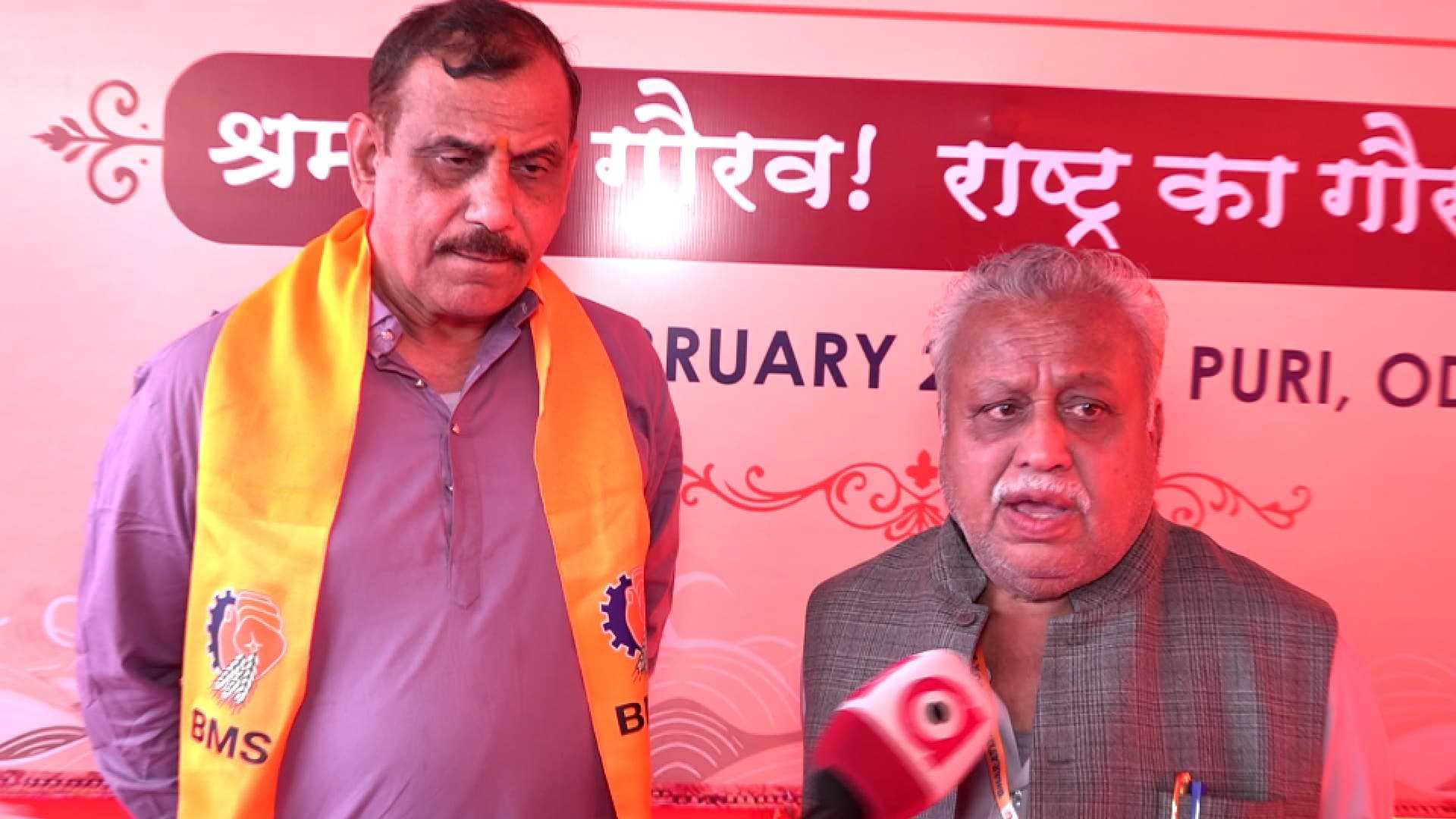
Ahead of the event, Argus Digital spoke with BMS All India General Secretary Ravindra Himte, Zonal Organising Secretary (West) Pawan Kumar, and Dr. Gazi Doğan, Faculty Member (Asst. Prof.) of the Department of History at Ankara Social Sciences University, International Relations Coordinator of Memur-Sen Confederation of Turkiye (the largest trade unions in public sector).
Speaking on the occasion, Dogan emphasized that global cooperation among trade unions strengthens their ability to defend workers’ rights more effectively.
“All this kind of international level co-operation between
trade unions make our rights much stronger. When we work together we can demand
our rights in a much better way,” he added.
What Ravindra Himte said?
What is the core ideology of Bharatiya Mazdoor Sangh?

📱 Get Argus News App
✨BMS prioritises and works keeping national interest, interest towards industrial development, as well as welfare of labour workers in mind. For us, if the nation is there, industry will come and prosper, and if industry is there then only labourers and workers will benefit. So for us, nation comes first.
How do you assess the current state of India’s labour movement?
If we look at reservations, the situation of labourers is quite good in India. Look, there will be problems and it’s quite common. In our view, discussions should take place among the three groups — government, industry and labourers. And to make the situation even better, especially for labourers, these discussions should happen.
What are the biggest challenges Indian workers are facing today — job security, or working conditions?
For us, work culture and job security both are important. We have to respect and maintain the work culture, and if we have job security, this will not only help the labourers, but help the nation achieve its goal and achieve the government’s dream of Viksit Bharat.
Many workers feel unions are becoming less relevant in the private sector. How does BMS respond to that perception?
Currently, around 93% of work is carried out in the informal and private sectors. To support national growth, the labour union of every region has come forward to fulfil their role. If we face any issue, we try to resolve it through discussions with the government, and with the industry authorities.
How is BMS addressing the concerns of contract workers and gig-economy employees?
Last year, BMC had a couple of protests — both are against the contractors’ exploitation. So our demand was to shut down contract-based labour works, or to introduce restrictions so that the contractors will not be able to do anything wrong with labourers.
What is BMS’s stand on the new labour codes introduced by the government?
BMS supported all the four labour codes. We had also objected to some points, which were not favourable to labour workers. Union Labour Minister Mansukh Mandaviya has assured us to discuss those issues and find a solution.
Do you believe labour reforms are being carried out in favour of industry at the cost of workers?
No, nothing like that. For us, government, industries and labour workers are aligned. Everyone has their shares of responsibility if we have to prosper as a nation.
How does BMS maintain its independence while engaging with governments of the day?
BMS has its own ideology. No matter whoever is in power (government), we always work towards the labour workers’ interest and welfare. So government is not an obstacle for us.
Strikes are often criticised for hurting the economy. How do you justify them in today’s economic climate?
BMS is not in favour of strikes. We take such steps only when we see our labour workers suffer. Otherwise, we prefer to resolve the issues through dialogues and discussions.
What alternatives does BMS propose to resolve labour disputes without prolonged industrial action?
In general, we prefer peaceful protest. And we discuss with industry authorities and government to resolve whatever issues we have.
How can trade unions attract young workers who see unions as outdated?
Today, we have about 40% youth among the labour workers. So this question shouldn’t arise.
What steps is BMS taking to increase women’s participation in trade union leadership?
BMS always try to allow women to participate in important work affairs and many of them have been given important roles and responsibilities. Not only this, we have scheduled a discussion session on ‘increasing women’s participation in the Trade Union Movement’.
Nearly 90% of Indian workers are in the informal sector — how can unions effectively represent them?
So far, we have worked in an effective manner. It’s true that 90% of the workers are in informal sector. But it’s also true that BMS has such a team who can address all the issues of our labour workers and resolve it.
What Pawan Kumar said?
Should trade unions stay away from politics, or is political engagement unavoidable?
Trade unions should contribute in national policy building, rather than doing politics.
How does BMS counter allegations that trade unions are being used as political tools?
BMS is not a political tool and will never be.
What is your long-term vision for the Indian trade union movement?
BMS should contribute in national policy building. Keeping the national and social interest in mind, it should adapt to the path of communication and struggle.
How can economic growth and workers’ welfare move together rather than in conflict?
This is not a conflict. These two fulfils each other. If the purchasing power of a layman or a labour worker increases, then only the economic cycle will run smoothly and the national will grow.
What message would you like to give to workers who feel unheard or disillusioned today?
For the past 70 years, we have tasted success in various sectors. This trust encourages labour workers to stand with us. This is the reason that, for the last 36 years, BMS is the largest labour union in the country.
Is India becoming more employer-friendly than worker-friendly?
In our opinion, this thinking is delusional. BMS imagines a developed industrial family. We don’t work against the industry or its development. That’s why, the interests of industry and labourers are aligned.
One reform workers urgently need today?
In our opinion, the most important change should be the wage
system. A living wage structure — to support a labour worker’s daily life — should
be introduced instead of minimum wage system.
Related Topics
Explore more stories