



After Tripura, Karnataka, Odisha's Kandhamal Joins Mission to Prevent Out-of-Wedlock Teenage Pregnancies| Special Report
Key Points
- Systemic Trigger: The mission shifts from reactive school hostel tracking to community prevention after over 300 minors became pregnant within three years.
- Legal Zero Tolerance: Targets out-of-wedlock pregnancies, illegal abortions, and underage relationships that constitute statutory rape under the strict POCSO Act.
- National Blueprint: Replicates proactive frameworks like Tripura's elopement monitoring under Mission Sankalp and Karnataka's mandatory medical pregnancy audits.
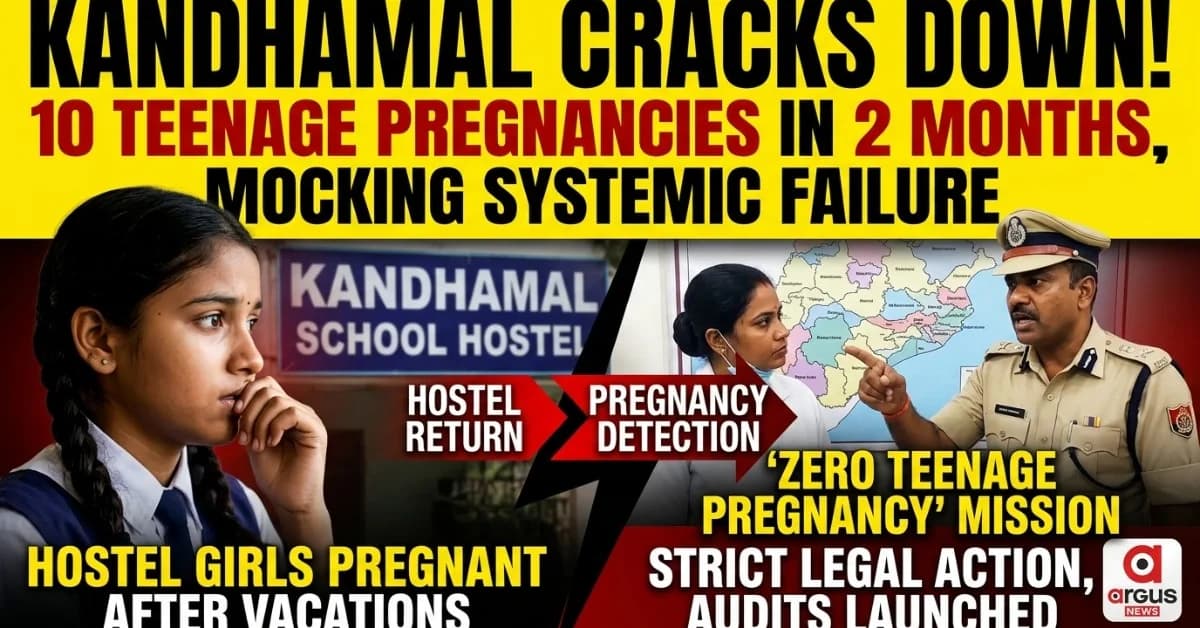
Bhubaneswar: A sudden spurt of nearly 10 cases of teenage pregnancies, including instances of alleged illegal abortions, reported in Kandhamal over the past two months has pushed the district administration to launch an ambitious 'Zero Teenage Pregnancy' mission – making it one of the few districts in India to adopt a focused administrative strategy against out-of-wedlock minor pregnancies.
The latest trigger is not an isolated incident. Over the past few years, Odisha has repeatedly witnessed a disturbing pattern: minor girls returning to government-run residential hostels (Sevashrams) after school vacations only to be found pregnant during routine health checks.
From Kandhamal and Malkangiri to Mayurbhanj, Keonjhar, Sundargarh, and even coastal Jajpur, case after case has exposed how pregnancies often occur during vacations at home and come to light only after the girls return to school.
Why Kandhamal Has Acted Now

📱 Get Argus News App
✨Unlike previous years when individual incidents were handled through police investigations and suspension of school officials, Kandhamal has now decided to attack the problem at its source.
The immediate trigger was the revelation by Kandhamal Superintendent of Police that around 10 cases involving minor pregnancies and alleged secret abortions surfaced within just two months, besides a growing number of POCSO cases involving school-going girls.
The district's internal assessment also showed that over 300 minors had become pregnant in the last three years, indicating that the problem was no longer episodic but systemic.
Officials realised that hostel authorities were merely detecting pregnancies after students returned from vacations. The conception itself was taking place outside institutional supervision, making reactive monitoring ineffective.
The district has therefore shifted from post-incident detection to community-level prevention, targeting villages, parents, adolescents, schools, police, health workers and child protection mechanisms before pregnancies occur.
A Crisis That Has Repeatedly Made Headlines
The decision comes against the backdrop of recurring incidents across Odisha over the last several years.
Kandhamal itself has figured repeatedly in such cases. In 2025, two Class X girls studying in separate state-run hostels in Tumudibandh were found pregnant after returning from summer vacation, leading to separate POCSO cases.
In March 2026, a Class IX student delivered a baby inside a school hostel in Firingia after allegedly concealing her pregnancy for months.
In July this year, another Class X girl from a government residential school at Gochhapada was found pregnant during routine health screening.
The trend extends beyond Kandhamal.
In Malkangiri, a 15-year-old tribal student delivered a baby on the rooftop of her hostel immediately after appearing for her Board examination, leading to suspension of school authorities.
Similar cases surfaced in Mayurbhanj, where a Class VIII student was diagnosed with pregnancy after complaining of abdominal pain following summer vacation; in Keonjhar, where a Class VI hostel resident was found pregnant; and in Jajpur, where a Class X student delivered a baby, triggering intervention by child welfare authorities.
Recognising the recurring pattern, the Odisha government had in 2024 launched a statewide awareness campaign across nearly 5,800 hostels, focusing on safe-touch awareness, legal provisions and adolescent health before schools closed for vacations. However, repeated incidents suggested that awareness alone had not stemmed the trend.
Not Just Child Marriage, But Out-of-Wedlock Pregnancies
The Kandhamal initiative differs from conventional child marriage campaigns.
While preventing child marriages remains one objective, the immediate focus is on out-of-wedlock pregnancies, sexual exploitation, underage relationships and illegal abortions involving minors.
Under the Protection of Children from Sexual Offences (POCSO) Act, any sexual relationship involving a person below 18 years constitutes statutory rape irrespective of consent, automatically triggering criminal investigation.
The mission therefore integrates police surveillance, health monitoring, adolescent counselling, school-based awareness, Childline intervention and community vigilance to identify vulnerable situations before they culminate in pregnancies.
Grassroots platforms such as Balya Bibaha Pratirodh Manch will also be used to prevent child marriages, recognising that early marriage and teenage pregnancy are closely linked in several tribal pockets.
Taking a Cue from Tripura and Karnataka
Kandhamal's strategy mirrors an emerging administrative trend seen in a few parts of the country where teenage pregnancy is increasingly being treated as a legal and public health emergency rather than merely a social issue.
Tripura's Mission Sankalp
In 2025, Sepahijala district in Tripura launched Mission Sankalp after the state recorded the country's highest teenage pregnancy rate under NFHS-5.
Instead of focusing only on child marriages, the administration targeted underage elopements, social media-driven relationships and vulnerable border villages. Community surveillance, inter-departmental coordination and incentives for villages reporting zero child marriages or underage elopements formed the backbone of the campaign.
By mid-2026, the district reported that 10 vulnerable villages remained free from child marriage and underage elopement for six consecutive months, providing one of the first measurable outcomes of such an intervention.
Karnataka's Mandatory Pregnancy Audit
Karnataka adopted an even stricter administrative model in April 2026 after health records identified 25,436 teenage pregnancies within an eleven-month period.
The state mandated medical audits for every pregnancy involving girls aged between 10 and 18 years. Taluk-level committees were tasked not merely with treatment but also with verifying whether mandatory POCSO complaints had been registered.
The system reduced the possibility of quietly settling cases within families or concealing pregnancies through illegal abortions by making every teenage pregnancy subject to administrative scrutiny.
A Shift in Administrative Thinking
The Kandhamal initiative reflects a broader shift in governance.
Instead of treating teenage pregnancy as an isolated family matter or responding only after a pregnancy is detected, administrations are increasingly relying on legal enforcement, community monitoring, school-health convergence and preventive interventions.
For Kandhamal, where recurring hostel pregnancy cases have repeatedly embarrassed the administration and exposed vulnerabilities in child protection systems, the mission marks an attempt to intervene much earlier – during the period when adolescents are away from institutional supervision.
The Bottomline
Tripura's village-level monitoring and Karnataka's mandatory pregnancy audits suggest that early detection, community surveillance and strict legal reporting can reduce hidden teenage pregnancies, when implemented consistently.
Whether Kandhamal can replicate those outcomes will depend on sustained coordination among the police, education, health and child protection departments, and on whether interventions extend beyond hostels into the villages where many of these pregnancies originate.
For now,
Odisha's tribal district has joined a small but growing group of
administrations trying to prevent teenage pregnancies before they become
criminal investigations.
Also Read: How Odisha's Rising C-Section Delivery Trend Could Fuel an Urban Diabetes Crisis Among Mothers and Newborns | Special Report
Related Topics
Explore more stories