



After Andhra Congress Govt’s Manual Lottery Experiment Failed, Odisha BJP Bets on Foolproof E-Lottery to Reform Sand Mining| Special Report
Key Points
Bhubaneswar: Determined to avoid the fate of Andhra Pradesh's failed sand lottery experiment, the Odisha government on Friday operationalised its new e-lottery-based sand mining allocation framework, nearly a year after the State Cabinet approved the amended policy.
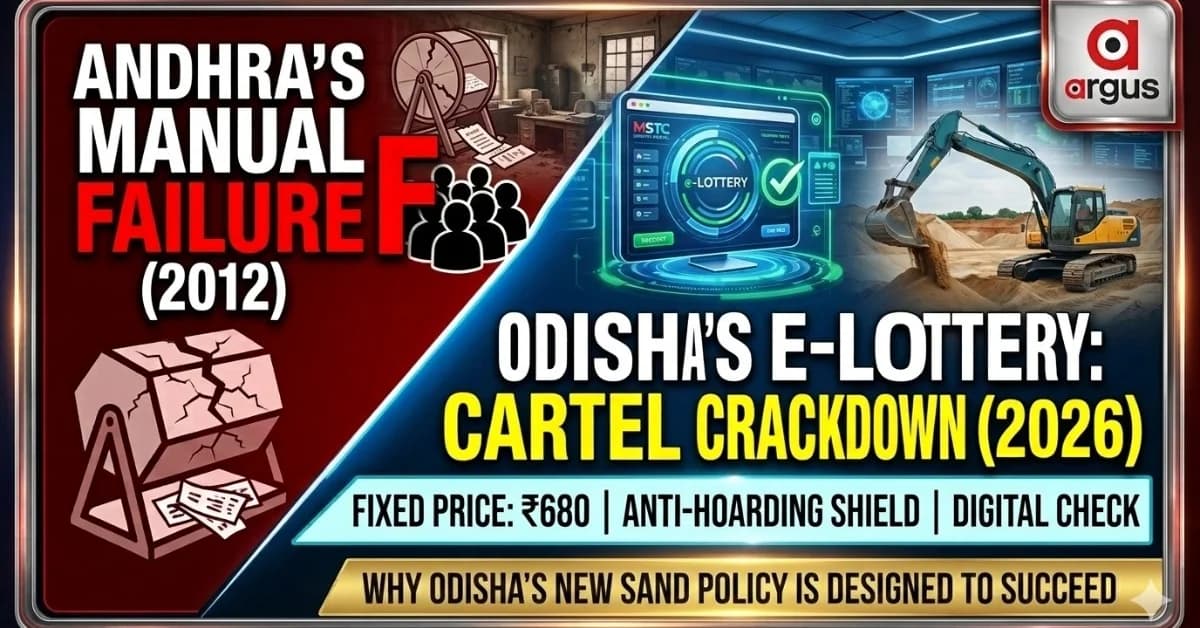
The rollout marks the transition from policy to implementation, with the government activating a centralized digital lottery system, capping mine ownership, fixing the mine-gate sand price at Rs680 per cubic metre, and empowering authorities to seize stock to prevent artificial shortages.
The objective is clear: democratise sand mine allocation without triggering the supply disruptions, cartelisation and black marketing that doomed Andhra Pradesh's manual lottery model.
Steel and Mines Minister Bibhuti Bhusan Jena used the launch to announce that the new regime has formally come into force, warning transporters and illegal operators that enforcement teams would carry out surprise inspections against overcharging and illegal transportation.

📱 Get Argus News App
✨The government has simultaneously assured builders and consumers that the computerized allocation process through the MSTC portal will ensure uninterrupted sand availability despite the shift from auctions to lotteries.
Flashback: The Andhra Pradesh Experiment That Collapsed
Odisha's new framework has unmistakable echoes of an experiment first attempted by the Congress government in Andhra Pradesh in October 2012.
Facing judicial restrictions on indiscriminate riverbed mining and mounting allegations of sand mafia dominance, the Andhra Pradesh government abolished competitive auctions and introduced a manual lottery system for allotting sand reaches. Individual applicants entered physical draws of lots, while the government fixed sand prices at Rs325 per cubic metre and prohibited mechanised mining, permitting only manual extraction.
The reform, however, quickly unravelled.
Manual extraction failed to keep pace with demand, creating severe shortages that crippled construction activity. Sand syndicates exploited the lottery by sponsoring thousands of proxy applicants from poor households to capture leases indirectly. As official supply dried up, black-market prices reportedly climbed several times above the government-fixed rate. Meanwhile, replacing competitive auctions with nominal lottery fees sharply eroded government revenues without delivering cheaper sand to consumers.
Within two years, the experiment was abandoned. The subsequent TDP government scrapped the lottery model in 2014, later experimenting with SHG-managed sand reaches, followed by the "Free Sand Policy" and eventually a centralized online booking system under the Andhra Pradesh Mineral Development Corporation (APMDC).
Odisha's E-Lottery vs Andhra's Manual Lottery
|
Risk Area |
Andhra Pradesh Manual Lottery (2012) |
Odisha E-Lottery (2026) |
|
Allocation System |
Manual draw of lots vulnerable to manipulation |
Fully digital e-lottery through MSTC portal |
|
Cartel Control |
Proxy applicants enabled syndicates to corner leases |
Mandatory family affidavits, digital verification and ownership cap of five mines statewide and three per district |
|
Supply Mechanism |
Manual mining caused production bottlenecks |
Mechanised loading permitted under environmental norms with guaranteed minimum production |
|
Artificial Scarcity |
Operators hoarded sand, fuelling black markets |
Government empowered to requisition up to 40% of stock to stabilise supply |
|
Price Control |
Official cap failed due to shortages |
₹680 mine-gate price backed by digital monitoring and enforcement |
|
Revenue Model |
Lottery replaced premium auction bids, reducing revenue |
Lower auction premium offset through tighter royalty administration and reduced leakages |
|
Administrative Control |
Decentralised execution |
Centralised under Mining Department through online platform |
Why Odisha's Framework Has Better Chances of Success
Unlike Andhra Pradesh's paper-based lottery, Odisha's architecture has been designed to plug the structural loopholes that enabled syndicates to flourish.
The biggest safeguard is digitisation. The centralized e-lottery substantially reduces opportunities for mass proxy participation that characterised Andhra's manual draws. Mandatory anti-proxy affidavits and restrictions on the number of mines that can be controlled by a single entity further limit concentration of leases.
The second structural difference lies in supply management. Andhra's blanket prohibition on mechanised mining severely restricted production, creating shortages almost immediately. Odisha, by contrast, has retained mechanised loading within environmental norms and has prescribed minimum production obligations, reducing the possibility of sudden supply collapses.
Perhaps the most significant innovation is the government's statutory power to requisition up to 40% of privately mined sand during periods of artificial scarcity. This gives the administration a direct instrument to intervene in the market if operators attempt to engineer shortages or inflate prices.
Collectively, these measures suggest that Odisha's framework is structurally more resilient than Andhra Pradesh's 2012 experiment and is less likely to witness the rapid policy collapse that followed there.
Bottomline: The Last-Mile Challenge
Yet the success of Odisha's reform will ultimately depend less on the e-lottery than on what happens after the sand leaves the mine.
While the government has frozen the mine-gate price at Rs680 per cubic metre and digitised lease allocation, transportation remains the weakest link. If transport syndicates inflate freight charges or illegally divert consignments, consumers could still end up paying exorbitant prices despite the regulated mine-gate rate.
Similarly, the government's power to seize stock and prevent hoarding will be meaningful only if district mining officials and police consistently enforce the rules through surprise inspections, vehicle checks and strict action against illegal storage and transport.
In other words, Odisha appears to have corrected the
structural flaws that brought down Andhra Pradesh's manual lottery model.
Whether the reform becomes a lasting success – or merely another policy
experiment – will now depend on rigorous last-mile enforcement against
transport cartels and illegal market practices.
Also Read: Odisha Food Pro 2026: What ₹43,437-Crore Headline Number Tells Another Bigger Story| Exclusive Details Inside
Related Topics
Explore more stories