



4cr Odias Still Out of Reach of Modi’s Cheap Medicine; How Mission Shakti Can Fix Odisha’s Jan Aushadi Kendras Gap | Exclusive
Key Points
Bhubaneswar: Odisha now has 881 functional Jan Aushadhi Kendras (JAKs), offering a wide range of generic medicines for multiple diseases, including advanced vitamin supplements, at prices that can be around a third of those of branded alternatives.
Yet, for a large section of rural Odisha, the promise of affordable medicines remains largely out of reach, as the Jan Aushadhi network has developed with a highly skewed and relatively small geographical footprint.
The paradox is striking: Odisha appears better placed than several populous states when measured by the number of people served by each Jan Aushadhi Kendra, but the aggregate numbers conceal a deep coastal-urban versus interior-rural divide in access.
881 JAKs for 4.6 crore: The numbers look better than UP, Bengal

📱 Get Argus News App
✨As of June 30, 2026, Odisha had 881 functional JAKs, against 20,149 nationally. On a simple population-to-store ratio, Odisha appears reasonably well served, with approximately 52,000 people per JAK. That compares favourably with Uttar Pradesh, where the ratio is around 56,800, and is significantly better than Bihar and West Bengal, where one JAK caters to roughly 1 lakh people each.
|
State |
JAKs |
Approx. population |
People per JAK |
|
Odisha |
881
~4.6 crore
~52,000
Bihar
1,304
~13 crore
~1,00,000
Uttar Pradesh
4,226
~24 crore
~56,800
West Bengal
1,014
~10 crore
~98,600
But this is where the devil lies in the details.
A state-level ratio treats every JAK as if it were equally accessible to every citizen. It is not. The data shows that JAKs are disproportionately concentrated in developed urban and coastal locations, while large parts of rural, tribal and interior Odisha have very few outlets.
The result is a classic case of statistical adequacy masking physical inaccessibility. A JAK in Bhubaneswar or Cuttack may improve the state's average, but does little for a villager in a remote block of Malkangiri, Rayagada or Nabarangpur who may have to travel to a district headquarters to access the same low-cost medicines.
District footprint: Odisha’s JAK map mirrors its economic divide
The district-wise distribution exposes the problem more starkly. Cuttack, Khordha, Ganjam and Balasore emerge as high-density hubs, benefiting from stronger logistics, healthcare clusters, urban demand and greater consumer awareness.
The central and western industrial belt – including Sambalpur, Angul, Jharsuguda, Bargarh and Sundargarh – has moderate coverage, but even here JAKs tend to remain concentrated around district headquarters and industrial townships rather than penetrating deeply into rural blocks.
The sharpest deficit is visible across the southern tribal and interior belt. Malkangiri, Rayagada, Deogarh, Nabarangpur, Boudh and Gajapati have some of the weakest footprints, with multiple districts having fewer than 5–10 active JAK locations across their entire territory. In vast rural geographies, a single outlet can end up serving hundreds of villages.
This concentration is not accidental. The JAK model depends significantly on the viability of individual franchise operators. Low population density, weaker purchasing power, difficult terrain, poor logistics and connectivity make remote tribal blocks less commercially attractive. In some districts, the only reliably active JAK may be located in or around the district hospital, leaving patients with virtually no secondary access if stocks run out.
4.4 crore out of reach: The rural access paradox
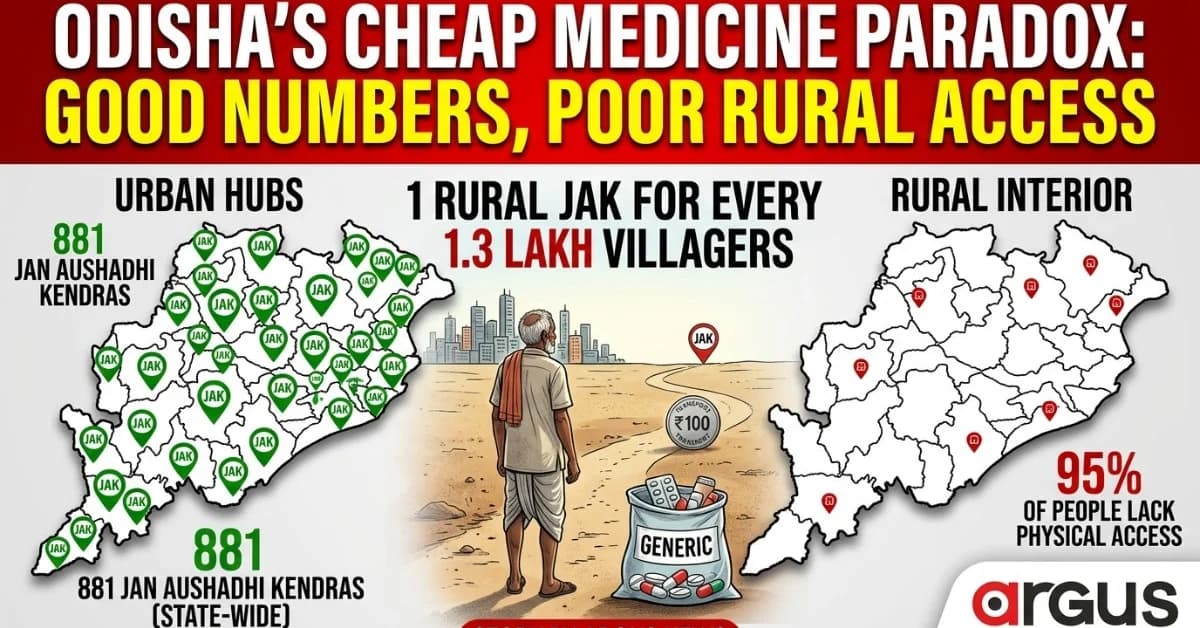
An analysis estimates that 4.3–4.45 crore people, roughly 92% to 95% of the state's population, remain outside regular physical access to the low-cost Jan Aushadhi retail network.
The rural skew makes the gap even more consequential. Odisha has roughly 3.92 crore rural residents, accounting for about 83.3% of its population, while more than 60% of JAKs are estimated to be concentrated in municipal corporations, district headquarters and urban blocks. That leaves only around 300–350 stores serving the vast rural landscape – a ratio of roughly one rural JAK for every 1.1–1.3 lakh villagers.
For a poor rural household, the economics can therefore turn upside down. If reaching the nearest JAK requires spending Rs100 on transport to save Rs70 on medicines, the cheaper medicine is no longer cheaper in practical terms. The result is that the Jan Aushadhi remains strongest where pharmacies, roads, healthcare facilities and purchasing power already exist, precisely where access to medicines is relatively easier.
That is the central contradiction in Odisha's Jan Aushadhi story: the State has a respectable number of Kendras on paper, but the network has yet to become a genuinely rural medicine-access grid. Until JAKs move from district headquarters and urban centres into the village-level geography of healthcare demand, millions of Odias may continue to live outside the practical reach of Modi's cheap-medicine promise.
BOTTOMLINE: Mission Shakti Can Solve the Last-Mile Problem
Odisha's network of more than six lakh Women Self-Help Groups offers an institutional alternative to the individual-franchise model. Instead of depending exclusively on individual entrepreneurs to take JAKs into commercially unattractive areas, mature SHG federations can be brought into the operating ecosystem.
The model, however, must preserve the distinction between pharmacy management and pharmacy operations. SHG members can manage billing, inventory, accounts, community outreach and day-to-day operations, while a qualified registered pharmacist remains responsible for dispensing, prescription compliance and statutory requirements.
This would turn JAKs from isolated retail outlets into community-based medicine access points.
Make the Economics Work in the Hardest Blocks
The weakest JAK locations are precisely those where commercial viability is lowest. A rural expansion programme will therefore require a targeted viability-support mechanism rather than a uniform subsidy.
Existing central incentives can be layered with state support for working capital, premises, connectivity and initial operating costs in remote and tribal blocks. The objective should not be to permanently subsidise inefficient outlets, but to bridge the viability gap until sufficient local demand and institutional support develop.
The Final Test Is Not How Many JAKs Odisha Has
The success of Jan Aushadhi in Odisha should no longer be measured simply by the number of Kendras opened or the state's population-to-JAK ratio.
The more meaningful question is: How far does a rural citizen have to travel to buy an affordable generic medicine?
Until a villager in a remote block can access a Jan Aushadhi Kendra within a reasonable distance, Odisha's 881-store network will remain a case of good numbers but poor geography.
The
opportunity is therefore clear: move Jan Aushadhi from the district
headquarters to the doorstep of rural Odisha, using the state's existing healthcare,
cooperative and Mission Shakti infrastructure. That is the route to turning
cheap medicine from a policy promise into a genuinely accessible public
service.
Also Read: Glowing Trend: Rising Gold Loan Portfolio May Spell Doomsday for Odisha’s Sahukaars| Exclusive
Related Topics
Explore more stories