



CJP / Weak Jantar Mantar Protest Puts CJP's Viral Rise & Follower Claims Under Scanner
·4 months ago·4 min read
Key Points
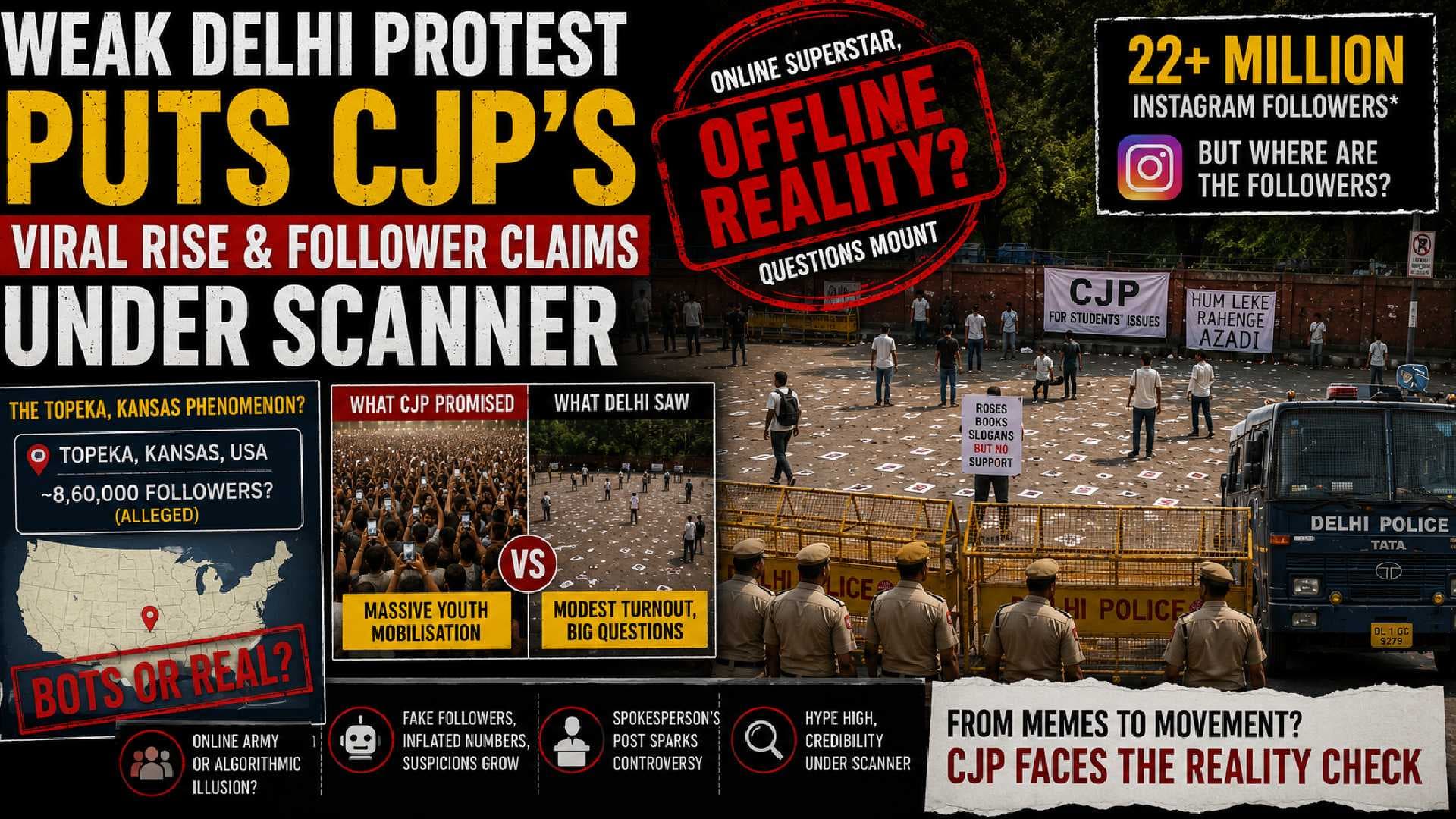
CJP's first major protest at Jantar Mantar in New Delhi on Saturday fizzled out amid heavy police deployment, raising questions about its 22 million Instagram followers.
New Delhi, Jun 6: For weeks, the Cockroach Janta Party (CJP) looked like the internet’s newest political supernova. Memes everywhere. Reels everywhere. “Youth revolution” hashtags everywhere. Even at this point, the CJP has more than 22 million Instagram followers, a number large enough to make several established political outfits look digitally undernourished. Then came Saturday’s protest at Jantar Mantar in New Delhi -- the movement’s first serious attempt to prove that its online army could become an offline crowd. However, it did not go as planned.
The demonstration, pitched as a major youth mobilisation, fizzled out amid heavy police deployment. Instead of the kind of mass turnout that a 22-million-follower movement might suggest, the gathering was modest enough for critics to ask the obvious question: where exactly were all those followers?
The Curious Case Of Topeka
That question has been haunting CJP for some time.
One of the stranger data points circulating online involves Topeka, Kansas -- a US city with a population of roughly 126,000. Screenshots shared by critics allegedly showed around 8,60,000 CJP followers connected to that location.
Also Read: Cockroach Janta Party Protest Falters at Jantar Mantar
CJP founder Abhijeet Dipke rejected those allegations and previously claimed that over 94 per cent of the movement’s audience is Indian. The organisation says follower fluctuations are the result of routine platform clean-ups and algorithm changes.
Maybe. Maybe not.
But when a movement claims a digital following larger than the population of many countries and then struggles to fill a protest site in Delhi, people tend to start doing arithmetic.
When Numbers Stop Adding Up
The gap between online engagement and physical mobilisation has become the central question surrounding CJP. Political movements across the world have discovered that likes, shares and follows do not automatically translate into feet on the ground.
Saturday's protest was expected to be CJP's coming-of-age moment. Instead, it became an unexpected reality check.
Spokesperson's Post Draws Attention
The scrutiny has also widened beyond follower counts.
CJP recently appointed investigative journalist Saurav Das as its chief spokesperson. But Das is now facing criticism over a social media post from December 30, 2025, in which he described former JNU activist Umar Khalid as “the bravest” and called his imprisonment a “permanent blot” on India’s judiciary.
The post prompted critics to question the ideological leanings of some individuals now representing the movement publicly.
Beyond Memes And Metrics
Supporters of CJP argue the movement is simply giving voice to frustrated students and unemployed youth. Critics counter that the organisation is better at manufacturing virality than building a real political base.
And for a movement that built its identity on staggering follower counts, the events at Jantar Mantar raised an uncomfortable question: Is CJP a mass movement that happens to live in the La La Land of social media, or an internet phenomenon still searching for a mass movement?
The demonstration, pitched as a major youth mobilisation, fizzled out amid heavy police deployment. Instead of the kind of mass turnout that a 22-million-follower movement might suggest, the gathering was modest enough for critics to ask the obvious question: where exactly were all those followers?
The Curious Case Of Topeka
That question has been haunting CJP for some time.
One of the stranger data points circulating online involves Topeka, Kansas -- a US city with a population of roughly 126,000. Screenshots shared by critics allegedly showed around 8,60,000 CJP followers connected to that location.
Now, before anyone declares an Indo-American cockroach uprising in the American Midwest, a caveat is necessary: no independent audit has publicly verified those screenshots. They could represent followers, impressions, VPN-routed traffic, advertising reach, or some other platform metric. But the numbers were odd enough to fuel allegations that part of CJP’s audience may consist of bots or non-authentic accounts.Cockroach 🪳 Janta Party
— Swathi Bellam (@BellamSwathi) May 28, 2026
BOT 🤖 & BOUGHT 💰 CAMPAIGN
8.9 lakhs followers from a town Topeka in USA (1.26 lakh population)
8.9 lakhs from Palestine
8.9 lakh from Malaysia
8.9 lakh from Ivorycoast
8.9 lakh from Brazil
Iam sure all this are from Karachi Insta gram farm 😂 same…
Also Read: Cockroach Janta Party Protest Falters at Jantar Mantar
CJP founder Abhijeet Dipke rejected those allegations and previously claimed that over 94 per cent of the movement’s audience is Indian. The organisation says follower fluctuations are the result of routine platform clean-ups and algorithm changes.
Maybe. Maybe not.
But when a movement claims a digital following larger than the population of many countries and then struggles to fill a protest site in Delhi, people tend to start doing arithmetic.
When Numbers Stop Adding Up
The gap between online engagement and physical mobilisation has become the central question surrounding CJP. Political movements across the world have discovered that likes, shares and follows do not automatically translate into feet on the ground.
Saturday's protest was expected to be CJP's coming-of-age moment. Instead, it became an unexpected reality check.
Spokesperson's Post Draws Attention
The scrutiny has also widened beyond follower counts.
CJP recently appointed investigative journalist Saurav Das as its chief spokesperson. But Das is now facing criticism over a social media post from December 30, 2025, in which he described former JNU activist Umar Khalid as “the bravest” and called his imprisonment a “permanent blot” on India’s judiciary.
It can be mentioned here that Khalid remains an accused in the larger conspiracy case linked to the 2020 Delhi riots. Delhi Police chargesheets invoked provisions of the Unlawful Activities (Prevention) Act (UAPA) dealing with unlawful activities, terrorist acts, funding and conspiracy, along with IPC charges including criminal conspiracy, rioting and promoting enmity.Mulaqat with the bravest, Umar Khalid. 5 years in jail over false, frivolous charges—a permanent blot on India’s judiciary. Mad respect for him and his undying spirit. ❤️🩹 pic.twitter.com/UprQEBoPfy
— Saurav Das (@SauravDassss) December 30, 2025
The post prompted critics to question the ideological leanings of some individuals now representing the movement publicly.
Beyond Memes And Metrics
Supporters of CJP argue the movement is simply giving voice to frustrated students and unemployed youth. Critics counter that the organisation is better at manufacturing virality than building a real political base.
And for a movement that built its identity on staggering follower counts, the events at Jantar Mantar raised an uncomfortable question: Is CJP a mass movement that happens to live in the La La Land of social media, or an internet phenomenon still searching for a mass movement?

📱 Get Argus News App
✨📰 60 Word News🎬 Argus Podcast📺 Live TV and Breaking News🔔 Free Notification Alerts
Download Free:
Related Topics
Explore more stories