



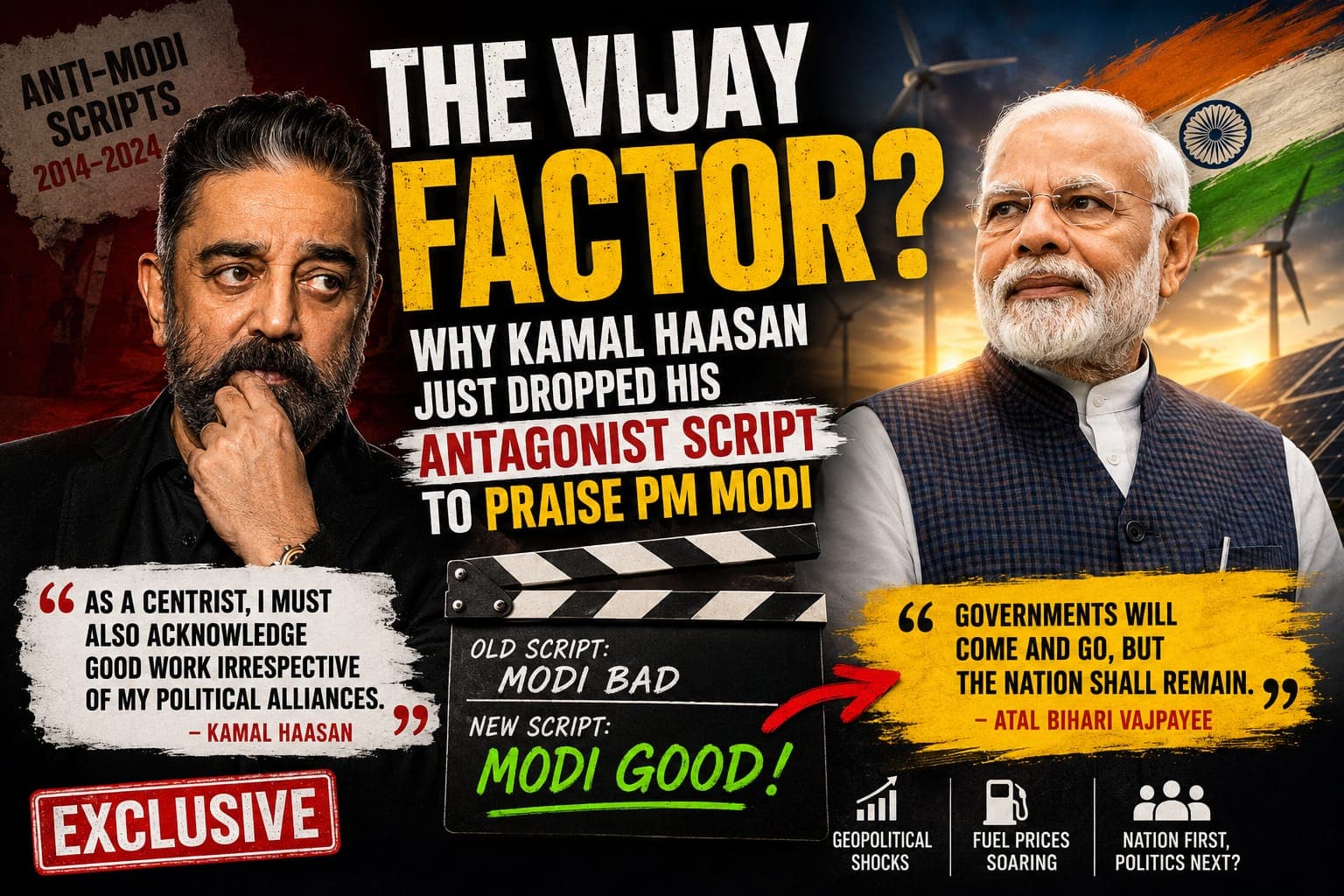
Kamal Hasan / The Vijay Factor? Why Kamal Hasan Just Dropped His Antagonist Script to Praise PM Modi| Exclusive
Key Points
Bhubaneswar: Walter Benjamin once famously observed that cinema is an art form “capable of demonstrating how matter plays tricks on man,” serving as an excellent vehicle for materialistic representation.
For over half a century, Kamal Haasan has been the master of manipulating that cinematic matter. However, on the grand, volatile screen of Indian democracy, the veteran actor-politician is finding that politics, too, has a way of playing tricks on the most seasoned scripts.
In a recent video tweeted by ANI, Haasan—the founder of Makkal Needhi Maiam (MNM) and currently a Rajya Sabha MP backed by the DMK—delivered a statement that has sent shockwaves through Tamil Nadu’s political corridors and caught New Delhi by surprise.
Addressing the nation on the economic ripples of the ongoing Iran War, Haasan didn't just break character; he executed a stunning ideological pivot.

📱 Get Argus News App
✨By praising Prime Minister Narendra Modi’s green energy initiatives and invoking Atal Bihari Vajpayee’s famous dictum—“Governments will come and go, but the nation shall remain”—the veteran antagonist of the Modi administration has introduced an unexpected, cinematic plot twist to his political arc.
The Plot Twist: Discovering 'Modi Goodness' Amid Geopolitical Shocks
Standing against the backdrop of global supply chain anxieties, Haasan’s statement was a masterclass in calculated statesmanship.
Citing Singapore Prime Minister Lawrence Wong’s stark warnings regarding stagflation, rising food costs, and prolonged logistics disruptions from the Iran War, Haasan pitched himself not as a partisan sniper, but as a sober, deeply concerned Indian centrist.
"As a centrist, I must also acknowledge good work irrespective of my political alliances. Under the PM's leadership, India's solar and wind energy capacity has increased over the last decade. I'm encouraged by recent investments in coal gasification, renewable and nuclear energy."
— Kamal Haasan
For a leader who spent the last decade characterizing the Modi government’s policies as structural threats to the nation's fabric, this sudden toast to the Prime Minister's vision represents a tectonic shift.
While he balanced his praise by demanding that the Centre and States collaborate to lower VAT on fuel and slash public transport fares to ease the burden on the common man, the takeaway was unmistakable: Kamal Haasan is discovering Modi’s governance merits, and he is doing so with deliberate public fanfare.
From Rebel to Realist: Tracking the Antagonist’s Past Scripts
To understand why this "centrist" pivot feels so jarring, one must look at the extensive track record of Haasan’s fierce opposition to the Centre since 2014. His political identity was largely forged in the fires of anti-Modi rhetoric:
The Lockdown & Demonetization Parallels: During the 2020 pandemic, Haasan penned a blistering open letter to PM Modi, comparing the sudden COVID-19 lockdown to the economic trauma of the 2016 demonetization drive. He slammed the administration for opting for "warm and fuzzy campaigning" (like lighting lamps) while leaving migrant laborers stranded—dismissing the fact that the lockdown aligned with global scientific consensus to halt explosive transmission across vulnerable states.
The Demonetization Regret: Having initially given a cautious nod to demonetization in 2016, Haasan publicly apologized in 2017, claiming he supported the move without fully foreseeing the economic ruin it would inflict on the masses. Critics viewed the flip-flop as an early sign of a leader adjusting his sails for political expediency.
The "Hindia" Battle: Haasan has been an aggressive opponent of the Centre's delimitation exercises, warning that bypassing a timely census to redistribute parliamentary seats would dilute southern representation and turn India into a homogenized "Hindia."
The Central Vista Dig: He famously took a public swipe at the construction of the new Parliament building, asking why a new structure was needed when millions of citizens were facing hunger—a critique that leaned heavily into populism, considering that a parliamentary committee had long established the need for a modernized democratic infrastructure.
Add to this his highly controversial past remarks—such as labelling independent India’s first terrorist a Hindu in 2019, claiming "Kannada was born out of Tamil" in mid-2025 (which triggered massive cross-border protests), and declaring that education is the only weapon to break the "chains of dictatorship and Sanatan"—and Haasan’s brand seemed indelibly stained in deep anti-right-wing hues.
The Box Office Reality: What Forced the Rewrite?
Why has the man who routinely weaponized his vocabulary against the BJP suddenly chosen to play the harmonizing centrist?
The answer lies not in a sudden philosophical epiphany, but in harsh, unavoidable political realism.
1. The Dismal Electoral Balance Sheet
Haasan’s political vehicle, Makkal Needhi Maiam, has consistently failed to find its footing at the polling booth. In the 2019 Lok Sabha elections, the party drew a blank with a meager 3.72% vote share in contested seats. The ultimate humiliation came in the 2021 Tamil Nadu Assembly elections, where Haasan himself lost the Coimbatore South seat to BJP Mahila Morcha President Vanathi Srinivasan. Though he finally secured a backdoor entry to parliament via a Rajya Sabha seat in July 2025, it happened entirely on the charity and surplus votes of the DMK.
2. The Rise of Vijay and the TN Reshuffle
The Tamil Nadu political landscape has fundamentally fractured. The traditional, rabidly anti-Modi platform long monopolized by the DMK alliance faces an existential threat. Actor Vijay’s dramatic entry into politics and his rapid emergence as a powerful central pole—drawing massive appeal across traditional caste lines and generational demographics—has shattered old calculations.
With the BJP making aggressive ideological inroads and Vijay bestriding the state's political imagination, Haasan’s old script of pure, unadulterated Modi-bashing has lost its market value. The Tamil Nadu electorate is signalling a fatigue with boilerplate anti-Centre rhetoric.
| Era |
Kamal Hasan's Core Strategy |
Key Political Alignment |
| 2018 - 2021 |
Radical Challenger/Ideological Critic Independent |
Anti Establishment |
| 2024 - 2025 |
Pragmatic Partner (secured RS seat) |
Dependent on DMK Alliance |
| 2026 |
Strategic Centrist (Acknowledging National Leadership) |
Re-aligning with Pan India Geopolitical Reality |
The Director’s Cut: Relevance Over Rhetoric
By declaring himself a "centrist" who praises good work across the aisle, Kamal Haasan is attempting a sophisticated rebranding. He realizes that to remain relevant in a changing India—where geopolitical shocks require national cohesion and where the political center of gravity in Tamil Nadu is shifting—he can no longer afford to play a one-dimensional antagonist.
Borrowing Benjamin’s framing, the material reality of Indian democracy has played its trick on Kamal Haasan.
His sudden
discovery of "Modi goodness" is an act of sheer political survival.
Confronted by the headwinds of his alliance’s vulnerabilities, the rising star
power of younger rivals like Vijay, and a national mood focused on resilience
over resistance, the veteran actor has done what he does best: rewritten his
character to ensure he isn’t written out of the sequel.
Also Read: Tamil Nadu Politics / Stalin’s Sanatana Dharma Pitch in Assembly: Strategic Trap for CM Vijay or Political Overreach?
Related Topics
Explore more stories