



Pulwama Mastermind / THE FALL OF THE ‘DOCTOR’: Inside the Elimination of Pulwama Conspirator Hamza Burhan and the Crippling of Al-Badr

Key Points
Bhubaneswar: In what is being viewed as another devastating blow to the cross-border terror apparatus operating against India, Arjumand Gulzar Dar, alias Hamza Burhan, alias ‘Doctor’, a top operational commander of the banned terrorist outfit Al-Badr and a key conspirator behind the deadly 2019 Pulwama terror attack, has been shot dead.
According to intelligence sources, Burhan was targeted by unidentified gunmen inside his highly fortified office in Muzaffarabad, located in Pakistan-occupied Kashmir (PoK). Assailants reportedly breached his security, fired multiple rounds at close range—striking him repeatedly in the head—before vanishing into the area.
While Pakistani authorities have maintained a tight-lipped silence, refusing to release details or identify the attackers, the elimination of the 27-year-old commander marks the end of a dangerous cross-border operations career and signals the near-total collapse of one of Kashmir's oldest Pakistan-backed fundamentalist outfits.
The Pulwama Bloodline: Who was Hamza Burhan?

📱 Get Argus News App
✨Born in Kharbatpora, Ratnipora in Jammu & Kashmir’s Pulwama district, Burhan crossed over to Pakistan in 2017 under the guise of pursuing higher studies. Once there, he was quickly absorbed into the ranks of Al-Badr, eventually scaling the ladder to become its operational commander.
Investigative
agencies explicitly linked Burhan to the February 14, 2019, Pulwama terror
attack, where Jaish-e-Mohammed (JeM) suicide bomber Adeel Ahmed Dar rammed an
explosives-laden vehicle into a CRPF convoy at Lethpora, killing 40 personnel.
Investigators identified Burhan as an essential conspirator and a vital Over
Ground Worker (OGW) during the planning phases, bridging the gap between local
logistics and Pakistan-based extremist networks. 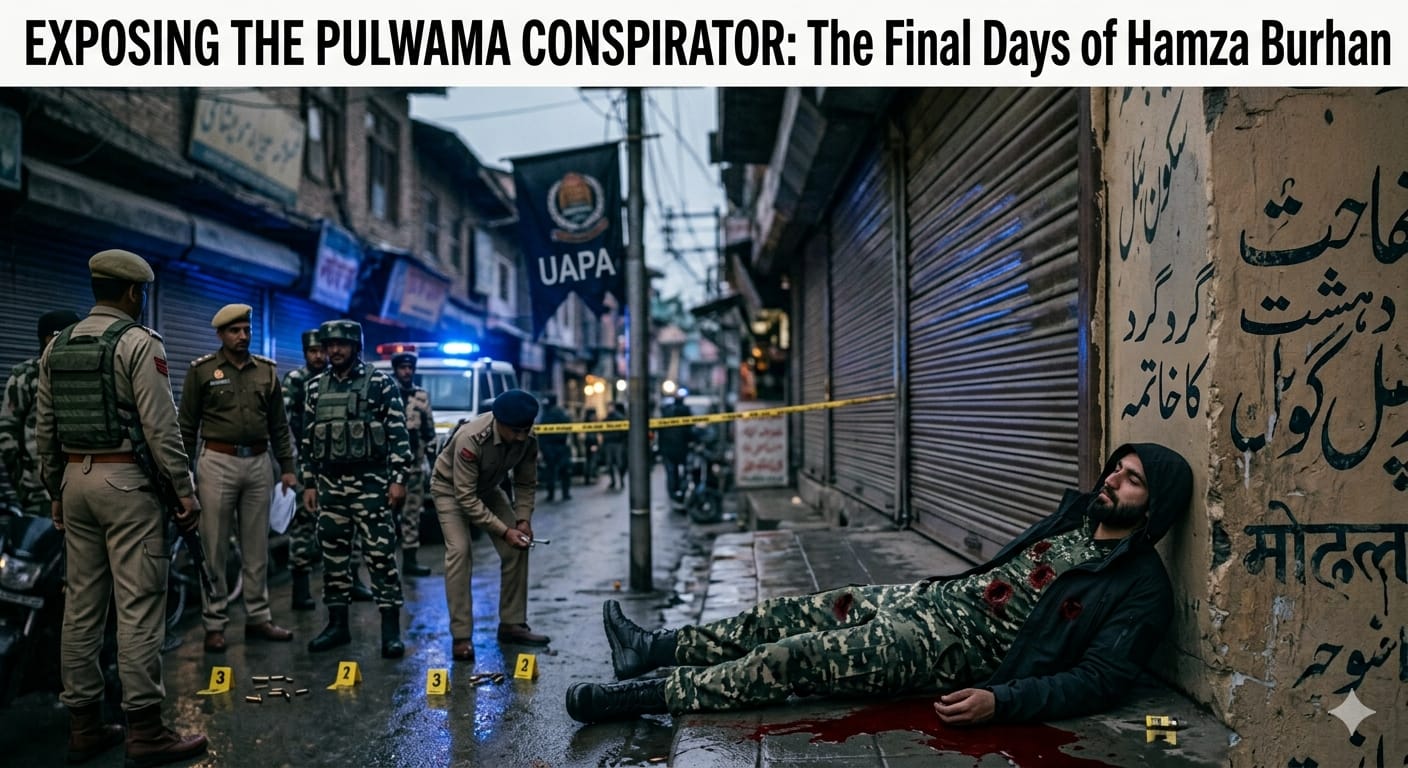
Recognizing his escalating threat level in managing digital radicalization, arms supply lines, and grenade attacks in South Kashmir, the Government of India officially designated him an individual terrorist under the Unlawful Activities (Prevention) Act (UAPA) in 2022.
From the MHA 2022 UAPA Notification:
"Arjumand Gulzar Dar alias Hamza Burhan alias Doctor... is an associate member and commander of Al Badr... operating from Pakistan through virtual modes to orchestrate violence in the Kashmir Valley."
Anatomy of Al-Badr: A Legacy of Blood and Isolation
The elimination of Hamza Burhan cannot be viewed in isolation; it is inextricably linked to the decaying state of his parent organization, Al-Badr.
Attribute Details
Origin: Formed in 1971 during the East Pakistan (now Bangladesh) pogroms; moved to Afghanistan under Gulbuddin Hekmatyar’s Hizb-i-Islami; infiltrated Kashmir in 1990.
Operational Split: formed as an independent armed wing of Jamaat-e-Islami under the Hizb-ul-Mujahideen (HM) banner; split from HM in 1998 due to ideological rifts.
Tactical Signature: Alongside LeT and JeM, it is the only outfit to introduce Fedayeen (suicide) tactics to the Kashmir Valley.
Headquarters: Mansehra, Khyber Pakhtunkhwa, Pakistan.
Historically backed by Pakistan's Inter-Services Intelligence (ISI), Al-Badr carved out a reputation for uncompromising fundamentalism. Unlike indigenous outfits, it actively opposed peace negotiations, rejected pro-independence groups like the JKLF, and fought alongside Pakistani regulars against India during the 1999 Kargil War under Chief Commander Bakht Zameen.
The War on Women and Local Backlash
Al-Badr's extreme enforcement of fanatical Sharia laws ultimately alienated the Kashmiri population.
In 2002 and 2003, the group targeted local women, killing several and issuing decrees demanding they give up education by age 14 and strictly wear veils. This brutal social policing destroyed its legitimacy locally, forcing the group to rely almost exclusively on foreign mercenaries—primarily Pashtuns from Afghanistan and Khyber Pakhtunkhwa.
The Ghost Guns: A Pattern of Attrition
The execution of Burhan inside PoK fits into a larger, highly coordinated pattern of attrition plaguing Pakistan-based terror infrastructure. Over the past few years, dozens of high-profile, India-wanted terrorists have met identical fates at the hands of "unidentified gunmen."
Prior to Burhan's death, Al-Badr had already been severely crippled by Indian counter-insurgency operations, notably through the 2021 elimination of its top Valley-based commander, Abdul Ghani Khawaja. Driven into a corner by a severe shortage of funds, forced to shut down multiple training camps, and lacking local support, Al-Badr relied entirely on Burhan's "digital radicalization model" to run virtual modules in Pulwama, Shopian, and Awantipora.
The Final Verdict
With Hamza Burhan dead, Al-Badr’s operational capabilities have effectively been brought to a standstill. Western intelligence agencies and the US State Department—which lists Al-Badr as a Foreign Terrorist Organization (FTO)—have noted the group's waning influence.
Stripped of its top leadership, facing severe financial bankruptcy, and losing relevance in the strategic calculations of its primary patron, the ISI, the killing of Hamza Burhan may well be the final nail in the coffin for Al-Badr.
Related Topics
Explore more stories