



Bhojshala Temple / The Ayodhya Blueprint: How Science and Precedent Redefined the Bhojshala Verdict
Key Points
Bhubaneswar:
Friday reminisces the Ayodhya Judgement Moment. The Madhya Pradesh High Court
in a landmark judgement declared the disputed Bhojsala as Temple.
To
understand the legal side of the Madhya Pradesh High Court’s decision, how the
court relying on history and science delivered its verdict, here is the
breakdown of the court's reasoning – An Explainer
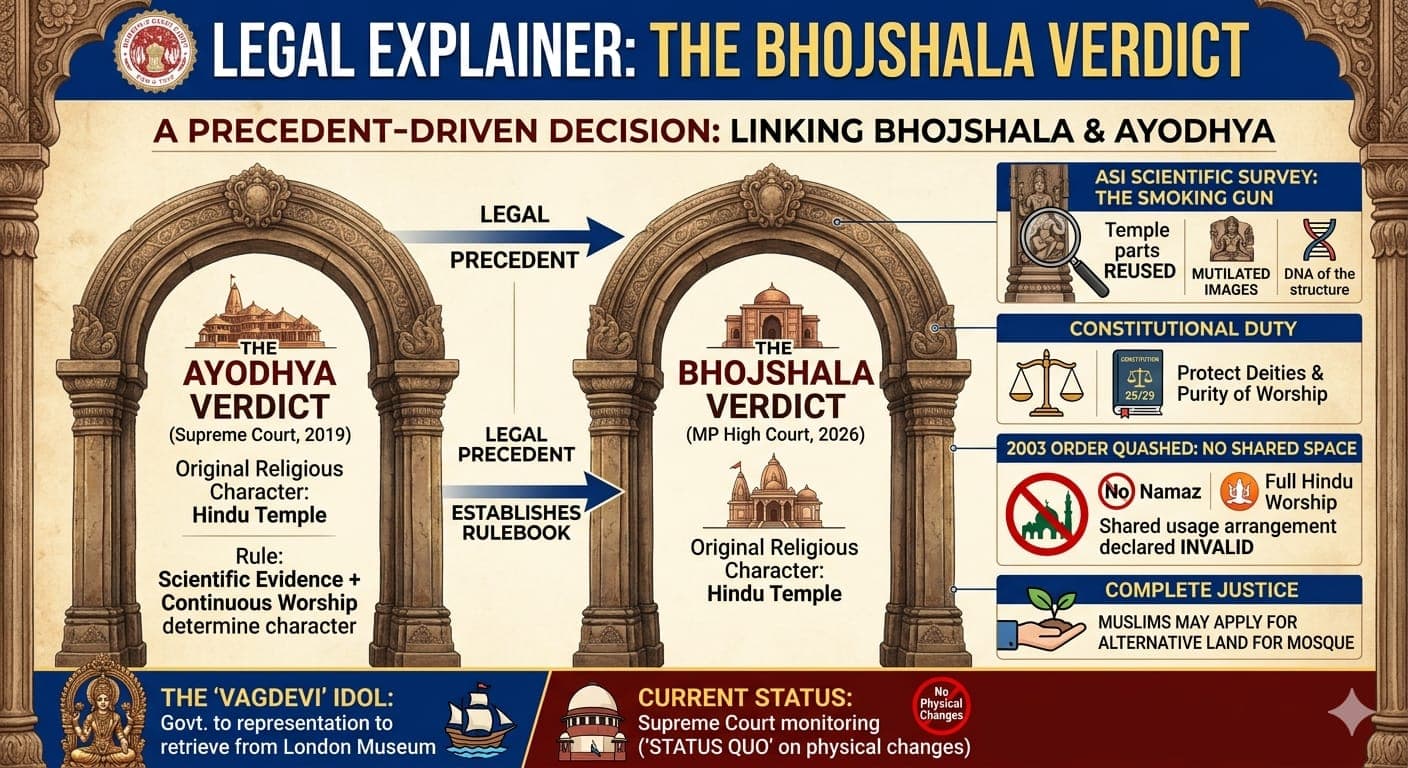
1. The "Ancient DNA" of the Building
The biggest legal question was: What is the true "religious character" of this site?
The Court looked at the Archeological Survey of India (ASI) report like a DNA test. The ASI found that the mosque wasn't built from scratch; it was constructed using pieces of an older temple.

📱 Get Argus News App
✨The Evidence: Pillars with images of Hindu deities (which had been defaced) and inscriptions showing it was a centre for Sanskrit learning.
The Legal Result: Because the "root" of the structure was a temple dedicated to Goddess Saraswati, the Court ruled that its fundamental identity is a Temple, not a mosque.
2. Quashing the "Middle Ground" (The 2003 Order)
Since 2003, there was a "sharing arrangement": Hindus worshipped on Tuesdays, and Muslims offered prayers on Fridays.
The Court’s Logic: The Court decided this "split-custody" arrangement was legally invalid. If the site is a temple, then restricting Hindu worship or allowing Islamic prayers there contradicts its religious character.
The Court quashed the 2003 order, effectively ending the shared usage.
3. The "Ayodhya Precedent"
The Court heavily relied on the Supreme Court’s 2019 Ayodhya Judgment. In law, a "precedent" is a previously decided case that acts as a rulebook for future ones.
The Rule: If archeological evidence proves a temple existed and the religious "continuity" (meaning Hindus never stopped trying to worship there) remained, the land can be awarded to the original religious character.
Constitutional Duty: The judges noted that under Articles 25 and 26 of the Constitution, the government has a duty to protect sites of spiritual importance and the "purity" of the deity.
The Verdict Sheet
|
ACTION |
LEGAL INSTRUCTION |
|
Status of Site |
Declared Protected monument and a Saraswati Temple |
|
Muslim Community |
Can apply to the State for alternative land in Dhar ro build a mosque |
|
The Bitish Connection |
Asked Govt to try and bring back the Vagdevi (Saraswati) idol from London Museum. |
|
Management |
ASI will still keep the keys and manage the site to ensure it is preserved. |
What Happens Next?
While the High Court has given this "Final Answer," the case is still under the eyes of the Supreme Court. Earlier, the Supreme Court said no "physical changes" should be made to the site until they've had a final look.
Unlike
Ayodhya verdict delivered by the SC, the Judgment on Bhojasala ball is now in
court of SC.
Also Read:
Related Topics
Explore more stories