



Attention Economy / The Attention Economy: Who Owns Our Time?
Key Points
In the digital age, attention has become currency. Notifications and algorithms compete for our focus, reshaping how we think, learn, and live — making conscious attention the new measure of wealth.
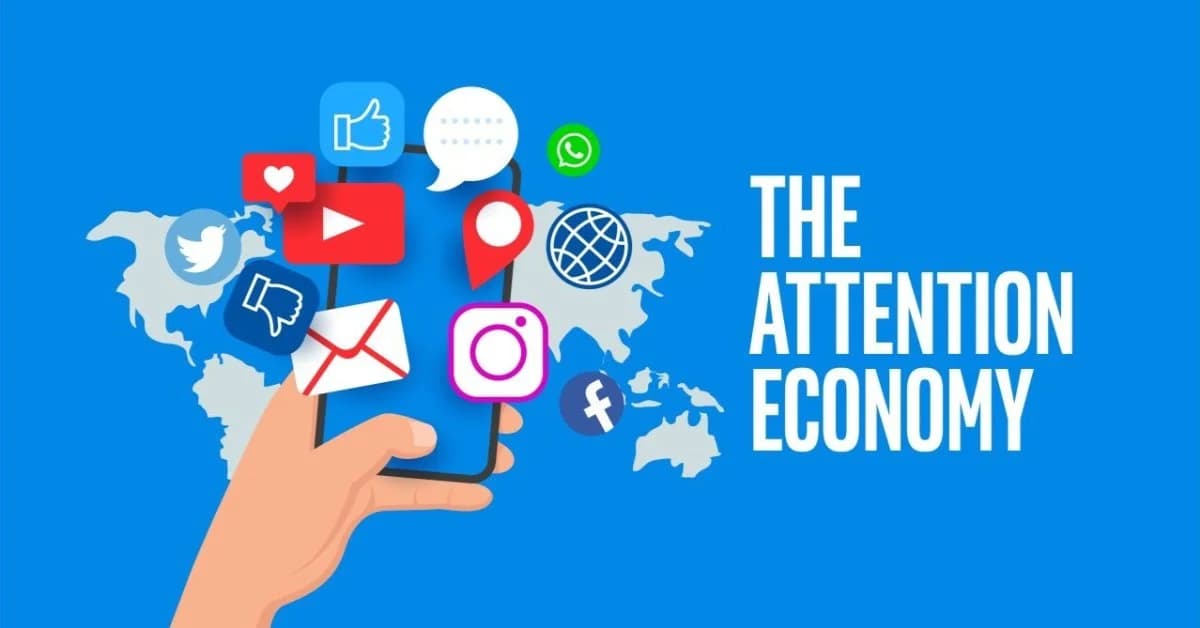
Time has always been one of the few resources equally distributed among human beings. A billionaire and a daily-wage worker wake up with the same twenty-four hours. A student and a scientist may have different responsibilities but neither can purchase an additional hour in a day. Yet in the digital age, something more subtle has changed. While we still technically own our time, an increasingly sophisticated economy is competing for our attention. Notifications, short videos, advertisements, streaming platforms, social media feeds, online news and recommendation systems constantly ask for a small part of our concentration. Individually, each interruption may appear insignificant. Collectively, they can reshape how we work, think, communicate and even experience life. This is the central question of the attention economy: if our attention has become an economic resource, who owns our time?
The attention economy is built around a simple principle. Human attention is limited while the amount of information seeking that attention is almost unlimited. Every platform, creator, advertiser and digital service competes within this scarce marketplace. In traditional markets, consumers pay for products with money. In many digital environments, the transaction is less obvious. Users may receive a service without directly paying for it while their attention becomes part of the value exchanged. The longer people remain engaged, the more opportunities there are for advertising, interaction, data generation or content consumption. This has created a business environment in which capturing and retaining attention can be as important as selling a physical product.
There is nothing inherently wrong with seeking attention. Newspapers have competed for readers for centuries. Television channels compete for viewers and authors compete for readers. The difference today is the scale, speed and precision of competition. Digital platforms can learn from our behaviour continuously. What we watch, skip, search for, like or share can influence what appears before us next. Recommendation systems are designed to make content increasingly relevant to individual users. This can make digital services convenient and useful, but it can also create an environment where leaving becomes surprisingly difficult.
The most valuable commodity in this system is not necessarily information. It is continued attention.

📱 Get Argus News App
✨Consider the seemingly harmless habit of checking a phone for a minute. One notification leads to a message. The message leads to a social media application. A post leads to another video. A video leads to another recommendation. What began as a sixty-second interruption can become twenty minutes without any deliberate decision to spend those twenty minutes. The important point is not that technology forces people to behave in a particular way. Individuals retain agency. The more important observation is that many digital products are deliberately designed to reduce the friction between one piece of content and the next. The user does not always have to make a conscious decision to continue. The next piece simply appears.
This changes our relationship with boredom. Earlier, waiting for a bus, sitting alone in a room or travelling without conversation could create empty spaces in the day. Those spaces were not necessarily wasted. They allowed the mind to wander, observe, remember and reflect. Today, a few seconds of silence can be immediately filled. The moment we stand in a queue, enter a lift or sit alone at a café, the phone becomes an automatic companion. We have gained constant entertainment but perhaps lost some of our capacity to be comfortable with stillness.
Attention is not merely required for productivity. It is fundamental to thought itself. Reading a difficult book, understanding a complex idea, listening carefully to another person or reflecting on a personal decision requires sustained concentration. The human mind needs periods in which it is not constantly responding to external stimuli. When attention becomes fragmented throughout the day, the consequence may not simply be fewer productive hours. It can affect the depth at which we think.
This is particularly important for young people. A generation growing up surrounded by smartphones and algorithmically selected content is developing its habits of learning and communication in a very different environment from previous generations. Young people today have extraordinary access to information. A student in a small town can access lectures from leading universities, learn a foreign language, read international newspapers or communicate with peers around the world. This is an enormous democratic opportunity. But access to information does not automatically create knowledge, and exposure to content does not necessarily produce understanding.
The challenge is increasingly one of selection.
When information was scarce, education focused heavily on helping people find information. When information is abundant, education must also teach people what deserves their attention. The ability to say “this is important” and “this is not important” may become as valuable as the ability to find information. In that sense, attention management is becoming a form of intellectual literacy.
The attention economy also changes the meaning of popularity. A thoughtful essay that takes ten minutes to read may receive less immediate engagement than a ten-second video designed to provoke an emotional reaction. A complex public issue may struggle to compete with entertainment because complexity requires patience. This creates a structural tension between what captures attention quickly and what deserves sustained attention.
The problem is not entertainment itself. Nor is every short-form piece of content harmful. The concern arises when the mechanisms of attention begin to influence what society considers important. If visibility increasingly depends on immediate engagement, content creators may have incentives to prioritise novelty, outrage, controversy or emotional intensity over nuance. In such an environment, the loudest idea can sometimes become more visible than the most thoughtful one.
There is also a deeper philosophical dimension to this question. Our lives are ultimately experienced through attention. We remember the conversations to which we listened, the places we observed, the books we read, the people with whom we spent time and the experiences in which we were fully present. To control our attention is therefore not simply to control our productivity. It is to influence what parts of life we actually experience.
This is why the question “Who owns our time?” may be slightly misleading. No technology can literally take ownership of our twenty-four hours. We make choices. We decide whether to open an application, watch another video or put the phone away. But choices are made within environments that influence behaviour. The more important question may therefore be: How consciously are we choosing where our attention goes?
This distinction between availability and agency matters. Digital technology has made almost everything available at almost every moment. But having access to everything can make it harder to choose anything deeply. We can read thousands of books but finish none. We can follow hundreds of people but know few well. We can receive constant updates about the world but struggle to understand any single issue deeply.
Perhaps the answer is not digital rejection but digital discipline.
We do not need to abandon technology to reclaim attention. We need to develop the ability to use technology deliberately rather than automatically. Turning off unnecessary notifications, creating periods of uninterrupted work, reading without simultaneously checking messages, keeping phones away during conversations and allowing ourselves moments of boredom are small acts, but they restore something important: choice.
Institutions also have a role. Schools can teach digital literacy not merely as the ability to use technology but as the ability to understand how digital environments influence behaviour. Workplaces can recognise the value of uninterrupted concentration rather than celebrating constant availability. Technology companies can be encouraged to consider transparency and responsible design. Families can create spaces where conversation does not compete with screens.
Ultimately, the attention economy forces us to reconsider what we mean by wealth. We often measure wealth in terms of money, property and material possessions. But in an increasingly crowded information environment, undivided attention may itself become a form of wealth. The ability to give an hour to a book, a conversation, a child, a colleague, a creative idea or simply to oneself without interruption is becoming increasingly valuable.
The irony is that the digital age has given humanity more ways to save time while simultaneously creating more ways to consume it. Technology can make a transaction instantaneous, a message global and information accessible within seconds. Yet the same technology can fill every available moment with something demanding our attention.
The challenge of the coming decades may therefore not be how to find more information but how to protect our capacity to think amidst information. Not how to make every moment productive but how to decide which moments deserve our presence.
Our phones may know where we are. Algorithms may predict what we will watch next. Platforms may know what captures our attention. But one thing should remain ours: the conscious decision about what deserves it.
Written By: Hrudananda Prusty, Author & Policy
Professional
Related Topics
Explore more stories