



Water Conservation / President Murmu Presents National Water Awards
Key Points
President Murmu urges efficient water use amid climate challenges.
Awards recognize community participation and innovative conservation practices.
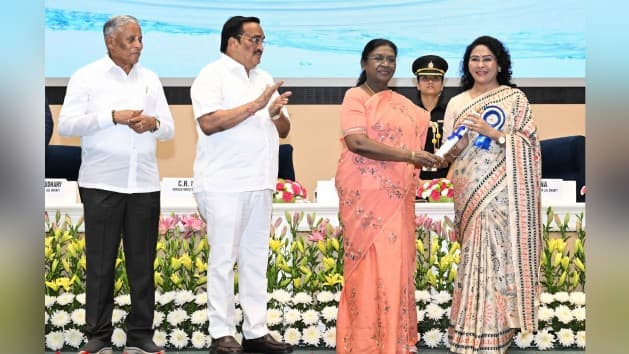
New Delhi, Nov 18: President Droupadi Murmu presented the sixth National Water Awards and Jal Sanchay-Jan Bhagidari Awards at a ceremony in New Delhi on Tuesday. The awards recognize outstanding contributions to water conservation, efficient usage, and community-driven initiatives across the country.
Water as the Foundation of Civilization
Speaking on the occasion, the President highlighted that the story of human civilization is deeply linked to rivers, lakes, and water sources. She reminded the audience that in India’s national song, Bankim Chandra Chatterjee began with the word Sujalam, symbolizing the abundance of water resources. This, she said, reflects the priority of water in India’s cultural and national identity.

📱 Get Argus News App
✨
Challenges of Water Availability
President Murmu emphasized that efficient water use is a
global necessity, especially for India where water resources are limited
compared to the population. She noted that per capita water availability
remains a major challenge, further complicated by climate change disrupting the
water cycle. She urged both government and citizens to work together to ensure
water security.
Also Read: President Murmu to Address Odisha Assembly on Nov 27
Achievements Under Jal Sanchay-Jan Bhagidari
The President expressed satisfaction that under the Jal Sanchay-Jan Bhagidari initiative, launched last year, over 35 lakh groundwater recharge structures have already been built. She praised industries adopting circular water economy systems, water treatment, and recirculation, with many achieving zero liquid discharge targets.
Collective Responsibility
Murmu stressed that water conservation must be prioritized at every level—central and state governments, district administrations, village panchayats, and municipal bodies. She acknowledged the role of educational institutions, NGOs, and citizen groups in spreading awareness. Farmers and entrepreneurs were advised to adopt innovative methods to maximize production while minimizing water use.
The President concluded by reminding citizens that water is a precious asset and must be treated with respect. Tribal communities, she noted, exemplify reverence for natural resources. Effective water management, she said, is only possible through collective participation of individuals, families, society, and government.
Related Topics
Explore more stories