



Pakistan's J-35 Stealth Fighter with LD-8A Missiles Could Challenge India's S-400 Air Defence Shield| Defence Update
Key Points
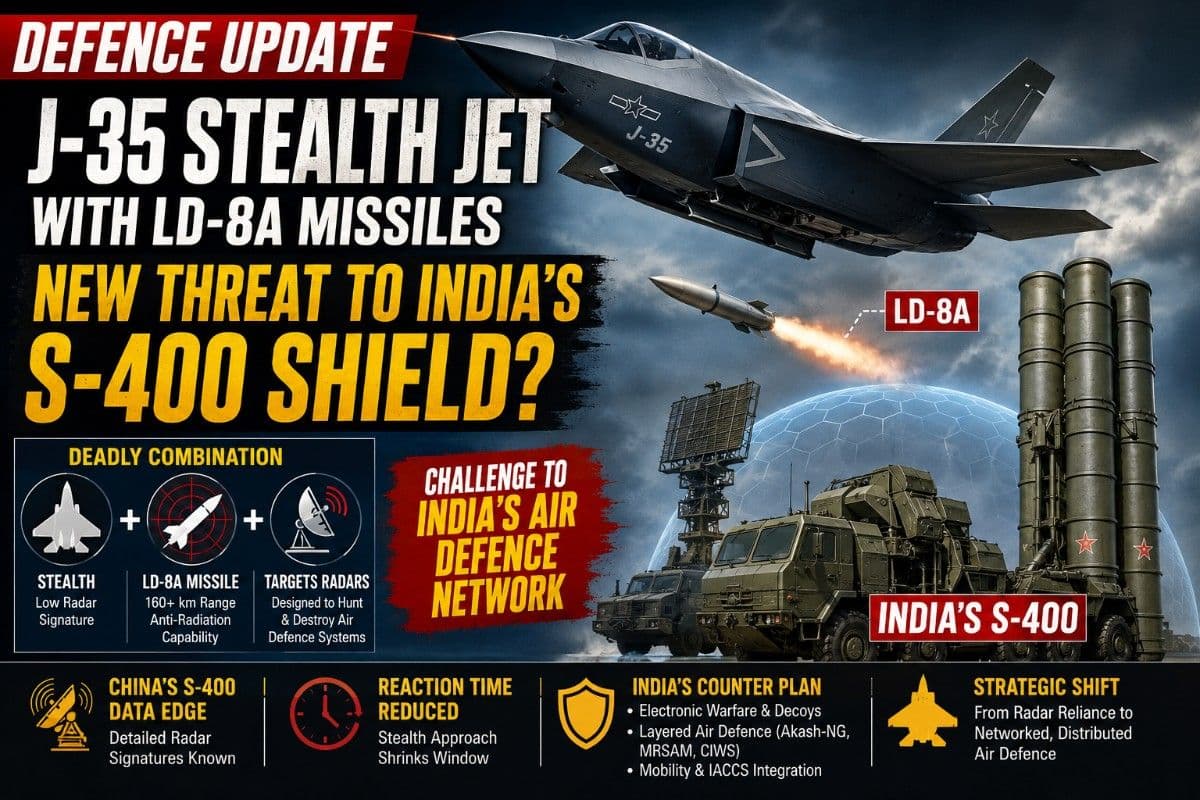
* Because China operates the S-400, its engineers likely possess the precise electronic signatures needed to program the LD-8A missile to efficiently home in on India's radars.
* India plans to neutralize this SEAD threat using a distributed network of passive sensors, radar decoys, and short-to-medium-range interception systems like Akash-NG and MRSAM.
Bhubaneswar: Pakistan's possible acquisition of China's J-35 stealth fighter armed with LD-8A anti-radiation missiles (ARMs) could significantly alter the air combat balance in South Asia, especially by posing a new threat to India's advanced S-400 air defence system.
Why the J-35-LD-8A Combination Matters
The J-35 is China's latest fifth-generation stealth fighter designed to evade radar detection. Unlike conventional fighters that carry missiles externally, the J-35 can carry the LD-8A missile inside its internal weapons bay, helping it maintain a low radar signature until weapon release, suggest latest defense reports.
The LD-8A is an anti-radiation missile reportedly capable of striking targets beyond 160 km. It is specifically designed to detect and destroy enemy radar systems.

📱 Get Argus News App
✨Key features include:
- Passive seeker that homes in on radar emissions.
- Ability to track air defence radars such as those used by the S-400.
- INS and satellite-guided navigation, allowing the missile to continue toward a target even if the radar is switched off after detection.
- Capability to exploit brief radar emissions, making traditional radar shutdown tactics less effective.
Could India's S-400 Be Vulnerable?
India's S-400 remains one of the world's most capable long-range air defence systems. However, military analysts note that stealth aircraft equipped with dedicated anti-radiation missiles create a unique challenge.
A major concern stems from the fact that China itself operates S-400 systems. This means Chinese engineers have detailed knowledge of the electronic signatures and operating characteristics of key S-400 radars, including:
- 91N6E "Big Bird" surveillance radar.
- 92N6E "Grave Stone" engagement radar.
If such data is incorporated into the LD-8A's threat library, the missile could potentially identify and target S-400 radar emissions more efficiently.
Another challenge is the reduced detection range against stealth aircraft. A J-35 could potentially approach much closer to an S-400 battery before being detected, shrinking the reaction time available to Indian operators.
India's Likely Countermeasures
Defence experts believe India is unlikely to rely solely on the S-400 for protection. Instead, it is expected to employ a layered and network-centric defence strategy.
Key measures could include:
Advanced Electronic Warfare
- Use of passive sensors and distributed radar networks.
- Strict emission control to reduce radar exposure.
- Deployment of radar decoys designed to attract incoming anti-radiation missiles.
Layered Air Defence
- Protection of S-400 batteries by systems such as Akash-NG and MRSAM (Barak-8).
- Interception of incoming anti-radiation missiles before they reach their targets.
- Integration of close-in defence guns for terminal protection.
Mobility and Networking
- Frequent relocation of S-400 batteries after operations.
- Deep integration with the Indian Air Force's Integrated Air Command and Control System (IACCS).
- Use of airborne early warning platforms such as Netra and Phalcon AWACS to detect threats without exposing ground radars.
Strategic Implications
The possible induction of J-35 stealth fighters and LD-8A missiles into the Pakistan Air Force would represent one of the most significant enhancements to Pakistan's SEAD (Suppression of Enemy Air Defences) capability.
While the combination could complicate operations for radar-dependent air defence systems, experts note that modern air warfare increasingly relies on sensor fusion, networking, mobility and layered defence rather than any single weapon system.
The emerging threat is also expected to accelerate India's efforts in indigenous stealth aircraft development, including the proposed Advanced Medium Combat Aircraft (AMCA), while pushing the country's air-defence architecture toward more distributed and resilient operations.
Bottom Line: The J-35-LD-8A combination could create a credible challenge for high-value radar assets, including the S-400. However, India's multi-layered air defence network, electronic warfare capabilities and integrated command systems are designed to ensure that no single platform becomes a decisive game-changer on the battlefield.
Related Topics
Explore more stories