



India Narco Terror / Operation RAGEPILL: How India’s First Captagon Bust Signals a New Narco-Terror Transit Threat
Key Points
Bhubaneswar: In what appears at first glance to be a routine drug interdiction, Operation RAGEPILL may, in fact, be a far more consequential national security moment.
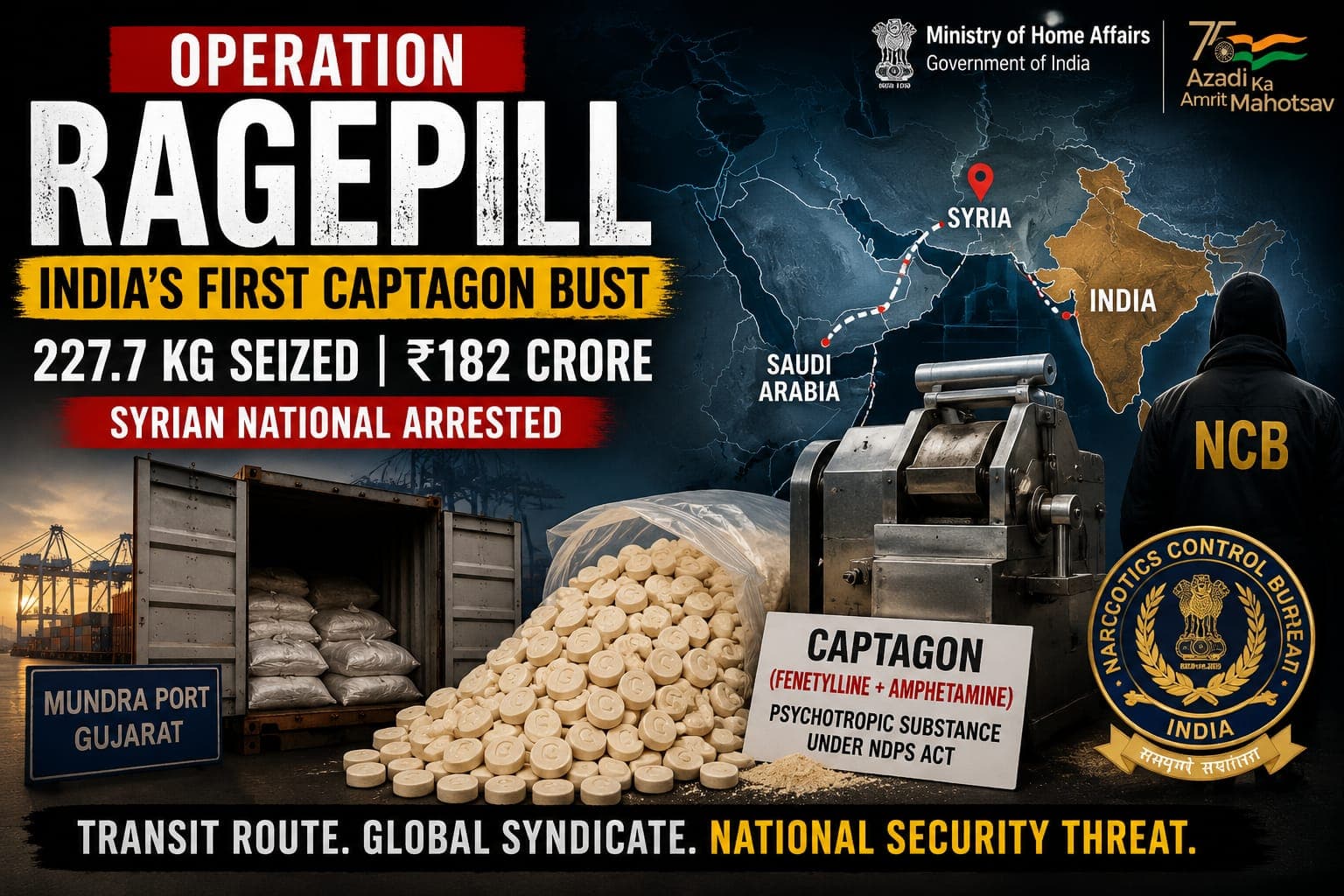
The seizure of 227.7 kg of Captagon—valued at Rs182 crore—and the arrest of a Syrian national have exposed something deeper: India’s emerging vulnerability as a transit corridor in a global narco-terror supply chain.
At the centre of this operation is the Narcotics Control Bureau, acting on foreign intelligence inputs—an important detail that underscores how India is now plugged into real-time international narcotics surveillance grids. But it also raises a troubling counterpoint: global syndicates now see India not just as a market, but as a logistics hub.
Drug That Changes the Stakes

📱 Get Argus News App
✨Captagon is not just another psychotropic substance. Often referred to in security circles as the “jihadi drug,” it has been widely reported to fuel conflict economies in West Asia. Its composition—primarily fenetylline and amphetamine—makes it a stimulant capable of enhancing endurance and suppressing fear.
This is where the story crosses from crime into national security.
The interception of a consignment headed for Saudi Arabia, routed through India, suggests that terror-linked or conflict-linked narcotics economies are experimenting with Indian routes. Unlike heroin or cocaine, Captagon’s geopolitical footprint is deeply tied to war zones, militia financing, and shadow economies.
When Union Home Minister Amit Shah publicly labels it a “jihadi drug,” it is not mere rhetoric—it is a signal that the state views this seizure through a security prism, not just a law enforcement one.
India: From Destination to Transit Node?
The facts of the case are telling:
· A chapati-making machine used to conceal 31.5 kg of tablets in Delhi
· A container shipment from Syria via Mundra port masking 196.2 kg of powder as sheep wool
· A foreign national overstaying visa, embedded within the logistics chain
Individually, these may seem like clever concealment tactics. Collectively, they indicate a structured, multi-layered transnational operation.
This is not opportunistic smuggling. This is supply chain engineering.
The use of containerized cargo—also seen recently in a 349 kg cocaine seizure in Mumbai—points to a shift in trafficking patterns. Syndicates are increasingly leveraging legitimate trade infrastructure, making detection harder and raising the stakes for port security and customs intelligence.
The Hawala–Logistics–Terror Nexus
What makes Operation RAGEPILL particularly significant is the ongoing probe into hawala linkages and financial trails.
Drug trafficking at this scale rarely operates in isolation. It intersects with:
· Illicit financial networks (hawala)
· Shell trade entities
· Diaspora-linked facilitators
· Potentially, extremist financing channels
If even a fraction of the Rs182 crore valuation feeds into destabilizing networks abroad, India’s role—wittingly or unwittingly—becomes strategically sensitive.
This is where the investigation could widen into narco-terrorism mapping, a domain where drug money fuels armed conflict and ideological extremism.
Foreign Intelligence Input: A Double-Edged Signal
The operation was triggered by intelligence from a foreign drug enforcement agency. While this highlights growing cooperation, it also implies that external actors identified India as a weak link in the chain before domestic interception occurred.
That is both reassuring and cautionary.
Reassuring—because intelligence-sharing worked.
Cautionary—because it suggests India is now on the radar of global trafficking cartels as a viable transit geography.
Policy Optics vs Ground Reality
Under the leadership of Prime Minister Narendra Modi, the government has repeatedly emphasized a “zero tolerance” policy on drugs. Operation RAGEPILL will be projected as validation of that stance.
But the deeper question is structural:
· Are Indian ports equipped with next-gen scanning and AI-based cargo profiling?
· Is there sufficient integration between immigration, customs, and narcotics intelligence databases?
· Can India track synthetic drug flows, which are far more complex than traditional narcotics?
Because Captagon is not cultivated—it is manufactured, often in conflict zones, making its supply chains harder to disrupt.
The Strategic Takeaway
Operation RAGEPILL is not just a successful seizure—it is a strategic warning.
India is no longer peripheral to global narcotics routes. It is becoming embedded within them.
And when the drug in question is tied to volatile regions like West Asia, the implications go beyond public health or crime—they touch upon:
· Geopolitical alignments
· Internal security vulnerabilities
· Financial integrity systems
The bust may have prevented Rs182 crore worth of contraband from reaching its destination. But more importantly, it has exposed a new axis of threat—where drugs, money, and geopolitics intersect on Indian soil.
The investigation now underway will determine whether this was an isolated breach—or the tip of a much larger, deeply entrenched network.
Either way,
Operation RAGEPILL has drawn a new red circle on India’s national security map.
Related Topics
Explore more stories