



Justice Yashwant Varma Case: Why a Locked Liquor Cabinet Is the Smoking Gun in Lok Sabha Inquiry Committee Report | Special Story
Key Points
Bhubaneswar: It seems the law has caught up. Justice Yashwant Varma, who spent his career mastering the technicalities of law, deployed almost every legal escape route available to him when the cash-at-home allegations closed in.
But the Judges Inquiry Committee report tabled in the Lok Sabha has methodically dismantled those defences.
The Inquiry Committee was led by SC Justice Aravind Kumar, and the members included the then Bombay HC Chief Justice and current SC judge Justice Chandra Sekhar and senior advocate BV Acharya.
The most consequential was his decision to withdraw from the proceedings on April 9, 2026, after the prosecution side had completed its evidence and cross-examinations and just as his defence was to begin.

📱 Get Argus News App
✨His 13-page withdrawal letter accused the committee of procedural unfairness, questioned the dropping of 22 of the 31 cited witnesses and alleged that the burden of proof had effectively been reversed.
The committee, however, treated the withdrawal not as a procedural knockout but as a moment when Justice Varma declined to confront the evidence against him.
The Delhi Police Alibi: A Lapse, But Not a Lifeline
Justice Varma's defence had one particularly potent technical point: the conduct of the first responders. His case was that the Delhi Police and fire officials did not formally seize, inventory or record the currency allegedly seen after the fire. His withdrawal letter specifically pointed to evidence that senior Delhi Police officers had decided not to record or seize the cash in accordance with the normal procedure. The Delhi Fire Services report, too, did not mention currency. Those omissions became the foundation for his argument that the cash narrative was evidentially defective.
The committee did not entirely whitewash the authorities. The failure to immediately secure and document the scene was a serious evidentiary lapse. But it did not accept the leap that an imperfect police response meant that the underlying discovery of cash could simply be erased. The panel had before it eyewitness accounts, photographs, videos and other material concerning burnt and half-burnt currency. In other words, the Delhi Police lapse could weaken the chain of custody; it could not by itself explain away the existence of the cash.
Then Came the Locked Liquor Cabinet
This is where the case turned dramatically against Justice Varma.
The storeroom was central to his defence because he maintained that it was detached from the principal residential structure and was accessible to outsiders. If that proposition had held, the conspiracy theory – that somebody could have entered the room, planted cash and engineered the circumstances surrounding the fire – would have retained a crucial foothold.
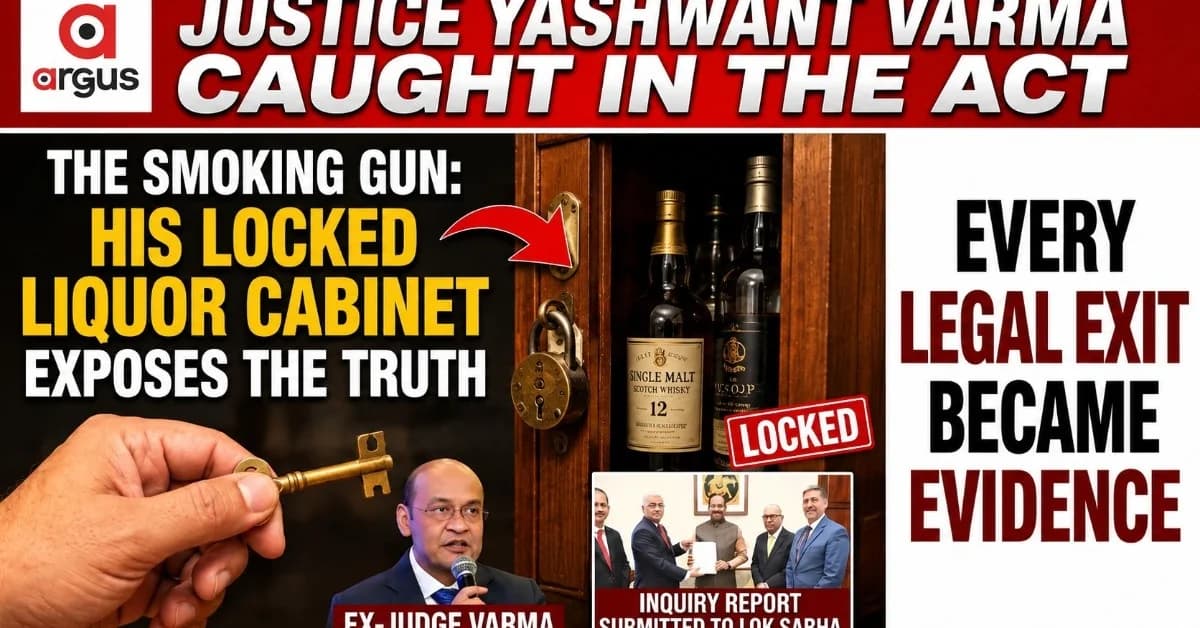
But the committee found something inside the room that transformed the argument over physical access into one of effective control: a liquor cabinet belonging to the household, which was kept locked. More significantly, Justice Varma acknowledged that the key to that cabinet was in his exclusive possession. The committee therefore had a physical object inside the supposedly detached and uncontrolled storeroom directly connecting the room to the household's use and control.
That detail matters enormously. The question was no longer merely whether the storeroom was structurally detached from the main house. It was whether Justice Varma and his family exercised control over it. The committee's reasoning was that the locked cabinet, its key and the household's use of the room were powerful evidence against the proposition that the storeroom was an uncontrolled utility structure to which anybody could freely gain access.
And this is precisely why the liquor cabinet became the smoking gun. Without that piece of evidence, Justice Varma could have continued to argue that the room was outside the effective control of his official residence and therefore that the presence of cash could not fairly be attributed to him. With it, the committee could bridge the gap between physical architecture and legal responsibility.
From 'Planting' Theory To A Missing FIR
Justice Varma's second major line of defence was conspiracy: that the cash could have been planted during the confusion surrounding the fire. But the committee found a striking weakness in that theory – the absence of any contemporaneous formal complaint by the judge alleging that somebody had planted the currency or tampered with the scene.
The committee also relied on the evidence of people who were present at the residence and the material captured by first responders. Earlier findings had recorded that Justice Varma's private secretary Rajinder Singh Karki and household staff member Mohd Rahil were involved in activities around the storeroom after the fire. The panel also noted contradictions in the accounts given by people associated with the household.
The evidentiary picture therefore became more complicated for the conspiracy defence: if an elaborate plot had been engineered to frame a sitting High Court judge, where was the contemporaneous complaint identifying the alleged conspirators, the planted cash or the tampering?
The 'Blameless Outsider' Defence Also Collapsed
Justice Varma's defence also sought to place responsibility for preservation of the scene squarely on the emergency responders. But the committee's account of what happened after the fire shifted the focus back inside the residence.
The panel found evidence that Karki and Rahil were involved in cleaning activities after the fire tenders had left, with the report examining whether burnt currency was removed during this period. Earlier inquiry findings also pointed to the disappearance of CCTV footage from the relevant period.
This did not make Delhi Police's handling of the scene any less questionable. Rather, it created two separate accountability questions: why did the authorities fail to preserve and document the evidence, and why was material allegedly removed or disturbed after the emergency response?
For the committee, the second question could not simply be answered by blaming the first.
The Final Trap: Institutional Conspiracy
The most striking feature of the report is therefore not any single piece of evidence but the way the committee connected apparently separate weaknesses in Justice Varma's defence.
His argument began with lack of knowledge of the cash. It moved to the detached-storeroom theory. It then advanced to the possibility of planting and conspiracy. Finally, it challenged the procedure adopted by the inquiry committee itself.
But each defence ran into another piece of evidence.
The storeroom was not simply an anonymous outbuilding: it was within the premises occupied by the judge and his family. The liquor cabinet established a concrete connection with household control. The cash itself was documented through photographs, videos and eyewitness accounts. The committee found that the judge failed to provide a plausible account of its source. And the conspiracy theory was not backed, in the committee's assessment, by corresponding legal action or convincing evidence.
The panel's earlier findings had described the room as being under the "covert" and "active" control of Justice Varma and his family, while rejecting the argument that an outsider could simply have entered and planted the cash.
BOTTOMLINE: When Every Legal Exit Became Evidence
The irony of the Justice Yashwant Varma case is that the very technical arguments deployed to create reasonable doubt ultimately became the route through which the committee examined his conduct more closely.
The Delhi Police lapse was real, and significant. The decision not to record or seize the cash immediately created an evidentiary vulnerability that Justice Varma was entitled to highlight. His objections over the selective examination of witnesses and the use of preliminary inquiry material also raised serious questions about procedure.
But the committee's answer was essentially this: procedural shortcomings in the response to the fire did not explain away the cash, nor did they establish the conspiracy alleged by Justice Varma.
Then came the locked liquor cabinet.
A cabinet that required a key. A key that, according to the evidence cited in the inquiry, was exclusively with Justice Varma. And a cabinet located inside the very room that his defence sought to portray as detached, uncontrolled and accessible to outsiders.
That small physical detail became disproportionately important because it attacked the foundation of the larger defence.
The report's larger indictment is consequently about more than whether cash was found after a fire. It is about institutional responsibility – who controlled the room, who entered it, what happened after the fire, why evidence was not preserved, why CCTV material disappeared, why household accounts allegedly contradicted the electronic evidence, and why the judge, despite alleging a conspiracy of such magnitude, did not pursue a contemporaneous formal complaint.
Justice Varma resigned and withdrew before presenting his defence in full. The committee nevertheless proceeded to assess the evidence and has now placed its findings before Parliament.
The
constitutional irony is stark: the attempt to build a legal citadel around
technical lapses could not withstand the physical evidence from inside the room
itself. And in that citadel, the locked liquor cabinet seems to have proved to
be the smallest object with the biggest evidentiary weight.
Also Read: Supreme Court / Sabarimala Case SC: “Every religion will break and every constitutional court have to be closed if court begins questioning every ritual”
Related Topics
Explore more stories