



INS Malvan Profile: India's Silent Hunter Joins Fleet: Why Mahe-Class Warship Could Become Indian Navy's Biggest Coastal Advantage Against Chinese Submarines
Key Points
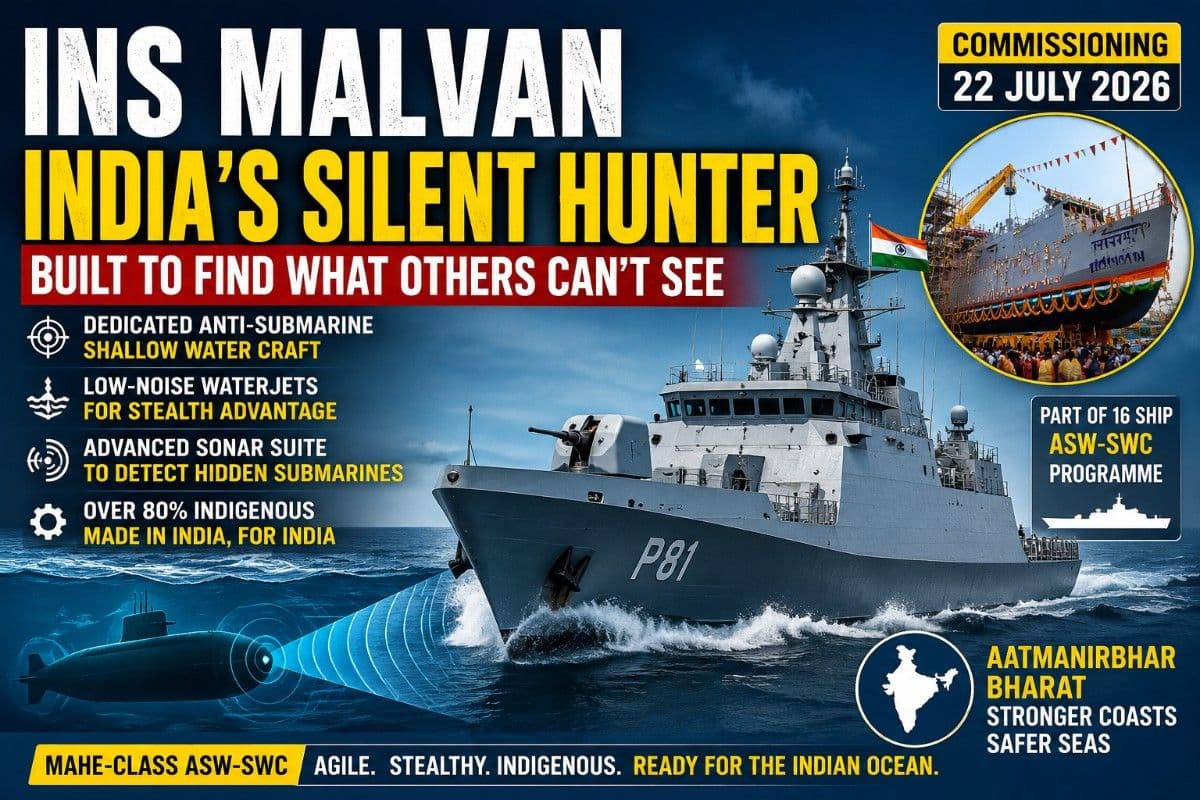
Bhubaneswar: On July 22, the Indian Navy will commission INS Malvan, the second vessel of the indigenous Mahe-class Anti-Submarine Warfare Shallow Water Craft (ASW-SWC), marking another milestone in India's quest to dominate one of the most challenging battle spaces in modern naval warfare—the shallow coastal waters.
While aircraft carriers and destroyers dominate headlines, it is compact warships like INS Malvan that could determine the outcome of future conflicts in the Indian Ocean, where stealthy submarines increasingly threaten ports, shipping lanes and strategic chokepoints.
Built by Cochin Shipyard Limited with over 80 per cent indigenous content, INS Malvan represents much more than another naval induction. It signals India's shift from operating imported coastal defence platforms to fielding a new generation of home-grown submarine hunters tailored for the country's unique maritime geography.
Why INS Malvan Matters

📱 Get Argus News App
✨The Indian Ocean Region is witnessing an unprecedented rise in submarine deployments.
China's People's Liberation Army Navy has steadily expanded its submarine presence, while Pakistan continues to modernise its underwater fleet. Unlike large warships that are optimised for blue-water operations, submarines often exploit shallow coastal waters where commercial traffic, uneven seabeds and thermal layers make detection extremely difficult.
This is precisely where INS Malvan has been designed to excel.
Instead of chasing enemy fleets across oceans, the vessel's mission is far more specialised – finding hostile submarines before they threaten India's coastline, naval bases, offshore energy assets or merchant shipping.
Defence planners describe such platforms as the Navy's "silent hunters" because they are built to detect submarines without revealing their own position.
Filling a Critical Capability Gap
For decades, the Indian Navy depended on the ageing Soviet-era Abhay-class corvettes, commissioned during the late 1980s.
Although reliable in their time, these ships lacked modern sonar systems, advanced underwater sensors and low-noise propulsion technologies required against today's ultra-quiet submarines.
The Mahe class changes that equation completely.
INS Malvan combines indigenous combat management systems with next-generation hull-mounted sonar and low-frequency variable-depth sonar capable of detecting submarines hiding beneath thermal layers – a tactic increasingly employed by modern diesel-electric submarines.
The result is a dramatic leap in India's coastal anti-submarine warfare capability.
A Different Philosophy from China
The closest international comparison comes from China's Type 056A Jiangdao-class corvette, which has been deployed extensively across the South China Sea.
On paper, the Chinese vessel appears more heavily armed.
It is nearly 600 tonnes heavier, carries anti-ship missiles and surface-to-air missiles, making it a versatile multi-role combatant.
INS Malvan follows an entirely different philosophy.
Instead of becoming a jack-of-all-trades, India has chosen to build a dedicated anti-submarine platform.
The ship sacrifices heavy missile systems in favour of specialised underwater warfare equipment, enhanced manoeuvrability and reduced acoustic signatures.
That makes it a focused predator rather than a general-purpose combat ship.
The Waterjet Advantage
Perhaps the biggest technological leap lies beneath the hull.
Unlike conventional naval vessels that rely on propeller shafts, INS Malvan employs three diesel-powered waterjet propulsors.
This offers two major operational advantages.
First, waterjets generate significantly less cavitation noise, making the ship much quieter while hunting submarines.
Second, they provide exceptional agility in confined coastal waters where quick manoeuvres often determine tactical success.
In anti-submarine warfare, silence can be as valuable as firepower.
The quieter a hunter remains, the better its chances of detecting enemy submarines before being detected itself.
Built for India's Coastline
India possesses a coastline stretching over 7,500 kilometres, dotted with naval bases, commercial ports, offshore energy installations and busy shipping routes.
Large destroyers and frigates cannot efficiently patrol every shallow coastal sector.
INS Malvan fills that operational gap.
With a displacement of about 900 tonnes, a length of 78 metres, a speed of 25 knots and an operational range exceeding 1,800 nautical miles, the vessel is designed for sustained patrols in littoral waters.
Its primary arsenal includes lightweight torpedoes, anti-submarine rockets and indigenous sonar systems specifically configured for shallow-water detection.
Aatmanirbhar Bharat at Sea
Beyond its combat capability, INS Malvan showcases India's expanding defence manufacturing ecosystem.
With over 80 per cent indigenous content, the ship has been designed and constructed domestically, significantly reducing dependence on foreign technology and imported spare parts.
Its combat systems, sensors and integration reflect the growing maturity of India's naval industrial base.
The programme also strengthens Cochin Shipyard Limited's role as one of India's premier warship builders while supporting hundreds of domestic suppliers involved in indigenous defence manufacturing.
Part of a Larger Fleet
INS Malvan is only the second vessel in an ambitious programme that envisages 16 Anti-Submarine Warfare Shallow Water Craft for the Indian Navy.
The fleet is being built across two shipyards.
Eight Mahe-class vessels are under construction at Cochin Shipyard Limited, while another eight Arnala-class ships are being built by Garden Reach Shipbuilders & Engineers (GRSE).
The lead ship, INS Mahe, entered service in November 2025, while subsequent vessels – including Mangrol, Malpe and Mulki – are progressing through various stages of construction and sea trials.
Together, they will gradually replace the ageing Abhay-class fleet and create a dedicated coastal anti-submarine force.
Joint Warfare Signal
The commissioning ceremony carries symbolic significance beyond the induction itself.
The event will be presided over by Air Chief Marshal A.P. Singh, Chief of the Air Staff, alongside senior naval leadership.
His presence underscores India's growing emphasis on joint theatre operations, where naval assets, maritime patrol aircraft, helicopters and air surveillance networks operate as an integrated force to counter underwater threats.
The Bigger Picture
INS Malvan is not India's largest warship.
Nor is it its most heavily armed.
Its importance lies elsewhere.
As submarine activity intensifies across the Indian Ocean Region, the future of maritime security may depend less on massive aircraft carriers and more on specialised platforms capable of quietly securing India's coastal approaches.
In that sense, INS Malvan represents the Indian Navy's transition from legacy coastal defence to networked, indigenous and technology-intensive undersea warfare.
It is a compact vessel built for one purpose –finding what cannot be seen.
And in
modern naval warfare, that capability may prove more decisive than sheer size
or firepower.
Also Read: ₹250 vs ₹1,000: India Prepares 'Iron Dome' Style Laser Shield for 18 Punjab & J&K Border Assets; DRDO's DURGA II in Focus| Special Story
Related Topics
Explore more stories