



Viksit Bharat / India Must Aim For Affordable And Sustainable Energy Security: Vice Chairman NITI Aayog
Key Points
India’s energy strategy focuses on scaling solar, hydrogen, and renewables while balancing climate goals with affordability.
Global partnerships and initiatives like the International Solar Alliance and Global Biofuels Alliance reinforce India’s leadership in sustainable energy.
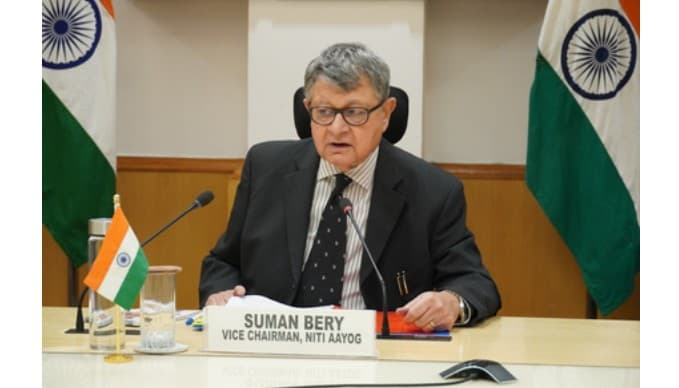
New Delhi, Nov 13: NITI Aayog Vice Chairman Suman Bery said on Thursday that India’s vision of Viksit Bharat goes beyond economic expansion to building a developed and inclusive society anchored in affordable and sustainable energy.
Speaking at CII’s energy security conference, Bery said,
“Energy security is not just about ensuring supply, it is about affordability,
diversification, and resilience. The future will not be about breakthrough
technologies, but about existing technologies breaking through at scale, solar,
hydrogen, and renewables made affordable and accessible.”
He further stated that the structure of India’s energy
market, particularly in hydrocarbons, “needs careful rethinking” as a balanced
mix of public and private participation will be critical to achieving energy
efficiency, resilience, and innovation.
He underscored that India’s commitment to global climate
goals stems from conviction, not compulsion, and highlighted the need to
balance environmental aspirations with domestic affordability and industrial
competitiveness.
Also Read: Odisha Gears Up To Host Global Energy Leaders’ Summit From December 5 to 7; Spotlight on Green Hydrogen

📱 Get Argus News App
✨Bery observed that energy security today is both a diplomatic and structural challenge. “In a world where energy markets have become unpredictable, energy security also means ensuring that the actions of others do not limit our choices,” he said.
The NITI Aayog vice chairman further stated that the
government has achieved remarkable success in expanding electricity access, but
energy affordability must remain central to avoid getting trapped in a
high-cost energy system.
“National security and resource security in the late 2000s
highlighted that owning resources abroad does not necessarily guarantee energy
security.”
India should focus on diversification of supply sources, of
technologies and of ownership models to ensure resilience, he observed.
He added that energy security must not be viewed narrowly as
supply assurance, but as an integrated policy framework that safeguards both
the economy and consumers from volatility, geopolitical disruptions and rising
system costs.
“The real test of our energy system will be whether we can
build scale in new technologies without creating price barriers for growth,” he
concluded.
Piyush Gangadhar, joint secretary, Ministry of External
Affairs, spoke on the global dimensions of energy security and the complex
interplay between geopolitics, trade, and technology. The key question is how
to ensure energy security in an unpredictable world, he said.
Gangadhar highlighted that new trade measures and evolving
policy frameworks, such as the EU Carbon Border Adjustment Mechanism (CBAM),
are reshaping global energy markets and influencing investment patterns.
“India’s approach to energy security is multi-pronged,
combining diversification of supply sources, strategic investments, and global
partnerships,” he said.
“We have built new supply ties with the US, Africa, and
Latin America, while continuing to pursue innovative means to secure critical
inputs and resources.”
He underlined that self-reliance in the energy sector must
be built on openness, cooperation, and strategic foresight.
“India’s leadership in initiatives such as the International
Solar Alliance, the Global Biofuels Alliance, and new supply-chain partnerships
under frameworks like the Quad demonstrates our commitment to sustainable
growth and global collaboration,” he observed.
He added that India is also seeking full membership of the
International Energy Agency (IEA) to strengthen its role in shaping the global
discourse on energy markets.
--IANS
Related Topics
Explore more stories