



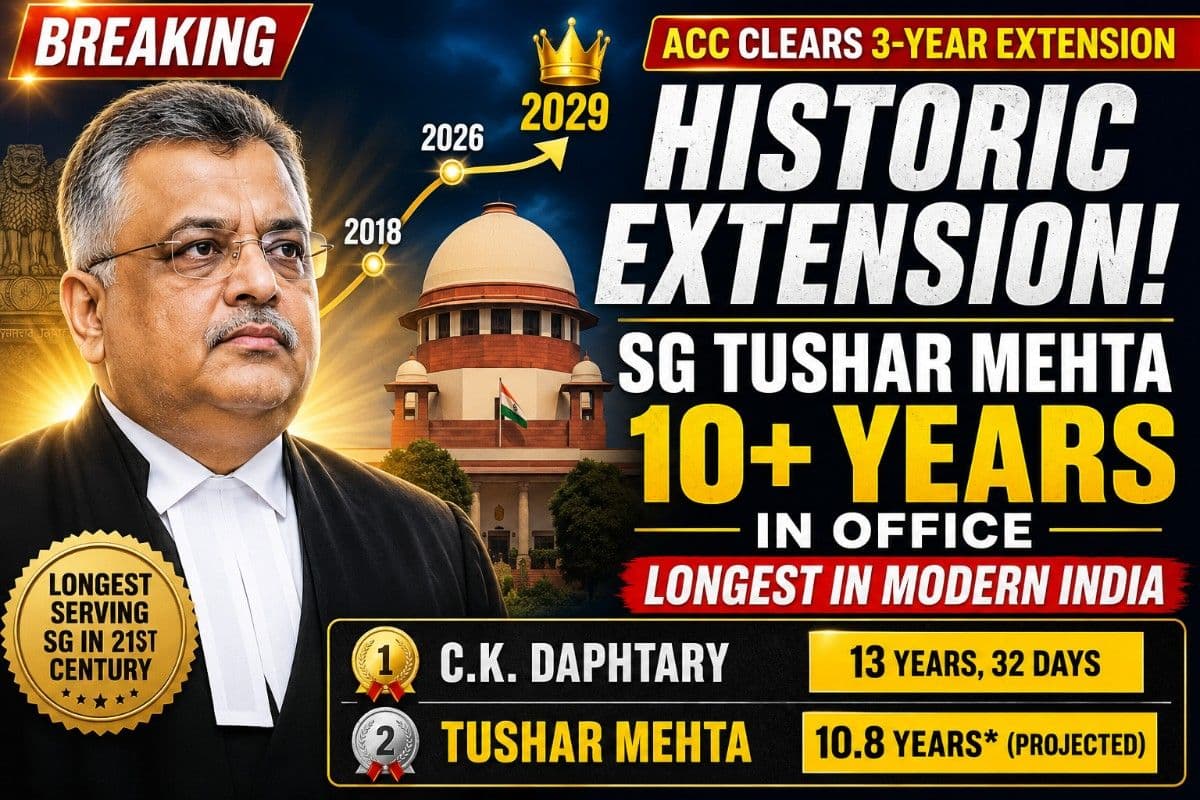
Historic Three-Year Extension To SG Tushar Mehta Makes him Longest-Serving Solicitor General in Modern India| Breaking
Key Points
* As the Centre's ultimate legal troubleshooter, Mehta has anchored landmark constitutional defenses, including the abrogation of Article 370, the Rafale jet controversy, and the structural defense of the PMLA for the ED.
* Alongside Mehta, the ACC cleared key extensions for five Supreme Court ASGs (including Vikramjit Banerjee and KM Nataraj) and a six-month extension for Delhi HC ASG Chetan Sharma to maintain absolute institutional stability.
Bhubaneswar: In a historic move that reshapes the institutional memory of India’s top law offices, the Appointments Committee of the Cabinet (ACC) has cleared a fresh three-year extension for Senior Advocate Tushar Mehta as the Solicitor General for India (SG).
Taking effect from July 1, 2026, this extension elevates Mehta’s tenure into uncharted territory for modern Indian jurisprudence. First appointed on October 10, 2018, Mehta has already crossed seven and a half years in office. With this new term projected to run until June 30, 2029, his total time in office will exceed 10 years and 8 months – making him the longest-serving Solicitor General in the 21st century and the second longest-serving in the nation's history since Independence.
Chasing History: The Elite Law Officers Table
The position of Solicitor General has historically been a revolving door, prone to political shifts, administrative reshuffles, or elevations to the Supreme Court bench. Only five individuals in India's history have ever crossed the four-year threshold.

📱 Get Argus News App
✨Here is where Mehta stands in the all-time hierarchy.
|
Rank |
Solicitor General |
Tenure Start |
Tenure End |
Total Time Served |
Prime Minister(s) Served
1
Chander Kishan Daphtary
January 28, 1950
March 1, 1963
13 years, 32 days
Jawaharlal Nehru
2
Tushar Mehta
October 10, 2018
Incumbent
7 years, 254 days (as of June 2026)
Narendra Modi
3
Dipankar P. Gupta
April 9, 1992
April 10, 1997
5 years, 1 day
P.V. Narasimha Rao, H.D. Deve Gowda
4
Goolam E. Vahanvati
June 20, 2004
June 7, 2009
4 years, 352 days
Manmohan Singh
5
Lal Narayan Sinha
July 17, 1972
April 5, 1977
4 years, 262 days
Indira Gandhi
The Historical Pivot: While C.K. Daphtary’s 13-year record reflects the foundational, post-independence era of a single continuous government, Mehta’s decade-long runway represents an unprecedented run of institutional stability in the highly adversarial, fast-paced world of modern constitutional litigation.
Why the "Mehta Era" Matters
Mehta’s historic longevity is not merely a statistical milestone; it carries profound significance for the operational mechanics of the Indian state before the judiciary.
1. The Anchor of Constitutional Continuity
Over his tenure, the Central Government has executed some of its most controversial and legally complex policy maneuvers – most notably the abrogation of Article 370, the management of Rohingya immigration challenges, and the defense of the Rafale jet acquisition. By retaining Mehta, the executive ensures that its legal shield possesses an unmatched, granular memory of these tectonic structural changes. He does not just read the briefs; he helped shape the state's jurisprudence around them.
2. The Architect of Regulatory Enforcement
Perhaps Mehta's most significant institutional footprint has been his role as the frontline strategist for the Enforcement Directorate (ED). He successfully anchored the state’s multi-year legislative and courtroom defense of the Prevention of Money Laundering Act (PMLA). Facing down legal giants like P. Chidambaram in the INX Media case, Mehta effectively institutionalized the Centre's aggressive anti-graft and white-collar enforcement architecture in the Supreme Court.
3. Complete Alignment of the State's Legal Machinery
Mehta’s journey from a powerhouse civil and criminal practitioner in the Gujarat High Court (designated Senior Advocate in 2007; Advocate General in 2008) to New Delhi in 2014 as an Additional Solicitor General underscore a rare trajectory of absolute political and executive trust. Shifting his base to the capital alongside then-AG Mukul Rohatgi and SG Ranjit Kumar, Mehta outlasted his peers by becoming the ultimate "troubleshooter" for Prime Minister Narendra Modi's administration. His retention signals that the Centre values absolute predictability and battle-tested stamina over institutional rotation.
Continuity Across the Board
To support Mehta's historic third full term, the ACC has simultaneously cleared extensions for six key law officers, reinforcing a battle-hardened legal frontline.
Supreme Court Core Lineup (Three-Year Extensions)
- Vikramjit Banerjee (ASG): Originally appointed on March 5, 2018, his fresh three-year term kicks off on July 1, 2026.
- K.M. Nataraj (ASG): A vital institutional player since January 14, 2019, his renewal takes effect from July 1, 2026.
- Suryaprakash V. Raju (ASG): The Centre's premier hand for high-stakes criminal trials and regulatory enforcement matters, his fresh term begins June 30, 2026.
- N. Venkataraman (ASG): The designated specialist for complex commercial, tax, and corporate policy litigations, renewed with effect from June 30, 2026.
- Aishwarya Bhati (ASG): Consistently anchoring complex social, environmental, and administrative matters for the Union, her fresh term begins June 30, 2026.
Delhi High Court Frontline
- Chetan Sharma (ASG): First appointed to lead the Centre's litigation wing at the Delhi High Court on July 1, 2020, Sharma has been granted a strategic six-month extension starting July 1, 2026, keeping him on the frontlines of critical national security and IT Act challenges currently brewing in the capital's high court.
Related Topics
Explore more stories