



Explained: What is a Smart Warehouse and How Does It Benefit the Common Man?
Key Points
Bhubaneswar: Initiating a major step toward modernising the foodgrain storage network in the country, the Ministry of Consumer Affairs, Food and Public Distribution launches the Smart Warehousing System, an Artificial Intelligence (AI) and Internet of Things (IoT)-powered platform designed to make grain storage safer, more efficient and more transparent.
The Department of Food and Public Distribution (DFPD) Thursday rolled out the system across 215 warehouses of the Central Warehousing Corporation (CWC) and another 150 warehouses of the Food Corporation of India (FCI), making it the world's largest deployment of AI and IoT technologies in public-sector foodgrain storage.
But what exactly is a Smart Warehouse, and why should ordinary citizens care?
What is a Smart Warehouse?

📱 Get Argus News App
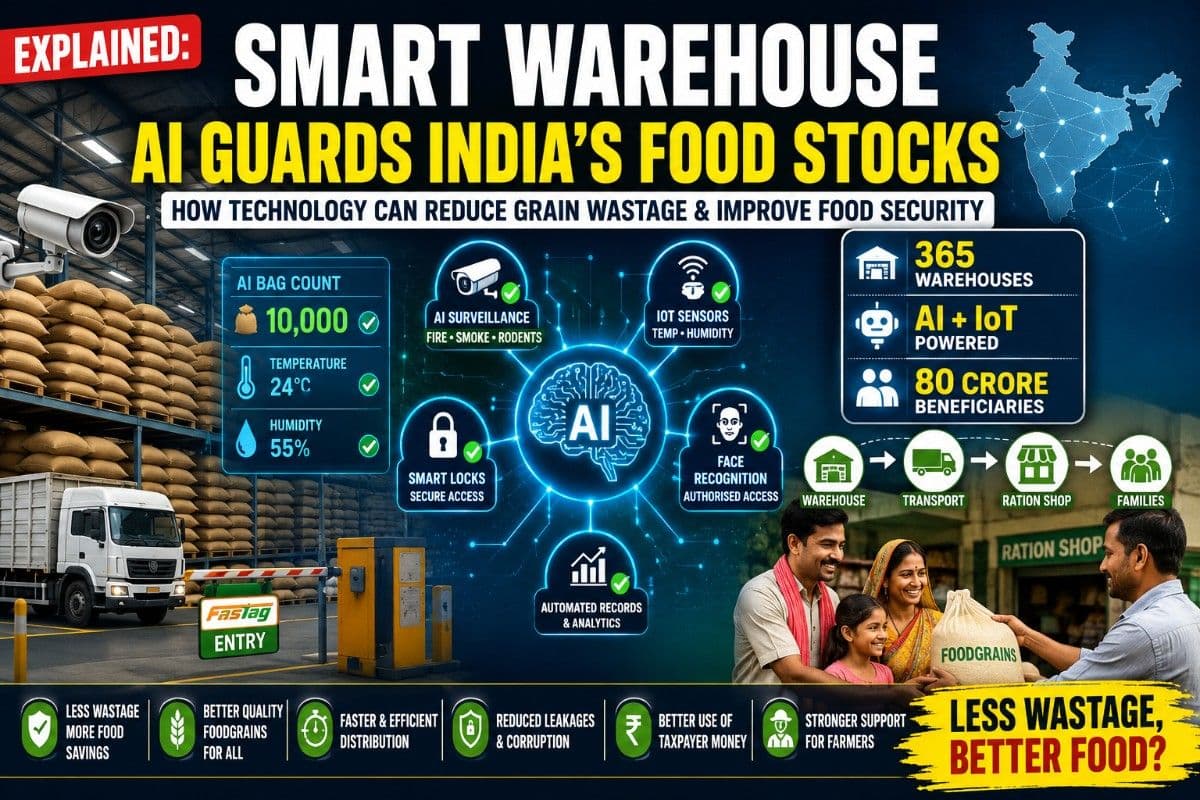
✨A Smart Warehouse is a technology-enabled storage facility that uses sensors, cameras, AI software and automated systems to monitor and manage foodgrain stocks in real time.
Instead of relying solely on manual inspection and paperwork, smart warehouses use digital tools to track grain movement, monitor storage conditions, detect risks and automate operations.
Some of the key technologies being deployed include:
- FASTag and ANPR-based gate automation to automatically record vehicle entry and exit.
- Geo-tagged smart locks for secure access control.
- AI-powered bag counting systems to accurately track grain stocks.
- Face recognition systems for authorised personnel access.
- IoT sensors to monitor temperature, humidity and other environmental conditions.
- AI surveillance systems to detect fire, smoke, rodent activity and other threats.
- Automated record generation and analytics for better warehouse management.
In simple terms, the warehouse becomes a "smart" facility capable of monitoring itself and alerting officials before problems become serious.
Why Does It Matter?
India stores millions of tonnes of wheat, rice and other grains every year to support the Public Distribution System (PDS), which provides subsidised food to over 80 crore beneficiaries.
Even small storage losses due to spoilage, pests, moisture or theft can translate into massive financial losses and reduced food availability.
Smart Warehousing aims to reduce such losses through continuous monitoring and early warning systems.
How Will the Common Man Benefit?
1. Better Food Security
Proper storage means less grain wastage. When foodgrains are preserved scientifically, the government can maintain adequate stocks for welfare schemes and emergencies.
This helps ensure uninterrupted supply under the Public Distribution System.
2. Better Quality Foodgrains
Temperature and humidity sensors help maintain ideal storage conditions. This reduces spoilage, fungal growth and pest infestation, leading to better-quality grains reaching ration shops.
3. Faster and More Efficient Distribution
Automated gate systems and digital record keeping reduce delays in grain movement. Faster warehouse operations mean foodgrains can reach distribution centres and fair price shops more quickly.
4. Reduced Leakages and Corruption
AI-enabled stock monitoring, automated counting and digital records make it harder to manipulate inventory data.
The government says technology-driven reforms have already helped identify and remove over 2.43 crore ineligible ration cards, improving targeting of food subsidies.
5. Better Use of Taxpayer Money
Foodgrain losses during storage ultimately cost taxpayers. By reducing wastage and improving efficiency, Smart Warehousing can help save public funds that would otherwise be lost due to spoilage, theft or operational inefficiencies.
6. Benefits for Farmers
When government agencies can store grains more safely and efficiently, procurement systems become more reliable. This supports smoother purchase of crops from farmers and reduces post-harvest losses.
How Is AI Helping?
Artificial Intelligence acts as the warehouse's digital watchdog.
AI systems can:
- Count grain bags automatically.
- Detect suspicious activities.
- Identify smoke and fire at an early stage.
- Spot rodent movement before major damage occurs.
- Generate alerts and reports without human intervention.
This allows warehouse managers to respond quickly and prevent losses.
Part of a Larger Digital Push
The Smart Warehousing System is not a standalone project. It complements other digital initiatives such as SMART PDS, Anna Chakra, Depot Darpan, ASHA, SCAN and Anna Darpan, which aim to strengthen procurement, storage, logistics and foodgrain distribution across India.
The initiative also aligns with the broader goals of Digital India, IndiaAI Mission, PM GatiShakti and Atmanirbhar Bharat.
The Bottom Line
A Smart Warehouse is essentially a grain storage facility equipped with AI, sensors and automation technologies that can monitor stocks, detect risks and improve efficiency in real time.
For ordinary
citizens, the benefits may not be immediately visible, but they are
significant: less food wastage, better quality grains, more efficient ration
distribution, greater transparency and stronger national food security. As
India continues to digitise its food supply chain, Smart Warehousing could
become a critical pillar in ensuring that food reaches those who need it most.
Also Read: El Niño Threat: Shivraj Singh Chouhan Orders Strategic Release of India’s 127% Surplus Reservoir Water; Centre to Intervene in Slow States| Breaking
Related Topics
Explore more stories