



Delhi Pollution / Delhi AQI improves slightly to 304, but air quality remains ‘Very Poor’
·21 mins ago·3 min read
Key Points
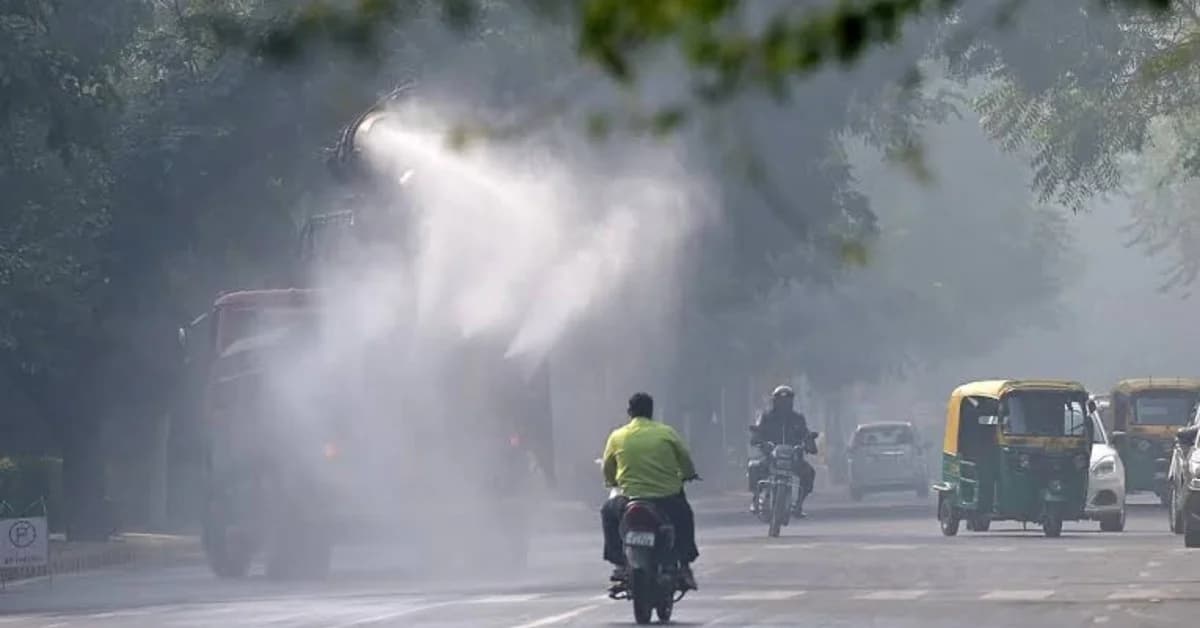
Delhi recorded an AQI of 304 on Tuesday morning, showing a slight improvement from Monday's post-Diwali pollution peak. However, air quality remains in the 'very poor' category, with several monitoring stations reporting dangerously high pollution levels. GRAP Stage III restrictions remain in force as low wind speeds and a lack of rainfall are expected to prolong the pollution crisis.
New Delhi, Nov 10: A slight improvement in air quality was witnessed in Delhi on Tuesday morning, but pollution levels continued to remain in the 'very poor' category, with the city's Air Quality Index (AQI) recorded at 304 around 8.10 a.m., according to data from the Central Pollution Control Board (CPCB).
The reading marked a decline from Monday's peak level, recorded a day after Diwali celebrations. However, several monitoring stations across the national capital continued to report high pollution levels.
Pusa and Chandni Chowk recorded the highest AQI readings of 395 each, followed by NSUT Jaffarpur at 382 and Commonwealth Sports Complex at 380.
Other monitoring stations also reported elevated pollution levels. The AQI stood at 303 in Burari, 236 in Karala, 272 in Ghoga, 266 in Nangloi, 293 in Tikri Kalan, 303 in Jharoda Kalan, 339 in NIH Narela, 327 at Lodhi Road and 370 at Talkatora Garden.

📱 Get Argus News App
✨📰 60 Word News🎬 Argus Podcast📺 Live TV and Breaking News🔔 Free Notification Alerts
Download Free:
Similarly, Aya Nagar recorded an AQI of 349, Punjabi Bagh 348, Shadipur 312, Sirifort 365, R.K. Puram 329, Delhi Technological University (DTU) 323, Rohini 301 and Bawana 314.
Meanwhile, Delhi-NCR is unlikely to receive any immediate respite from pollution, as weather conditions are expected to remain largely unfavourable for the dispersion of pollutants.
The India Meteorological Department (IMD) has predicted no rainfall in Delhi between November 10 and 15. An approaching Western Disturbance is expected to influence the western Himalayan region from Tuesday night, but its impact is unlikely to bring rain to the national capital.
Wind speeds are also forecast to remain relatively low, ranging between 5 and 15 kmph, limiting the possibility of significant improvement in air quality.
Meanwhile, Stage III restrictions under the Graded Response Action Plan (GRAP) remain in force following the Commission for Air Quality Management's (CAQM) decision. Authorities have been directed to intensify pollution-control measures, strengthen enforcement and ensure compliance to prevent further deterioration.
The restrictions cover Delhi and the adjoining districts of Haryana, Uttar Pradesh and Rajasthan. The emergency framework is implemented based on forecasts from the IMD and the Indian Institute of Tropical Meteorology (IITM), enabling preventive action before pollution levels reach the 'severe' category.
GRAP is a four-stage emergency mechanism coordinated by the CAQM, CPCB and state governments, with restrictions becoming progressively stricter as air quality worsens.
(IANS)
(IANS)
Related Topics
Explore more stories