



Ahmedabad Air India Crash: Here is Why Final AI-171 Report Could Be 6-12 Months Away Despite One Year of Investigation| Special Report
Key Points
* International testing, engine analysis, human-factor audits and ICAO-mandated reviews are extending the investigation timeline.
* Based on global aviation crash probes, the final AI-171 report is likely between December 2026 and June 2027.
Bhubaneswar: Exactly a year ago, in a hot and humid afternoon hours, the country had recorded the catastrophic crash of Air India Flight AI-171 shortly after take-off from Ahmedabad. A pall of gloom descended across the nation.
Even after a year passed, the moot question remains unanswered: Was it human action or a rare mechanical/electrical failure that shut down both engines? The final word on untimely loss of 260 lives is yet to be spoken.
Friday, on the anniversary of the tragic mishap, the Aircraft Accident the Aircraft Accident Investigation Bureau (AAIB) released a statement, making one thing clear: investigators are still not ready to declare a final cause. Instead, the probe has entered what aviation experts consider the most critical stage – integrated analysis of technical evidence, human factors, maintenance records and international laboratory testing.
Interim Statement Stops Short of Naming a Cause

📱 Get Argus News App
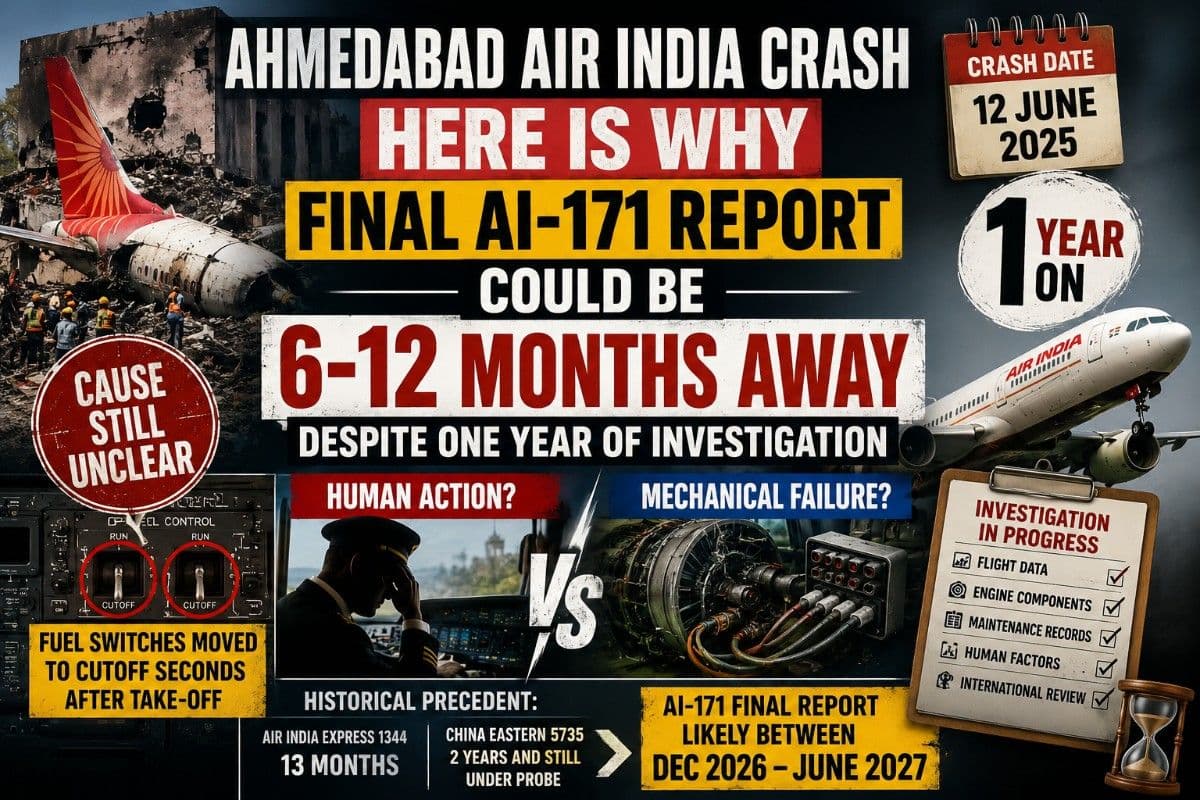
✨While the preliminary report issued on July 12, 2025, revealed that the Boeing 787-8's fuel control switches moved from RUN to CUTOFF seconds after take-off, the latest anniversary update carefully avoids attributing that movement either to pilot action or a system malfunction.
Instead, AAIB says investigators are continuing to analyse aircraft systems, flight recorder data, engine-related components, maintenance records and operational evidence before reaching conclusions.
The Two Competing Theories
Theory 1: Human Action
The preliminary report's revelation was that both fuel control switches were recorded as moving to the CUTOFF position shortly after take-off, starving the engines of fuel.
Boeing's fuel switches are protected by a mechanical lock system. According to the aircraft's design architecture, a pilot must consciously pull the switch over a detent before moving it from RUN to CUTOFF. The system is specifically engineered to prevent accidental movement caused by turbulence or incidental contact.
This finding led some observers to speculate that the shutdown could only have resulted from human intervention.
Theory 2: Mechanical or Electrical Failure
Pilot bodies and some technical experts strongly dispute that conclusion.
Their argument gained traction after a separate Air India aircraft reportedly experienced abnormalities involving a similar fuel switch module. That component has since been sent for examination by Boeing specialists in Seattle.
Supporters of the malfunction theory argue that worn switch mechanisms, vibration-induced slippage, electrical cross-talk or relay failures could theoretically mimic a fuel-cutoff command without intentional pilot action.
The AAIB's latest statement suggests these possibilities are still being examined through engine testing, component analysis and software evaluations.
Why Is the Final Report Taking So Long?
Under international aviation rules contained in ICAO Annex 13, complex accident investigations are not expected to conclude within a year. If a final report is unavailable after 12 months, investigators are required to issue an interim statement – precisely what AAIB has done.
Several factors are extending the timeline:
Massive Technical Workload
Investigators are examining:
- Flight Data Recorder data
- Cockpit Voice Recorder evidence
- Engine components
- Electronic switch assemblies
- Maintenance histories
- Airline operational records
- Human factors and training records
All findings must be cross-verified against physical evidence and laboratory testing.
International Participation
Because the aircraft, engines and several critical systems were designed and manufactured overseas, multiple foreign agencies are involved in the investigation. These include representatives connected to Boeing and U.S. aviation authorities.
Mandatory Global Review
Before publication, the draft report must be circulated to participating states and accredited representatives.
Those countries receive up to 60 days to submit technical observations, corrections or disagreements, all of which must be considered before finalisation.
How Much Longer Could the Wait Be?
Historical precedent suggests patience will still be required.
- Air India Express Flight 1344's final report took about 13 months.
- China Eastern Flight 5735 was still under active investigation two years after the accident.
- Complex international investigations involving extensive component testing typically require 18 to 24 months from the date of the crash.
Applying that benchmark to AI-171, which crashed on June 12, 2025, places the likely window for a final report between December 2026 and June 2027.
Bottom Line
One year after India's deadliest aviation disaster in decades, investigators have still not determined whether AI-171 was brought down by human action, a mechanical defect, an electrical anomaly, or a combination of factors.
The AAIB's anniversary statement neither confirms nor rejects any theory. Instead, it signals that the investigation has entered its most consequential phase – one where conclusions must be supported by evidence robust enough to withstand scrutiny from Boeing, engine manufacturers, international regulators and the global aviation community.
Until that process is complete, the question that has dominated aviation circles for a year remains unresolved.
Related Topics
Explore more stories