



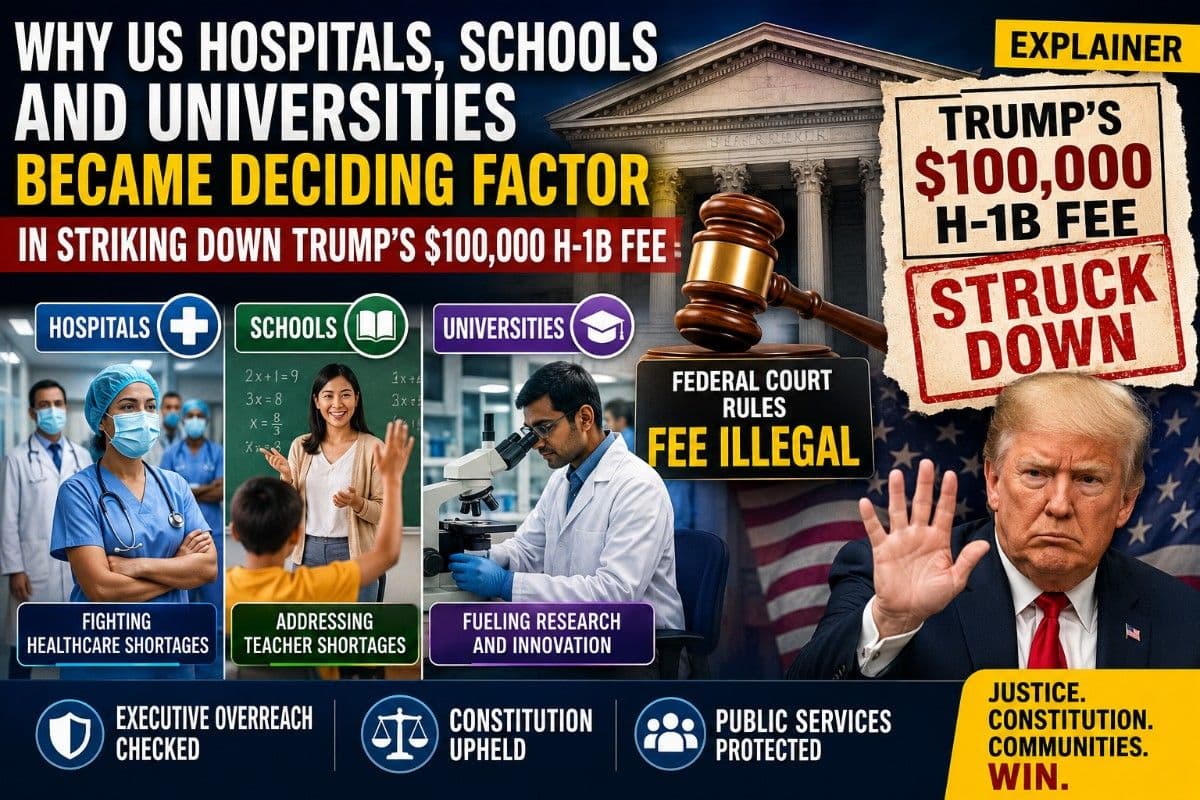
Why US Hospitals, Schools and Universities Became Deciding Factor in Striking Down Trump's $100,000 H-1B Fee| Explainer
Key Points
* States successfully argued the fee would deepen shortages of doctors, teachers, professors and researchers across America.
* The nationwide ruling immediately restores the traditional H-1B visa fee structure while putting the issue back in Congress's hands.
Bhubaneswar: In a significant setback for the Trump administration’s immigration agenda, a federal court has struck down a controversial policy that imposed a $100,000 fee on every new H-1B visa petition, ruling that the executive branch exceeded its constitutional authority.
In a sweeping decision issued on June 8, 2026, U.S. District Judge Leo T. Sorokin vacated the policy nationwide, holding that the administration had effectively imposed an unauthorized tax and bypassed mandatory federal rulemaking procedures.
The ruling immediately halts enforcement of the fee and restores the traditional H-1B filing framework for employers across the United States.
Why the Court Intervened

📱 Get Argus News App
✨The legal challenge centred on Presidential Proclamation 10973, signed on September 19, 2025. The proclamation imposed a $100,000 surcharge on H-1B specialty occupation petitions, with the administration arguing that the measure was necessary to combat alleged abuse of the visa program and protect American workers.
Judge Sorokin, however, found that the policy failed on both constitutional and administrative grounds.
1. The Executive Branch Cannot Impose Taxes
At the heart of the ruling is a fundamental constitutional principle: the power to levy taxes belongs to Congress.
The administration argued that the fee was a regulatory condition tied to immigration authority under the Immigration and Nationality Act (INA). The court disagreed.
According to the judgment, the sheer magnitude and revenue-generating nature of the $100,000 charge transformed it into a tax rather than a regulatory fee. Because Congress had never explicitly delegated such taxing authority to the President, the administration lacked the legal power to impose it.
The court concluded that the proclamation effectively attempted to exercise Congress’s exclusive "power of the purse," violating the separation of powers established by the Constitution.
2. Federal Agencies Ignored Rulemaking Requirements
The court also found that federal agencies sidestepped the requirements of the Administrative Procedure Act (APA).
Normally, agencies must publish proposed rules and allow the public to comment before implementing policies carrying the force of law.
Instead, agencies including U.S. Citizenship and Immigration Services (USCIS) and Customs and Border Protection (CBP) implemented the fee through website guidance, FAQs and administrative instructions without undergoing formal notice-and-comment rulemaking.
Government lawyers argued that foreign affairs and emergency exceptions justified the shortcut. Judge Sorokin rejected those claims, ruling that neither exception applied.
As a result, the policy was deemed procedurally unlawful in addition to being constitutionally defective.
The States’ Winning Strategy: Beyond Silicon Valley
Although the administration framed the fee as a tool to prevent technology companies from replacing American workers, the coalition of 20 states challenging the policy shifted the debate to its broader consequences for public services.
Their argument proved pivotal.
Healthcare: A Potential Staffing Shock
States argued that public hospitals, medical centers and healthcare systems depend heavily on H-1B professionals, including physicians, specialists, researchers and certain nursing personnel.
A $100,000 fee for every hire would dramatically increase recruitment costs at a time when many regions already face chronic healthcare shortages.
The states contended that the policy would reduce access to medical care, strain public health systems and increase costs for taxpayers.
Education: Teacher Shortages Could Worsen
School districts across the country use H-1B visas to recruit teachers in critical shortage areas such as mathematics, science, special education and bilingual instruction.
According to the states, imposing a six-figure fee on each international hire would effectively price many school districts out of the market, worsening staffing shortages already affecting thousands of classrooms.
Universities and Research Institutions
Higher education institutions were another major concern.
American universities routinely rely on cap-exempt H-1B visas to recruit professors, researchers and scientists from around the world.
The plaintiffs argued that the surcharge would severely undermine research programs, limit academic recruitment and weaken the United States' global competitiveness in science and innovation.
The court appeared receptive to these concerns, noting the substantial harms the policy could inflict beyond the technology sector.
What Happens Next?
Immediate Impact: Fee Eliminated Nationwide
Because Judge Sorokin issued a nationwide vacatur rather than a limited injunction, the policy itself has been nullified.
Effective immediately:
- USCIS can no longer collect the $100,000 surcharge.
- Employers nationwide return to the traditional H-1B fee structure.
- New petitions will proceed under existing statutory fee schedules.
For most employers, filing costs revert to standard H-1B rates, which vary depending on company size and filing category but remain a fraction of the invalidated surcharge.
Could the Government Appeal?
Yes.
The administration may appeal the decision to the U.S. Court of Appeals for the First Circuit.
To revive the fee while litigation continues, government lawyers would need to obtain an emergency stay of the district court’s order.
Legal analysts note that securing such relief could prove difficult given the court’s findings on both constitutional and procedural grounds.
Congress Holds the Key
Perhaps the most consequential aspect of the ruling is what it says about executive power.
The court made clear that if policymakers wish to fundamentally reshape the economics of the H-1B program through massive surcharges or premium fees, Congress – not the President – must authorize those changes through legislation.
In other words, the administration's policy objective may still be pursued, but only through the legislative process.
Why This Case Matters
Beyond immigration policy, the ruling is likely to become an important precedent in the broader debate over presidential authority.
The decision reinforces two enduring constitutional principles:
1. Only Congress has the power to impose taxes or raise revenue through major financial exactions.
2. Federal agencies must generally follow established rulemaking procedures before implementing policies that affect the public.
For employers, universities, hospitals and school systems that rely on highly skilled foreign professionals, the ruling provides immediate certainty.
For the administration, it serves as a reminder that even ambitious immigration reforms must operate within constitutional and statutory limits.
As the case potentially moves into the appellate courts, its implications may extend well beyond the H-1B program, shaping future battles over the scope of executive power in the United States.
Related Topics
Explore more stories