



BRICS / Ghana's Proposed Inclusion in BRICS-Plus Could Open New Economic Opportunities, Strengthen Global South Ties
·51 mins ago·3 min read
Key Points
Ghana's proposed inclusion in BRICS-plus could open new economic opportunities and strengthen its ties with Global South countries as the grouping seeks to broaden its influence under India's chairmanship.
Sofia, Oct 17: Ghana’s proposed inclusion in BRICS-plus could open up new economic opportunities and strengthen its ties with countries across the Global South, as the grouping seeks to broaden its international influence under India’s chairmanship. A report has noted that Indonesia was the most recent country to join the bloc as a full member, in January 2025.
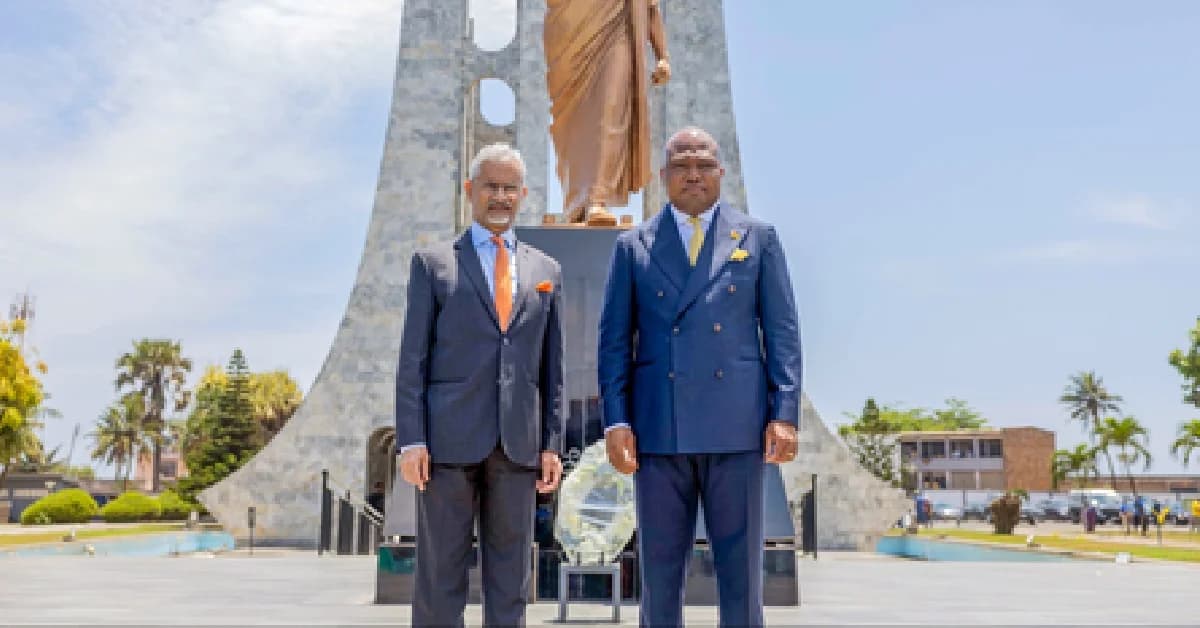
External Affairs Minister S Jaishankar and his Ghanaian counterpart, Samuel Okudzeto Ablakwa, announced plans to formally seek partner status after their traditional diplomatic consultations this month.
“Seeking deeper engagement with other emerging powers, the Foreign Ministers acknowledged that joining BRICS+ would complement, rather than replace, its existing relationships with the International Monetary Fund, World Bank, and other traditional partners. Formally established in 2009 by Brazil, Russia, India, and China, BRICS was founded on the premise that international institutions such as the World Bank and the IMF were overly dominated by Western powers and had ceased to serve developing countries,” a report in Bulgaria-based 'Modern Diplomacy' detailed.
“South Africa joined in 2010 by invitation of China. The bloc has since expanded to include six new members: Ethiopia, Egypt, Indonesia, Iran, Saudi Arabia, and the United Arab Emirates,” it noted.
External Affairs Minister S Jaishankar and his Ghanaian counterpart, Samuel Okudzeto Ablakwa, announced plans to formally seek partner status after their traditional diplomatic consultations this month.
“Seeking deeper engagement with other emerging powers, the Foreign Ministers acknowledged that joining BRICS+ would complement, rather than replace, its existing relationships with the International Monetary Fund, World Bank, and other traditional partners. Formally established in 2009 by Brazil, Russia, India, and China, BRICS was founded on the premise that international institutions such as the World Bank and the IMF were overly dominated by Western powers and had ceased to serve developing countries,” a report in Bulgaria-based 'Modern Diplomacy' detailed.
“South Africa joined in 2010 by invitation of China. The bloc has since expanded to include six new members: Ethiopia, Egypt, Indonesia, Iran, Saudi Arabia, and the United Arab Emirates,” it noted.

📱 Get Argus News App
✨📰 60 Word News🎬 Argus Podcast📺 Live TV and Breaking News🔔 Free Notification Alerts
Download Free:
Ten countries, including Nigeria, currently hold partner status, enabling them to attend summits without enjoying full voting rights. Ghana’s inclusion would make it the second West African nation after Nigeria to join the partner category, underscoring the economic opportunities and political credentials associated with the two countries, Modern Diplomacy mentioned.
According to the report, joining the BRICS-plus platform would mark a historic milestone for Ghana, which has established a prominent position in multilateral institutions such as the Economic Community of West African States (ECOWAS), the African Union (AU) and the United Nations. Since January 2025, Ghana has also headed the Commonwealth Secretariat.
Also Read: School Roof Collapse Claims 18 Lives, Injures 30
“Unlike South Africa, which acquired a full-fledged membership status in 2011, and Ethiopia, Nigeria, and Uganda, which were taken into the ‘partner states’ category, Ghana has all the fundamental requirements to become part of the BRICS-plus alliance. It is necessary to understand the basic definition and meaning of BRICS-plus in the context of the geopolitically changing world,” the report stated.
“The BRICS alliance operates on the basis of non-interference. As a non-Western association, it stays open to mutual cooperation from countries with ‘like-minded’ political philosophy,” it added.
BRICS members retain the freedom to pursue bilateral relations with any country of their choosing. The report also noted that the BRICS-plus strategic partnership is not intended to promote confrontation but to encourage collective efforts to address global challenges, while respecting each nation’s right to chart its own course.
According to the report, joining the BRICS-plus platform would mark a historic milestone for Ghana, which has established a prominent position in multilateral institutions such as the Economic Community of West African States (ECOWAS), the African Union (AU) and the United Nations. Since January 2025, Ghana has also headed the Commonwealth Secretariat.
Also Read: School Roof Collapse Claims 18 Lives, Injures 30
“Unlike South Africa, which acquired a full-fledged membership status in 2011, and Ethiopia, Nigeria, and Uganda, which were taken into the ‘partner states’ category, Ghana has all the fundamental requirements to become part of the BRICS-plus alliance. It is necessary to understand the basic definition and meaning of BRICS-plus in the context of the geopolitically changing world,” the report stated.
“The BRICS alliance operates on the basis of non-interference. As a non-Western association, it stays open to mutual cooperation from countries with ‘like-minded’ political philosophy,” it added.
BRICS members retain the freedom to pursue bilateral relations with any country of their choosing. The report also noted that the BRICS-plus strategic partnership is not intended to promote confrontation but to encourage collective efforts to address global challenges, while respecting each nation’s right to chart its own course.
(IANS)
Related Topics
Explore more stories