



Solar Eclipse / 96% of The Sun Will Vanish Tomorrow, Know Why
·7 months ago·2 min read
Key Points
- The first solar eclipse of 2026, an annular "Ring of Fire" eclipse, will occur on February 17.
- The annular phase will last up to 2 minutes 20 seconds, with the Moon covering nearly 96% of the Sun's centre.
- The eclipse will not be visible from India; visibility is over Antarctica, Southern Africa, and parts of South America.
Washington, Feb 16: The first solar eclipse of 2026 will take place on Tuesday, February 17, drawing global attention to the rare celestial spectacle popularly known as the “Ring of Fire”.
According to the National Aeronautics and Space Administration (NASA), an annular solar eclipse occurs when the Earth, Moon and Sun align, and the Moon passes between the Sun and Earth while being at or near its farthest point from the planet.
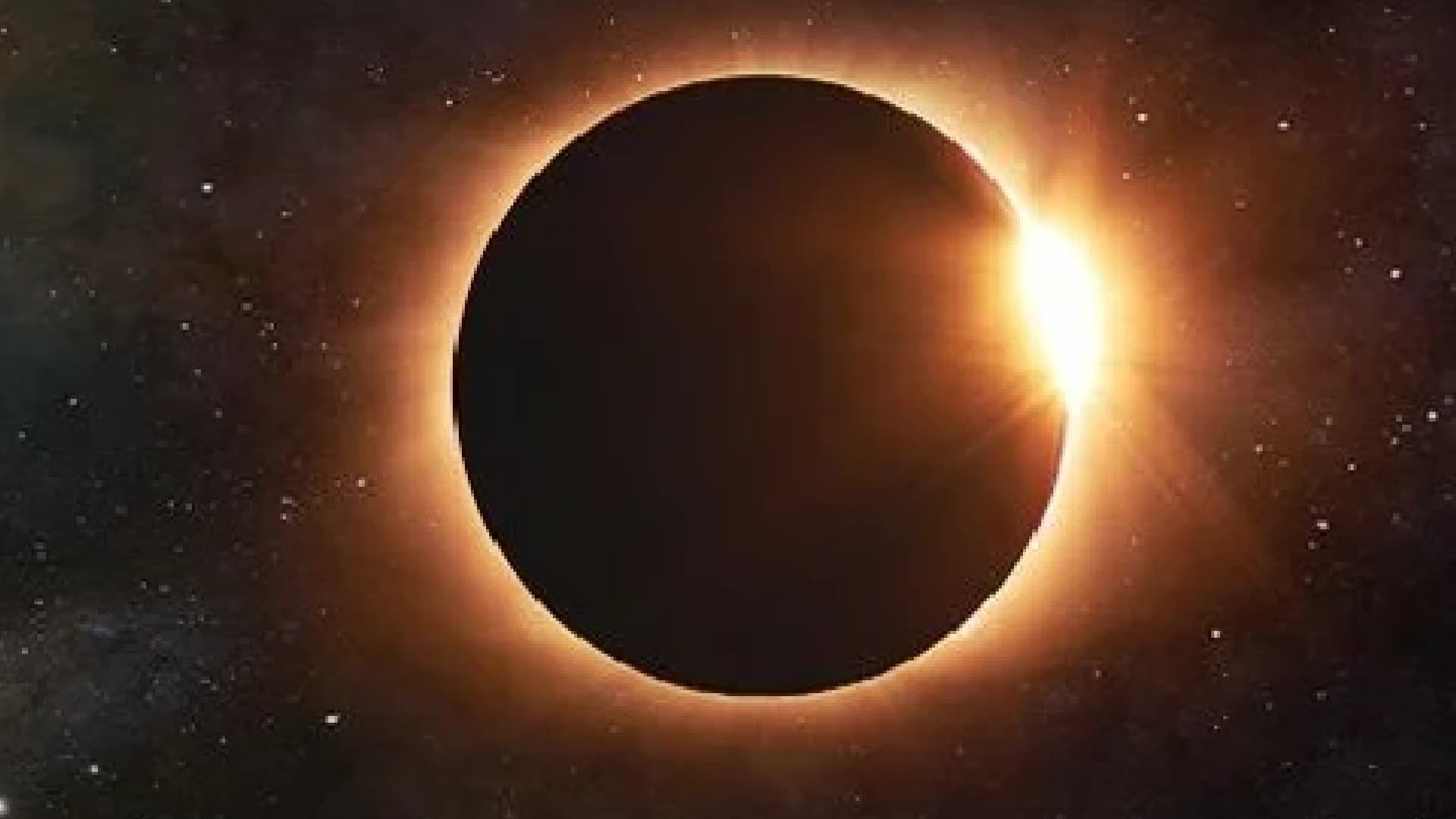
Because the Moon is farther away at that time, it appears smaller and does not completely cover the Sun. Instead, it forms a dark disc against a larger bright disc, leaving a thin, luminous ring around it — the striking “Ring of Fire” effect.
Also Read: India Now Has Capability to Track and Image Enemy Satellites in Orbit
According to the National Aeronautics and Space Administration (NASA), an annular solar eclipse occurs when the Earth, Moon and Sun align, and the Moon passes between the Sun and Earth while being at or near its farthest point from the planet.
Because the Moon is farther away at that time, it appears smaller and does not completely cover the Sun. Instead, it forms a dark disc against a larger bright disc, leaving a thin, luminous ring around it — the striking “Ring of Fire” effect.
Also Read: India Now Has Capability to Track and Image Enemy Satellites in Orbit

📱 Get Argus News App
✨📰 60 Word News🎬 Argus Podcast📺 Live TV and Breaking News🔔 Free Notification Alerts
Download Free:
As reported by Forbes, the eclipse will begin at 07:01 UTC on February 17.
According to Space.com, the annular phase will last up to 2 minutes and 20 seconds, with the Moon expected to cover nearly 96 per cent of the Sun’s centre at maximum eclipse.
Will it Be Visible from India?
No, the eclipse will not be visible from India. The alignment will occur primarily over the Southern Hemisphere at a time when the Sun will remain below the horizon in India.
The maximum eclipse will be visible over Antarctica, particularly from research stations such as Concordia and Mirny. In Southern Africa, countries including South Africa, Tanzania, Zambia and Zimbabwe will witness a partial eclipse.
Parts of South America, especially Argentina and Chile, will also experience visibility.
Eclipse meteorologist Jay Anderson wrote on his website that very few people are expected to witness the annular phase due to the remote path of the eclipse, noting that the inhabited locations within the annular shadow are not set up for tourism.
According to Space.com, the annular phase will last up to 2 minutes and 20 seconds, with the Moon expected to cover nearly 96 per cent of the Sun’s centre at maximum eclipse.
Will it Be Visible from India?
No, the eclipse will not be visible from India. The alignment will occur primarily over the Southern Hemisphere at a time when the Sun will remain below the horizon in India.
The maximum eclipse will be visible over Antarctica, particularly from research stations such as Concordia and Mirny. In Southern Africa, countries including South Africa, Tanzania, Zambia and Zimbabwe will witness a partial eclipse.
Parts of South America, especially Argentina and Chile, will also experience visibility.
Eclipse meteorologist Jay Anderson wrote on his website that very few people are expected to witness the annular phase due to the remote path of the eclipse, noting that the inhabited locations within the annular shadow are not set up for tourism.
Related Topics
Explore more stories