



Odisha Signs Amrita Hospital MoU for Free CHD Treatment: Why Congenital Heart Disease is Emerging as State’s Major Infant Health Challenge| Special Report
Key Points
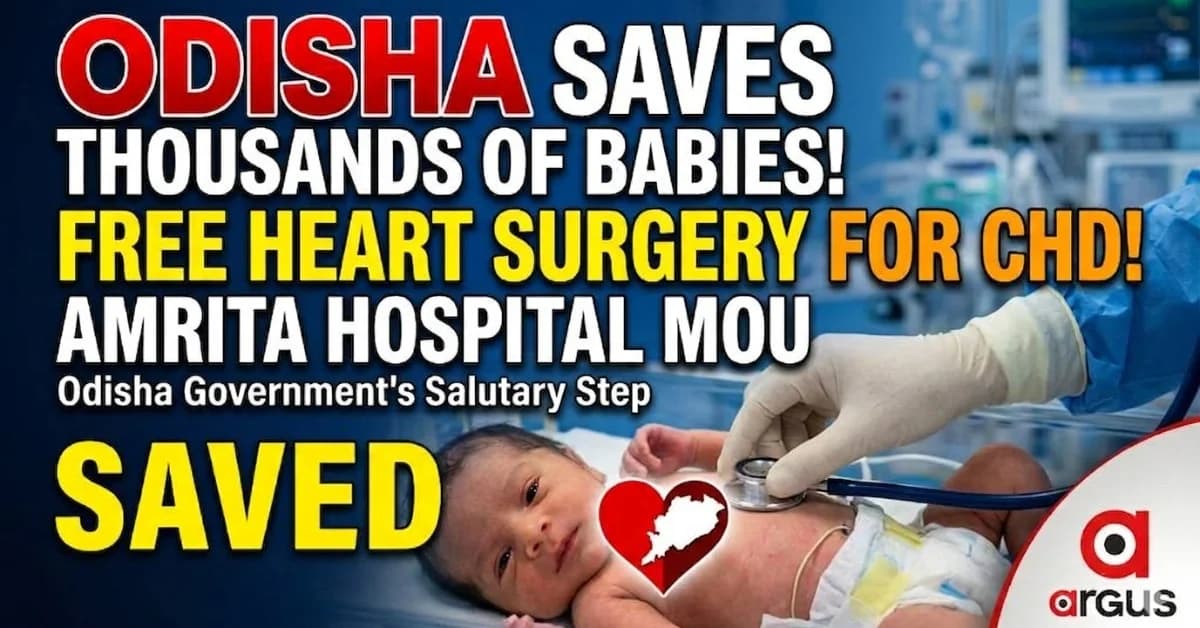
Bhubaneswar: With Odisha figuring among the emerging high-load states for Congenital Heart Disease (CHD) among infants in the country, the BJP government Tuesday took a salutary step to improve the State's under-five mortality rate and save the lives of thousands of children afflicted with CHD.
The Odisha Health and Family Welfare Department on Tuesday signed a landmark Memorandum of Understanding (MoU) with the Paediatric Cardiac Care Department of Amrita Hospital, Kochi, ensuring completely free surgeries, interventional procedures and long-term follow-up care for children suffering from Congenital Heart Disease (CHD).
Health Minister Mukesh Mahaling said the initiative would ensure that no child in Odisha loses life because parents cannot afford expensive cardiac treatment, adding that the partnership will strengthen the state's fight against congenital heart defects by combining early screening with advanced specialist care.
CHD Burden in Odisha: Thousands of Babies Born with Heart Defects Every Year

📱 Get Argus News App
✨Congenital Heart Disease (CHD) refers to structural defects of the heart or major blood vessels that are present at birth.
These abnormalities develop during the first eight weeks of pregnancy when the fetal heart is forming. Even a minor disruption during this crucial developmental window can leave a baby with life-threatening cardiac defects.
Medical estimates indicate that CHD affects 8-10 infants in every 1,000 live births. With Odisha recording nearly 7.5-8 lakh live births annually, the state is estimated to witness 6,000-8,000 babies born with congenital heart defects every year.
The burden becomes even more alarming among critically ill newborns admitted to neonatal intensive care units, where hospital studies in Odisha have found CHD prevalence touching 26.2 per 1,000 sick neonates.
While not every child requires surgery, nearly one-fourth of babies born with severe CHD may not survive beyond their first birthday if timely intervention is unavailable.
CHD Detection in Odisha through RBSK Screening
|
Year |
Major Development |
Estimated Children Tracked/Managed |
|
2021 |
Pandemic-disrupted screening |
~4,200 |
|
2022 |
Full RBSK screening resumed |
~4,900 |
|
2023 |
Expanded detection through medical colleges |
~5,500 |
|
2024 |
Intensive outreach in tribal districts |
~6,100 |
|
2025 |
Large-scale referral programme |
~6,800-7,200 |
Health experts say these figures represent only detected cases through Rashtriya Bal Swasthya Karyakram (RBSK), while several children in remote areas may remain undiagnosed.
Why Ganjam Tops Odisha's CHD Chart
Among Odisha districts, Ganjam consistently reports the highest number of CHD cases. However, doctors say this does not necessarily mean children in Ganjam are genetically more vulnerable.
Instead, the district's higher numbers reflect a stronger public health ecosystem.
Several factors have contributed to Ganjam emerging as the state's leading CHD detection district:
- Being Odisha's most populous district naturally results in a larger number of births and consequently more CHD cases.
- Highly active RBSK Mobile Health Teams regularly screen children in Anganwadi centres, schools and villages.
- Presence of MKCG Medical College and Berhampur City Hospital enables faster diagnosis through pediatric echocardiography.
- Efficient referral mechanisms have helped hundreds of children undergo free surgeries outside Odisha.
The district has already routed 668 children into free surgical treatment pathways under various government-supported programmes, making it the state's most successful referral district.
Health experts believe the actual biological incidence of CHD remains nearly uniform across Odisha. Lower numbers reported from western and tribal districts are largely attributed to under-diagnosis rather than lower disease prevalence.
Odisha Among India's Emerging High-Load CHD States
India witnesses nearly 2-2.5 lakh babies born with Congenital Heart Disease every year, making it one of the country's largest causes of birth-related infant illnesses.
While Uttar Pradesh and Bihar account for the highest absolute number of cases because of their enormous birth rates, Odisha has emerged among the country's high-burden eastern states due to its large rural population, widespread poverty, delayed diagnosis and growing screening network.
Where Odisha Stands
|
State |
CHD Burden Profile |
|
Uttar Pradesh |
Highest absolute number of CHD births |
|
Bihar |
High birth rate with delayed diagnosis |
|
West Bengal |
High eastern India burden |
|
Odisha |
Emerging high-load state with expanding screening programme |
|
Rajasthan |
Large hidden burden in rural areas |
|
Madhya Pradesh |
Significant under-diagnosed population |
Unlike Kerala and Tamil Nadu, which possess well-developed paediatric cardiac centres and digital tracking systems, Odisha continues to depend heavily on referral pathways for advanced pediatric heart surgeries.
The MoU with Amrita Hospital is expected to bridge this long-standing treatment gap.
Why the Amrita Hospital MoU is a Game-Changer
The partnership represents far more than another inter-state healthcare agreement.
Private paediatric cardiac surgeries generally cost anywhere between Rs2 lakh and Rs5.5 lakh, making treatment impossible for thousands of economically weaker families.
The agreement eliminates this financial barrier by providing:
- Free corrective heart surgeries.
- Free catheter-based cardiac interventions.
- Free post-operative treatment.
- Long-term follow-up care.
- Faster referral from RBSK screening teams to specialist surgeons.
The MoU also addresses Odisha's shortage of dedicated paediatric cardiothoracic facilities by directly connecting identified children with one of India's leading pediatric cardiac centres.
Health officials believe the programme will substantially improve survival among children born with severe congenital heart defects while contributing to further reduction in Odisha's under-five mortality.
Can CHD Be Prevented? Here's What Doctors Recommend
Although nearly 70% of Congenital Heart Disease cases occur without any identifiable cause, medical experts say a significant proportion can be prevented by reducing known maternal risk factors before and during early pregnancy.
DOs
- Take folic acid supplements before conception and during the first trimester.
- Keep diabetes under strict control before pregnancy.
- Receive Rubella/MMR vaccination before conception.
- Undergo Level-II anomaly scan and fetal echocardiography during pregnancy whenever advised.
- Seek genetic counselling where close-relative marriages are common.
- Attend regular antenatal check-ups.
DON'Ts
- Do not consume alcohol during pregnancy.
- Avoid smoking and exposure to second-hand smoke.
- Never self-medicate during pregnancy.
- Avoid high-risk medicines (including BP medicines) without doctor's advice.
- Do not ignore abnormal fetal ultrasound findings.
- Delay specialist consultation if a newborn develops bluish skin, breathing difficulty or poor weight gain.
Bottom Line: The Odisha government's partnership with Amrita Hospital marks one of the most significant interventions in paediatric cardiac care undertaken by the state in recent years.
By linking
early screening under the RBSK programme with completely free specialised
surgeries, the initiative has the potential to save thousands of children born
every year with Congenital Heart Disease, reduce preventable infant deaths and
strengthen Odisha's fight against one of the country's leading congenital
causes of under-five mortality.
Also Read: Critical Health Alert / NFHS-6 Drops Health Bombshell on Odisha: Young Adults Getting Trapped in Sudden Sugar, BP Spike| Exclusive Breaking
Related Topics
Explore more stories