



Textbook Controversy / Textbook Blunder: Probe is Welcome, but Odisha Awaits Real Accountability
Key Points
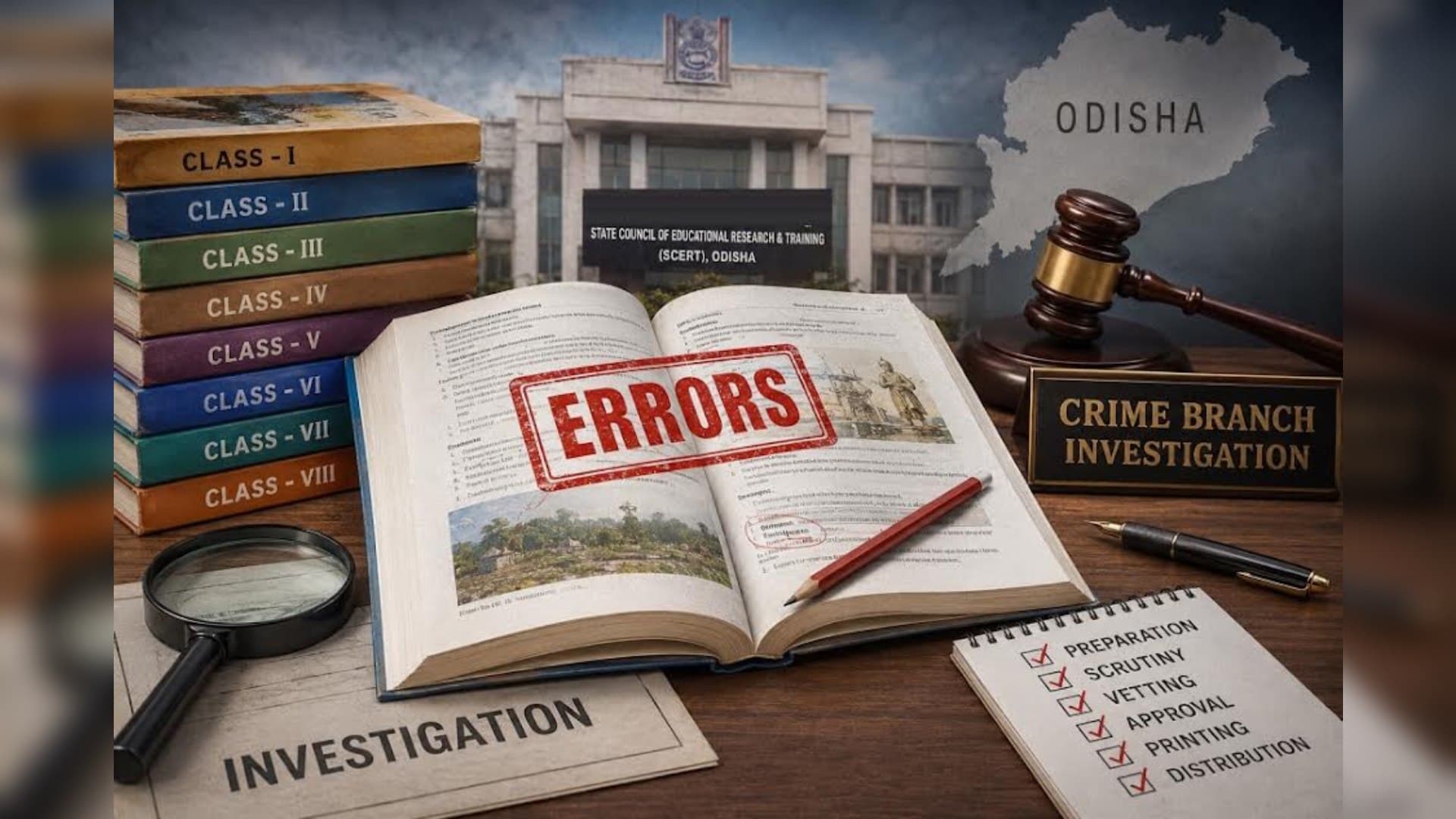
Odisha orders Crime Branch probe into textbook errors for Classes I–VIII, aiming to restore trust through accountability, transparency, and reforms in academic governance and education system integrity.
Bhubaneswar, Jul 13: The Odisha government's decision to order a Crime Branch investigation into the glaring errors found in school textbooks for Classes I to VIII is undoubtedly a step in the right direction. By directing the State Crime Branch to conduct a criminal investigation and asking the present SCERT Director to lodge a formal complaint, Chief Minister Mohan Charan Majhi has conveyed that the government is treating the issue with the seriousness it deserves. Yet, an investigation order alone cannot restore public confidence. What the people of Odisha now expect is visible, credible and time-bound action.
The controversy over the erroneous textbooks is not merely about typographical mistakes or editorial lapses. School textbooks shape the knowledge, values and historical understanding of an entire generation. Any distortion, omission or factual error in such books has consequences far beyond the classroom. It affects the intellectual foundation of young minds and raises legitimate questions about the standards of academic governance in the state.
The government had earlier constituted a high-level committee under the Development Commissioner DK Singh to examine the reasons behind the errors. Acting on the committee's findings, the former Director of SCERT and three Assistant Directors were suspended, while disciplinary proceedings were initiated against several other officials. These actions demonstrated administrative responsiveness, but they did not answer the larger question that continues to trouble the public: How did such extensive mistakes escape every stage of scrutiny?
The textbook preparation process is neither casual nor hurried. It passes through multiple institutional layers involving subject experts, editorial boards, scrutiny committees, vetting panels and administrative approval before finally reaching the printing stage. Even after printing, there are quality checks before books are distributed to lakhs of students. When such an elaborate system exists, the occurrence of widespread errors appears highly unusual.

📱 Get Argus News App
✨This naturally raises several uncomfortable questions. Were all the committees functioning as required? Did every expert discharge his or her responsibility with due diligence? Were established quality control mechanisms followed, or were they reduced to mere formalities? If modern digital tools or artificial intelligence were used during content preparation, were they adequately supervised by qualified academicians? These are questions that deserve objective answers rather than speculation.
The controversy has also acquired political significance. Soon after the issue surfaced, the Chief Minister remarked that the incident appeared to be the outcome of a conspiracy and assured that those responsible would face stringent action. However, as days passed without any major criminal proceedings, opposition parties intensified their criticism, while the debate expanded rapidly across social media. The longer uncertainty continues, the greater the erosion of public trust.
The financial dimension of the issue is equally important. The preparation, editing, printing and statewide distribution of school textbooks involve expenditure running into crores of rupees from the public exchequer. Alongside financial resources, countless hours of professional work by government officials, academicians and technical experts are invested in the process. If serious lapses have indeed occurred, the issue extends beyond academic negligence; it concerns accountability for the use of public resources.
The damage to the government's image has already been considerable. Rarely has an educational issue generated such widespread discussion across urban centres, villages and digital platforms alike. Public confidence in educational institutions depends not merely on policy announcements but on the assurance that systems function responsibly and transparently.
The Crime Branch investigation, therefore, assumes immense significance. Its credibility will depend on whether it traces responsibility across the entire chain of decision-making instead of limiting accountability to a few officials. If evidence points to deliberate manipulation, negligence or abuse of authority, those responsible must face appropriate legal consequences irrespective of their position. Equally important, if systemic weaknesses are identified, they must be corrected through institutional reforms that prevent similar failures in the future.
Ultimately, this controversy is not about politics alone. It is about the integrity of the education system and the responsibility of the State towards its children. Parents, teachers and students deserve textbooks that are accurate, reliable and prepared with the highest academic standards. They also deserve the assurance that mistakes of this magnitude will never be repeated.
The government's decision to order a criminal investigation
is an important beginning. But the success of that decision will be measured
not by the announcement itself, but by the transparency of the investigation,
the accountability it establishes and the reforms that emerge from it. Anything
less will only deepen public suspicion and weaken confidence in the
institutions entrusted with shaping the future of Odisha's children.
Related Topics
Explore more stories