



Special Report | More Than One Pregnancy a Month: What is Failing Inside Odisha’s Tribal Residential Hostels?
Key Points
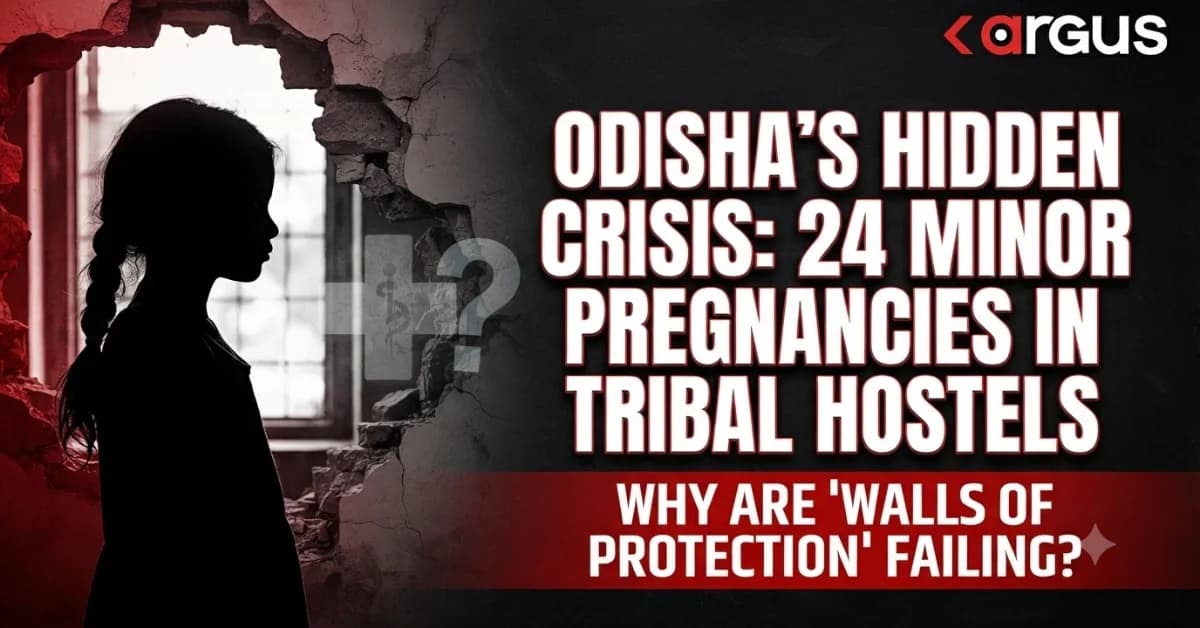
24 Minor Pregnancies Recorded: Odisha's state-run tribal school hostels reported 24 minor pregnancy cases over the 2024–26 period, averaging over one case every month.
The Vacation Vulnerability: Institutional safety ends at the hostel gate, leaving adolescent tribal girls exposed to risks and unequal power structures during long home holidays.
Detection vs. Prevention Paradox: Stronger health surveillance and sanitary napkin monitoring are exposing hidden numbers, but the system lacks adequate early educational and counseling mechanisms.
Bhubaneswar: A residential school is supposed to be a wall of protection.
For a tribal girl from a remote village, it is meant to be more than a place to study. It is supposed to offer a safer ecosystem – classroom, hostel, food, health care, supervision and, above all, protection.
But Odisha's tribal residential-school system is confronting an uncomfortable paradox: the hostels are detecting adolescent pregnancies with increasing efficiency.
Fifteen pregnancies among minor girls in government school hostels in 2025–26 means, mathematically, more than 1 (1.25) cases every month.

📱 Get Argus News App
✨In the preceding year, there were nine.
Together, the two years account for 24 cases.
And suddenly, the question is no longer merely how many girls became pregnant?
The more disturbing question is: why is a system designed to keep vulnerable tribal children safe repeatedly discovering pregnancies only after something has already gone wrong?
The answer becomes even more intriguing when Odisha's experience is placed beside the country's centrally managed residential-school architecture.
Though, it cannot be said with absolutly that EMRS (Eklabya Model Residential Schools) or JNV (jawahar Navodaya Vidyalayas) systems have had zero pregnancies. In fact, isolated cases may have occurred in residential-school systems elsewhere.
But a comparative analysis indicates that such cases are reported far less frequently in central networks than in Odisha's state-run residential-school network.
That contrast deserves examination – not as a simple tale of one system being "good" and another "bad", but as a window into what happens when education, adolescence, tribal society, distance, holidays and institutional supervision collide.
The arithmetic that makes the issue impossible to ignore
The latest numbers have a peculiar way of changing the emotional scale of the story.
Fifteen cases in an entire state may initially look like a small number against a huge residential-school population.
But convert it into time.
One pregnancy every 29 days.
That is what 15 cases over 12 months roughly mean.
And the figure has risen from nine in 2024–25 to 15 in 2025–26. The official disclosures made in teh State Assembly put the two-year total at 24.
Odisha's recent picture
|
Academic year |
Reported pregnancies |
Approx. monthly average |
Major districts reported |
|---|---|---|---|
|
2024–25 |
9 |
0.75 |
Rayagada (3), Baleshwar (1), Debagada (1), Kendujhar (1), Koraput (1), Malkangiri (1), Mayurbhanj (1) |
|
2025–26 |
15 |
1.25 |
Kandhamal (5), Koraput (4), Debagada (1), Kendujhar (1), Malkangiri (1), Mayurbhanj (1), Rayagada (1), Sundargarh (1) |
|
2024–26 |
24 |
1.00 over two years |
Concentration visible in tribal-dominated districts |
The district distribution is revealing in its own way.
In 2025–26, Kandhamal alone accounted for five cases and Koraput four. Together, they contributed nine of the 15 cases.
In Koraput, cases posted a rise.
The district count expanded to 8 from 7.
The Big Takeaway has been that many districts repeat their name in the dubious list.
However, it is also to pertnent to menition that this is not a statistical storm uniformly sweeping every residential school in Odisha.
It appears concentrated around particular social and geographical vulnerabilities.
And that distinction matters.
The irony: the better the thermometer, the higher the fever
There is an important defence available to the system – and it should not be ignored.
Odisha has strengthened health surveillance.
Girls are subjected to health checks after returning from vacations. ANMs and health teams are involved. Menstrual-health monitoring and sanitary-pad distribution can provide early signals of missed periods or physical changes. Several pregnancies are detected precisely because someone is looking.
That means the rising number does not automatically mean that pregnancies themselves have risen by the same proportion.
Some of the increase may represent better detection.
This creates an unusual statistical paradox:
A system that starts looking harder will inevitably find more of what previously remained hidden.
But there is a second side to that argument.
Better detection can explain why the numbers are visible.
It cannot, by itself, explain why there are 15 cases in one year.
Detection answers the question "How did we find them?"
It does not answer the more important question:
"Why did the warning signs not work before pregnancy occurred?"
That is where the story moves from statistics into sociology.
The school ends at the hostel gate
For years, the official explanation has repeatedly pointed towards vacations.
The argument is straightforward: many girls return to their villages during summer, winter or festival breaks; some alleged exploitation takes place during that period; the pregnancy is discovered only when the girl returns to the hostel.
There is a cruel irony here.
The residential school may provide the child with accommodation, food, education and supervision for much of the year.
But the child does not live inside the institution's protection permanently.
The hostel gate opens.
The girl goes home.
The school becomes blind to what happens next.
Then she returns.
And the system's medical machinery discovers what the social machinery failed to prevent.
This is why calling it merely a "hostel problem" risks missing the real sociology of the issue.
The school is residential.
The vulnerability is not.
The holiday becomes the invisible classroom
For an adolescent tribal girl, the village is not simply a holiday destination.
It is family, relatives, neighbours, peers, social expectations, relationships and, in some cases, unequal power structures.
A glance at nationwide picture indicates that similar concerns have surfaced in other tribal residential-school networks too, including Maharashtra, Andhra Pradesh, Chhattisgarh and Madhya Pradesh. Across these cases, the recurring vulnerabilities include long vacations, remote locations, staff shortages and inadequate supervision during transit and village stays.
That produces an uncomfortable sociological equation:
The
school can control the classroom.
It can control the hostel.
It
can control the timetable.
It cannot automatically control the
social world into which the child returns.
And therein lies the loophole.
Why does the central-school comparison matter?
This is where Odisha's experience becomes particularly interesting.
EMRS and JNV campuses operate under more standardised central administrative frameworks. They provide stronger institutional supervision, structured grievance systems, mentor-mentee arrangements and more formalised campus management.
Their vacation arrangements are also described as more tightly controlled, with direct handover to registered parents or guardians and pre-vacation sensitisation.
And the contrast extends beyond security.
The central-school model places greater emphasis on professional support, including female nursing staff and psychological counselling, whereas Odisha's state network has historically relied more heavily on matrons and general teaching or administrative personnel for several functions.
That difference may sound bureaucratic on paper.
For a 14- or 15-year-old girl, it can be the difference between having someone trained to recognise a behavioural or physiological warning sign and simply having someone responsible for attendance and discipline.
That is not a small distinction.
Odisha's older numbers make the present spike even more curious
The historical record adds another layer.
Between 2009 and 2018, the Odisha Assembly was told of 16 institutional pregnancy cases over roughly a decade. The cases were concentrated largely in tribal districts including Koraput, Malkangiri, Mayurbhanj and Kandhamal.
Then came 2019, when three minor girls were officially confirmed pregnant by June, with cases linked to residential hostels in Bhubaneswar, Dhenkanal and Mayurbhanj.
The key takeaway here is it spread from tribal to State Capital and Central Odisha.
And now:
24 cases in just two financial years.
The longer timeline
|
Period |
Reported cases |
What the numbers suggest |
|---|---|---|
|
2009–2018 |
16 |
Cases accumulated slowly over roughly a decade |
|
By June 2019 |
3 |
A cluster triggered Assembly concern |
|
2024–25 |
9 |
Detection under stronger health surveillance |
|
2025–26 |
15 |
Highest recent annual figure |
|
2024–26 |
24 |
Average of one reported case every month |
But this table comes with an important warning.
These are not perfectly comparable statistical series. The monitoring architecture changed over time, and the pandemic years disrupted residential schooling and reporting. The government's explanation for the recent increase has included stronger screening and detection.
So the responsible conclusion is not that pregnancies have simply increased by a mathematical multiple.
It is that the system is now seeing a problem that was previously much less visible.
The real failure may sit between three doors
Perhaps the most revealing way to understand the problem is to imagine three doors.
Door No. 1: The school
Here the system can monitor attendance, health, hostel movement and behaviour.
Odisha has clearly strengthened this layer.
Door No. 2: The village
Here the institutional shield becomes weaker.
The girl returns to a social environment where the residential-school administration has little continuous visibility.
Door No. 3: The conversation
This may be the most neglected door of all.
What does a 13-, 14- or 15-year-old girl know about reproduction?
Can she identify sexual exploitation?
Does she know where to report pressure?
Can she discuss menstruation, relationships, unwanted touching or pregnancy without fear of punishment or stigma?
And, crucially, is there a trained adult she trusts enough to ask?
A study of central and state model points to a major difference here: central systems incorporate counselling and more formalised adolescent support, while state residential schools have often depended on general staff and generic "life-skills" approaches, with reproductive-health discussions constrained by social taboos.
That makes this less a story about biology than about knowledge, silence and institutional design.
The strangest part: the sanitary napkin becomes an alarm bell
There is something almost painfully ironic about the manner in which some cases are detected.
A girl misses her monthly sanitary-pad collection.
A matron notices.
A health worker checks.
A medical examination follows.
And suddenly an institution discovers a pregnancy.
A sanitary napkin distribution register, in other words, can become an early-warning system for a problem that began much earlier.
Reports earlier have specifically cited menstrual-health monitoring and anomalies in sanitary-pad collection as triggers for medical examination in some districts.
That is useful surveillance.
But it also tells us something else.
The system is becoming very good at finding the aftermath.
The larger educational challenge is to become equally good at recognising the warning signs before there is an aftermath to detect.
And this is where the comparison with central schools becomes uncomfortable
The central-school model tries to build several layers around the adolescent:
supervision + counselling + health support + vacation accountability + grievance mechanisms.
The state residential-school model often has:
hostel + warden/matron + teacher + periodic health intervention.
The difference is not simply money.
It is architecture.
One treats adolescent safety as a specialised institutional function.
The other can sometimes treat it as an extension of hostel administration.
And that is why the question confronting Odisha is not merely:
"Why are these girls becoming pregnant?"
It is:
"Why does the system have a medical mechanism to discover pregnancy faster than it has an educational mechanism to prevent vulnerability?"
A Compact comparison
The comparison with EMRS and JNV is not about declaring one system perfect and another defective.
It is about institutional design.
It indicates that centrally managed residential systems have more standardised arrangements around campus supervision, grievance mechanisms, mentor-mentee systems, vacation accountability and professional support.
Their vacation architecture is also described as more formalised, including direct handover to registered parents or guardians and pre-vacation sensitisation.
The difference becomes even more interesting around counselling and health support.
|
Protection layer |
Central residential model* |
Odisha state residential network |
|---|---|---|
|
Campus supervision |
More standardised institutional framework |
Varies across remote state-run institutions |
|
Counselling |
Professional counselling structures described |
Greater reliance on matrons/general staff in many settings |
|
Health support |
Dedicated professional support highlighted |
ANM/health-team intervention increasingly used |
|
Vacation control |
More formal parent/guardian handover and sensitisation |
Greater vulnerability once students return to villages |
|
Reproductive-health discussion |
More structured health/life-skills framework |
Social taboo can push sensitive issues into generic "life skills" |
|
Security infrastructure |
Codified campus arrangements |
Vulnerabilities reported in some remote/semi-permanent facilities |
|
Detection |
Institutional grievance and support mechanisms |
Increasingly strong post-vacation health detection |
The
difference, therefore, is not simply central
versus state.
It
is potentially the difference between seeing adolescent safety as a
specialised institutional responsibility and treating it largely as
an extension of hostel administration.
Also Read: Special Report| Is the Utkal University Paper Leak an Insider Job? Inside the Political Modus Operandi as Rahul Gandhi’s “Chatron Ki Goonj' Odisha Edition Nears
Related Topics
Explore more stories