



SBI Expansion Blueprint: Chairman CS Setty Announces 12K Nationwide Hiring Plan; Odisha Gain to Cross 1K Clerical, 81 Lateral Officer Placements| Special Report
Key Points
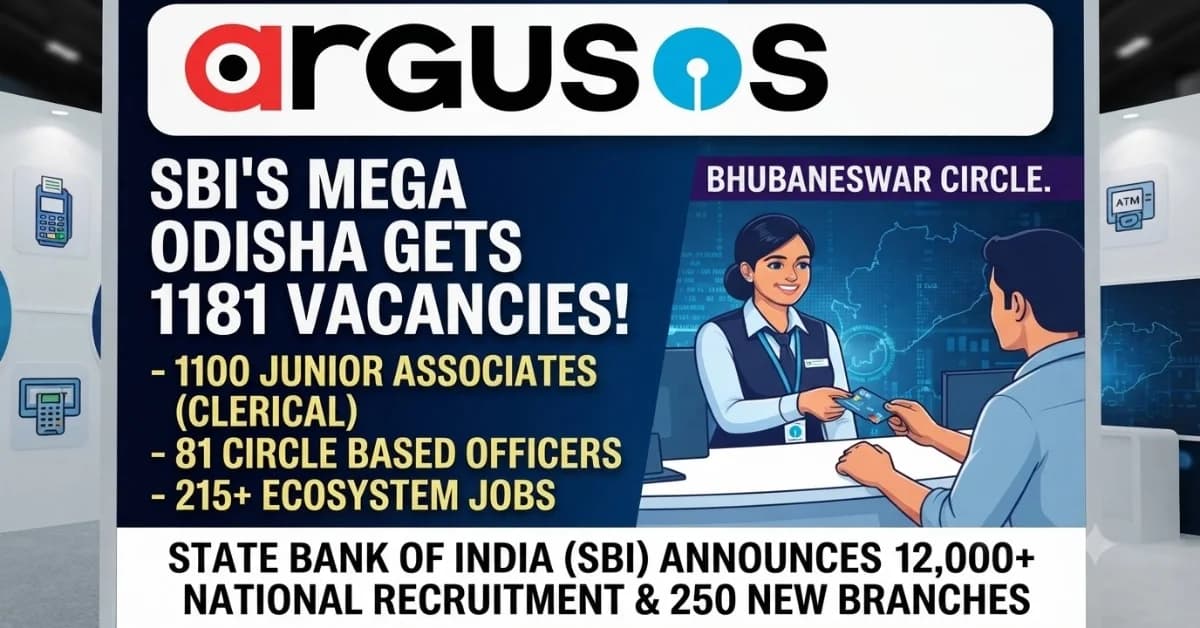
Bhubaneswar: In a major development for banking aspirants across the state, State Bank of India (SBI) Chairman C.S. Setty announced on September 6, 2026, that the country’s largest lender plans to recruit up to 12,000 personnel and establish 250 new physical branches during the ongoing financial year.
The announcement, delivered during a national interaction with the Press Trust of India (PTI), outlines an aggressive structural expansion strategy aimed at filling operational "white spaces" in rapidly emerging rural and commercial micro-markets.
For Odisha, however, the significance of the announcement lies not merely in the national 12,000-job figure but in how the expansion is translating into a sharp increase in circle-specific recruitment.
While Odisha’s general-pool clerical allocation has historically hovered well below 500 placements a year, the current recruitment cycle has pushed the state’s direct localized share to an unprecedented 1,100 regular clerical vacancies under the Bhubaneswar Circle.

📱 Get Argus News App
✨Breaking Down the Numbers: How Much Odisha Gains
The state-level impact of SBI’s nationwide workforce injection is moving through two distinct talent pipelines – a massive entry-level clerical intake and a parallel officer recruitment channel.
The first is the Junior Associate/clerical cadre, where around 9,766 positions are part of the national drive and 1,100 seats have been allocated to Odisha. These frontline Customer Support and Sales roles require proficiency in reading, writing and speaking Odia, giving candidates from the state a significant localized recruitment pool.
The second is the officer pipeline. SBI’s parallel Circle Based Officer (CBO) recruitment cycle has provided 81 dedicated vacancies for the Bhubaneswar Circle – 80 regular positions and one backlog position. The vacancies require a minimum of two years of local commercial banking experience and provide an entry route into Scale-I management for experienced banking professionals.
Taken together, the two pipelines create a substantial recruitment opportunity for Odisha: 1,100 localized clerical vacancies plus 81 circle-based officer positions, even before accounting for the wider impact of SBI’s national PO, SO and LBO recruitment.
Why Odisha's 1,100 Clerical Vacancies Matter
The scale of the clerical allocation becomes clearer when compared with the state’s normal recruitment pattern.
The current drive represents a sharp structural jump over the estimated 350-500 annual baseline for Odisha. Against that historical range, the present 1,100-seat allocation represents an estimated net addition of around 600 to 750 positions.
The increase is not uniform across states. Maharashtra, for instance, has an allocation of 1,718 Junior Associate positions, against a historical baseline of around 800-1,000, while Tamil Nadu has 1,410 positions against a baseline of 500-700.
Karnataka has received 760 positions, compared with an estimated historical range of 350-450; West Bengal has 555 against 250-350; Rajasthan 350 against 150-200; Gujarat 330 against 150-220; Chhattisgarh 287 against 100-150; Telangana 260 against 120-180; and Uttar Pradesh 250 against 120-180.
|
State/UT |
Historical annual baseline |
Current allocation |
Estimated structural addition |
|---|---|---|---|
|
Odisha |
350–500 |
1,100 |
+600 to 750 |
|
Maharashtra |
800–1,000 |
1,718 |
+700 to 900 |
|
Tamil Nadu |
500–700 |
1,410 |
+710 to 910 |
|
Karnataka |
350–450 |
760 |
+310 to 410 |
|
West Bengal |
250–350 |
555 |
+205 to 305 |
|
Rajasthan |
150–200 |
350 |
+150 to 200 |
|
Gujarat |
150–220 |
330 |
+110 to 180 |
|
Chhattisgarh |
100–150 |
287 |
+137 to 187 |
|
Telangana |
120–180 |
260 |
+80 to 140 |
|
Uttar Pradesh |
120–180 |
250 |
+70 to 130 |
The numbers indicate that the current recruitment exercise is not simply a replacement cycle. It is a workforce expansion in which SBI is distributing additional manpower according to the bank’s emerging regional requirements.
For Odisha, the stated drivers include extensive rural penetration and the upgrade of the Bhubaneswar Circle, while the broader national expansion is also targeting industrial, semi-urban and underserved banking markets.
The Bigger Opportunity: PO, LBO and Specialist Officer Hiring
The 12,000-personnel expansion is not restricted to clerical recruitment.
SBI’s officer recruitment architecture also shows a significant increase in management and specialist positions. The recruitment inputs indicate a projected 2,000-2,500 Probationary Officer intake, compared with a standard annual baseline of around 1,500-2,000, implying a structural increase of roughly 500 positions.
For Local-Based Officers (LBOs), the projected intake is 800-1,000, against a baseline of 500-800 – an addition of roughly 200 positions.
The most dramatic expansion is visible in the Specialist Officer (SO) category. The projected intake of 1,500-1,600 is far above the indicated annual baseline of 300-500, representing a potential structural increase of around 1,100-1,200 specialist positions.
|
Cadre |
Standard annual baseline |
Upcoming drive intake |
Structural increase |
|---|---|---|---|
|
Probationary Officers (PO) |
1,500–2,000 |
2,000–2,500 |
+500 |
|
Local-Based Officers (LBO) |
500–800 |
800–1,000 |
+200 |
|
Specialist Officers (SO) |
300–500 |
1,500–1,600 |
+1,100 to 1,200 |
The implications for Odisha extend beyond candidates competing for nationally allocated PO and SO positions. Odisha candidates compete on national merit for PO/SO recruitment, while LBO recruitment provides a more localized route, with candidates eligible through regional criteria.
250 New Branches: The Engine Behind the Hiring Surge
The underlying catalyst for the recruitment peak is SBI’s plan to establish 250 new physical branches across the country.
The expansion is significant because a new branch does not create only one or two jobs. It requires a complete operational workforce — management, operations, customer service and support functions — while simultaneously generating additional workload for credit-processing centres, administrative offices, audit functions and digital infrastructure.
The recruitment inputs estimate that a standard new retail or commercial SBI branch requires five to seven personnel, predominantly across frontline and clerical functions.
For Odisha, the inputs indicate a potential creation of around 10 to 15 new branches, particularly across growing industrial belts and semi-urban micro-markets. On that basis, the direct branch-level employment effect alone could range from 50 to 105 jobs.
But the larger story lies behind the branch counter.
One New Branch, Multiple Layers of Jobs
A physical SBI branch functions as part of a much larger banking ecosystem. The opening of a branch increases demand not only for frontline personnel but also for regional credit processing, legal verification, audit, technology and digital-support functions.
The staffing model supplied for Odisha breaks this effect into three broad segments:
|
Segment |
Staffing impact |
Expected Odisha expansion |
Direct job creation |
|---|---|---|---|
|
New retail branches |
5–7 personnel per branch |
~10–15 branches |
50–105 |
|
Back-end operations & specialist support |
Scaled across administrative clusters |
Regional expansion |
40–60 |
|
Digital banking & technology sourcing |
Local technical recruits |
State-level allocation |
30–50 |
On this calculation, the potential direct employment impact from the wider branch ecosystem could reach up to 215 jobs in Odisha, separate from the 1,100 clerical and 81 officer vacancies already identified in the recruitment cycle.
That distinction is important.
The 1,100 clerical vacancies and 81 officer positions are recruitment opportunities already visible in the hiring architecture, while the additional 215 figure represents the potential staffing impact associated with the projected physical and operational expansion in Odisha.
1. Frontline Branch Staffing: Up to 105 Jobs
The first layer is the visible banking workforce.
For the estimated 10 to 15 new branches, the staffing model envisages a combination of branch management, operations and customer-support personnel.
A typical branch module would include a Branch Head, responsible for credit disbursement, compliance and branch targets; an Operations Officer, handling cash custody, vault and locker systems; and three to five Customer Support Associates handling account opening, customer service, passbook updates and cash-counter operations.
At the upper end of the expansion, seven personnel across 15 branches would translate into 105 immediate localized jobs. The clerical component would also require local Odia-language proficiency.
2. Back-End Expansion: Another 40-60 Jobs
The second layer is less visible but equally important.
A branch does not operate as an isolated unit. New housing loans, vehicle loans, SME applications and other credit proposals generate additional workload for centralized processing centres such as the Regional Credit Processing Cell (RCPC) and other administrative functions.
As transaction and credit volumes rise, SBI would need additional manpower for document verification, legal property vetting, credit assessment, risk management and audit functions.
The conservate inputs estimate this back-end expansion could create another 40 to 60 structural management and specialist roles across Odisha’s administrative clusters.
3. Digital Banking: 30-50 More Jobs
The third layer is the technology ecosystem supporting the physical branch network.
Modern SBI branches increasingly function as hybrid banking units, combining traditional counters with digital banking infrastructure. New branches bring additional requirements for network connectivity, biometric systems, automated passbook printing, cash-deposit machines, ATMs and other technology systems.
The expansion therefore creates demand for IT support personnel, technical supervisors and engineers capable of maintaining these systems across rural and semi-urban banking networks.
The inputs estimate another 30 to 50 jobs in this digital and technical layer, particularly for technical graduates and engineers supporting regional operations.
The Real Employment Story Behind SBI's 12,000 Jobs
The significance of SBI Chairman C.S. Setty’s announcement for Odisha, therefore, extends beyond the headline number of 12,000 national recruitments.
At the most visible level, Odisha gets 1,100 Junior Associate vacancies and 81 Circle Based Officer vacancies. Beyond these, Odisha candidates remain eligible to compete for nationally recruited PO and SO positions, while the projected branch expansion creates another layer of direct operational, administrative and technical employment.
The structural impact is potentially even wider.
A new SBI branch creates a chain reaction: the branch needs frontline staff; higher transaction and credit volumes require back-end processing; new digital infrastructure requires technical support; and the wider expansion increases demand across regional administration, compliance, audit and specialist functions.
In other words, the economic impact of SBI’s expansion is not confined to the people who sit behind its counters.
For Odisha, the immediate recruitment numbers may be counted in four digits. But the larger significance of the expansion lies in the workforce ecosystem being built around the bank’s physical, managerial and digital footprint across the state.
With SBI moving simultaneously on recruitment and branch expansion, the current financial year could therefore mark a major shift in the scale and structure of banking employment opportunities available to Odisha’s workforce.
Related Topics
Explore more stories