



SAMS Odisha +2 First Merit List 2026 Records Big Shifts: Record Applicants Yet 7 in 10 get Dream Choice; Why Girls lead; 2nd List Inside |Exclusive
Key Points
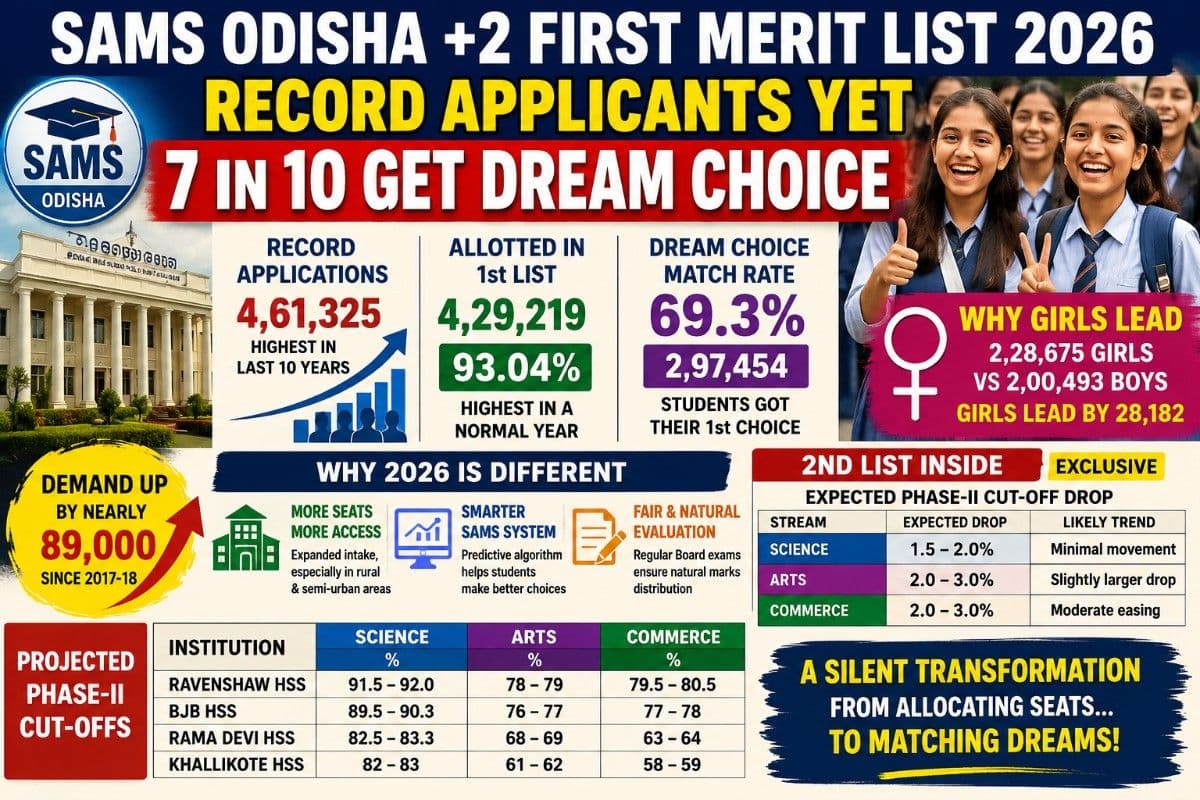
Record-Breaking Precision: Despite an all-time high of 4.61 lakh applications, a historic 69.3% of selected students secured seats in their absolute first-choice institution.
The Pandemic Contrast: While the 93.04% overall allotment matches the 2021 pandemic peak, 2026’s organic grading delivered vastly superior preference matching with minimal system friction.
Widening Gender Gap: Girls have completely consolidated a decade-long demographic shift, securing a massive 28,182-seat lead over boys in the first-phase allocations.
Bhubaneswar: The 2026-27 Plus 2 admission phase -1 cut off list released Wednesday recorded major shifts in the last decade.
Despite attracting a record 4,61,325 applications – the highest in last ten academic sessions – the state managed to allot seats to 4,29,219 students in the very first list, translating into a 93.04% first-phase allotment rate.
That is the highest first-list success rate in a normal examination year during the past decade.
The only comparable figure came in 2021-22 (93.2%), when physical Matric examinations were cancelled and marks were awarded through alternative evaluation, creating an abnormal admission cycle.

📱 Get Argus News App
✨However, this shift alone is not the real story. The bigger story lies elsewhere.
Demand Up by Nearly 89,000, Yet More Students Satisfied
The achievement becomes more significant when viewed historically.
Compared with 2017-18, the number of applicants has increased by 88,825, from 3.72 lakh to 4.61 lakh.
Normally, such a surge would be expected to intensify competition and reduce first-round allotments.
Instead, Odisha recorded its highest first-phase conversion rate in a regular examination year.
The explanation lies in three structural changes occurring simultaneously.
First, the state has steadily expanded higher secondary intake capacity, particularly in rural and semi-urban colleges.
Second, SAMS has evolved from a simple online allotment platform into a predictive admission system, enabling students to make more realistic choices based on historical cut-off trends.
Third, the return to conventional Board examinations has restored a natural distribution of marks, allowing the algorithm to distinguish candidates more accurately than during the pandemic years – means less candidates bagged the same scores.
The Real Story Is Not 93%; It Is 69%
The more remarkable statistic is hidden behind the headline numbers.
Of the students allotted seats, 2,97,454 candidates – nearly 69.3% – secured admission in their first-choice institution.
That is the highest "dream college" match rate recorded since digital admissions began.
A decade ago, less than half the selected students got their first preference.
In 2017-18, only 48.1% obtained their top choice.
Even during the post-pandemic recovery period, the figure remained between 62% and 66%.
This year, it has climbed to almost seven out of every ten selected candidates.
Why 2026 Is Different From 2021
At first glance, the 93.04% allotment rate in 2026 appears almost identical to 93.20% achieved in 2021.
The similarity, however, is misleading.
The two admission cycles were built on completely different foundations.
In 2021, admissions followed alternative evaluation after examinations were cancelled. The resulting mark inflation produced thousands of students with identical scores, overwhelming premier colleges and pushing many high scorers into second or third preferences.
Consequently, although 93% secured seats, only 54% received their preferred college.
In contrast, the 2026 cycle is based on regular Board examinations with naturally distributed marks.
The identical seat-allotment rate has therefore been accompanied by a record 69.3% first-choice success, indicating a system operating with far greater precision and considerably less friction.
Why Historic Gender Shift Continued
Another long-term trend became stronger this year.
Girls have further consolidated their lead in higher secondary admissions.
The first merit list allotted seats to 2,28,675 girls, compared to 2,00,493 boys, giving girls a lead of 28,182.
The shift is remarkable because the situation was exactly the opposite before the pandemic.
Between 2017 and 2020, boys consistently outnumbered girls in first-round allotments.
The turning point came after 2021.
Since then, girls have led every admission cycle, with the gap widening each year – from fewer than 1,000 in 2021 to over 28,000 in 2026.
Education experts attribute this to higher matriculation success rates among girls, improved retention after Class X, expansion of girls' hostels and welfare schemes, and the completely merit-based online admission process that eliminated many local barriers.
What to Expect in Phase II
The first list also provides a fairly reliable indication of the second merit list scheduled later this month.
Historical trends show that cut-offs at premier institutions usually decline by 1.5 to 3 percentage points between the first and second lists in normal years.
Given that nearly 70% of selected students have already secured their preferred institutions, analysts expect only limited movement this year.
The most likely reductions are:
|
Stream |
Expected Phase-II Drop |
Likely Trend |
|
Science |
1.5–2.0 percentage points |
Minimal movement due to high retention |
|
Arts |
2.0–3.0 percentage points |
Slightly larger drop as slide-up options open |
|
Commerce |
2.0–3.0 percentage points |
Moderate easing |
For the state's elite higher secondary schools, the projected second-list cut-offs are:
|
Institution |
Science |
Arts |
Commerce |
|
Ravenshaw HSS |
91.5–92.0% |
78–79% |
79.5–80.5% |
|
BJB HSS |
89.5–90.3% |
76–77% |
77–78% |
|
Rama Devi HSS |
82.5–83.3% |
68–69% |
63–64% |
|
Khallikote HSS |
82–83% |
61–62% |
58–59% |
These projections assume historical slide-up behaviour continues and no extraordinary migration pattern emerges after admissions begin.
A Silent Transformation
Beyond individual cut-offs, this year's admissions reveal something larger.
Odisha's higher secondary admission system has quietly undergone a structural transformation.
More students are applying than ever before.
More students are securing seats in the very first round.
More students are entering the institutions they actually wanted.
And more girls than ever are continuing into higher secondary education.
For a system that once struggled with aspirational overfilling, manual bottlenecks and uncertain second lists, the 2026 admission cycle marks a decisive shift – from simply allocating seats to matching students with the right institutions efficiently.
That may
ultimately prove to be the biggest story behind Odisha's first Plus-II merit
list.
Also Read: PGI 2.0 Report 2025-26: Odisha Ranks 6th In School Education But Learning Outcomes Stagnate| Exclusive
Related Topics
Explore more stories