



Odisha BJP Govt’s Novel Campus Safety Model: From Violence, Stalking,Ragging To Suicide, How ‘Shaktisree’ Seeks To Build A Safety Net For Girl Students
Key Points
Bhubaneswar: What happens when a girl student facing harassment does not trust her professor, principal or even the college administration enough to complain?
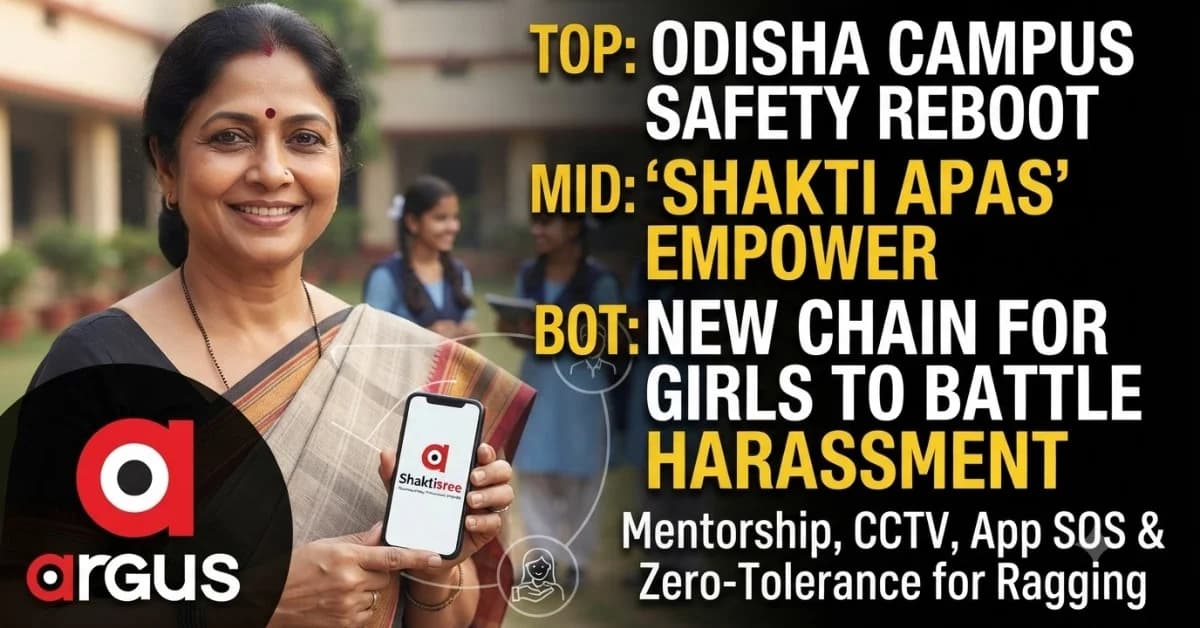
Odisha’s BJP government under Chief Minister Mohan Charan Majhi is attempting to answer that question by redesigning the campus safety architecture itself. Its flagship Shaktisree programme is not merely an anti-harassment campaign; it seeks to create an alternative support and reporting chain for female students facing sexual harassment, stalking, cyberbullying, ragging, intimidation, discrimination, physical or mental harassment and extreme emotional distress.
The government’s approach is significant because it recognises that campus violence does not always begin with a major crime. A stalker threat, repeated intimidation, cyber abuse, ragging or harassment by a senior or faculty member can gradually push a student into isolation and psychological trauma. Shaktisree therefore attempts to connect prevention, reporting, emergency response, accountability and mental-health support into one system.
From complaint box to an independent safety chain
The biggest departure is the introduction of Shakti Apas – experienced women professionals who function as mentors, confidantes and an external layer of oversight.

📱 Get Argus News App
✨The structure creates a three-way campus network: the Shaktisree Saathi, a female peer student leader; the Shaktisree Sanjojika, a female faculty coordinator; and the Shakti Apa, an external woman professional who can validate, escalate or override issues emerging from the campus-level system.
The distinction matters.
In a conventional institutional system, a student may have to approach the same administrative hierarchy in which the alleged harasser or his colleagues operate. Under Shaktisree, the external Shakti Apa is expected to hold private town halls with female students, bypassing college management while listening to complaints and institutional safety concerns.
This creates what the government hopes will be a parallel trust channel – one where a student can speak before a grievance becomes a police case, a dropout or a mental-health crisis.
Stalking, cyberbullying and ragging enter the same safety net
Importantly, the government’s definition of campus safety is not restricted to sexual assault.
The Shaktisree framework explicitly includes ragging, sexual discrimination, cyberbullying, stalker threats and mental or physical harassment, whether perpetrated by senior students or faculty members.
That gives the programme a wider operational canvas.
Ragging, for instance, often survives because junior students fear retaliation or academic and social consequences if they complain against seniors. The Shaktisree app's anonymous reporting mechanism, coupled with private interactions with external Shakti Apas, is designed to provide another route for reporting such cases.
The Higher Education Department has simultaneously pushed a zero-tolerance approach to ragging, including strengthening anti-ragging cells and directions for expulsion of students found guilty of ragging.
The ‘power asymmetry’ problem
Perhaps the most consequential component is the attempt to address the unequal power relationship between a student and a faculty member.
The mandatory Model Code of Conduct is to apply across 16 state universities and 730 colleges, according to govt. It provides for gender sensitisation and ethics and safety training for male faculty and campus staff.
More importantly, the Shaktisree Empowerment Cell is designed to operate outside the ordinary faculty chain. Where a male professor or staff member faces an allegation, the female Sanjojika and Shakti Apa can escalate the matter beyond the principal to the District Collector and state-level internal review mechanism.
That is a fundamental shift—from asking the institution to police itself to creating an external escalation route.
The framework also envisages 24/7 CCTV surveillance linked to security control rooms, annual independent safety audits and action against faculty members who suppress complaints or violate anti-harassment requirements.
A phone becomes a distress device
The other major pillar is technology.
The Shaktisree app is designed as a 24/7 emergency and grievance platform. A student can activate an SOS through the app, use the smartphone's power button three times in rapid succession, or access an integrated 112 emergency response mechanism.
The system is designed to push the student's location to the emergency network while simultaneously alerting three layers of support—the Shaktisree Saathi, Sanjojika and Shakti Apa.
For cases where there is no immediate physical danger but a student is being stalked, harassed or intimidated, the anonymous reporting mechanism allows complaints and supporting text, audio or video evidence to be submitted to the Internal Complaints Committee.
In effect, the government is trying to turn the smartphone from merely a communication device into an early-warning and emergency-response tool.
From harassment to suicide: why mental health is built into the model
The most sensitive dimension of the programme is its attempt to connect campus safety with suicide prevention.
The government fast-tracked Shaktisree following the tragic case of a female student at FM College in Balasore, who died after self-immolation following alleged faculty harassment. The programme therefore treats psychological trauma not as an issue separate from campus security, but as one possible consequence of sustained harassment and intimidation.
This has resulted in a dedicated ‘Safe Campaign’ component.
A six-day mental-health education module is to be integrated into the college curriculum, while Shakti Apas with backgrounds in mental health and public health can conduct mental-wellbeing interventions and identify students showing signs of depression or trauma.
The Shaktisree app is also linked with Tele-MANAS, giving students access to confidential professional psychological support around the clock.
So the architecture effectively runs through four stages:
Harassment/Ragging/Stalking → Safe Reporting → Immediate Protection & Escalation → Psychological Support
Who are the Shakti Apas?
The government has deliberately sought experienced women rather than creating another conventional administrative post.
Each district will initially nominate five eminent women, with the District Collector empowered to increase the number to 10, depending on geography and student population. Each Shakti Apa must visit assigned institutions at least once every three months and submit a report after interacting with students.
The eligibility architecture is also significant: candidates are expected to have at least 15 years of professional experience.
The preferred pool includes legal experts, cybersecurity specialists, retired women police or armed-forces personnel, mental-health counsellors, public-health experts, women-and-child-rights workers, senior educationists and women entrepreneurs.
This means the programme is attempting to bring law + cybersecurity + mental health + institutional experience + mentorship into one campus safety ecosystem.
The accountability loop
The real test, however, will not be the number of app downloads or mentors appointed. It will be whether complaints actually move through the system and produce action.
For that, Shaktisree has built in three measurable accountability mechanisms.
First, every higher education institution is required to submit an independent annual safety audit by December.
Second, the government intends to monitor the digital trail – app usage, SOS alerts, anonymous complaints and their resolution.
Third, the external Shakti Apas are expected to submit quarterly reports to district authorities, creating an independent feedback loop on whether an institution's safety mechanisms are actually functioning.
16 universities, 730 colleges: scale is the biggest challenge
The programme is not being positioned as a small pilot. The inputs indicate that it is being rolled out across all 16 state universities and 730 government/aided colleges.
The rollout itself is being phased. Nominations of Shakti Apas have already been completed in Angul, Balasore, Bargarh, Deogarh, Kalahandi, Khordha, Keonjhar and Rayagada, while the remaining districts are in the next phase.
The scale could become both the programme's biggest strength and its biggest test.
A sophisticated app cannot substitute for rapid police response. CCTV cannot replace a functioning complaints committee. A Shakti Apa cannot be effective if students do not trust the confidentiality of the system. And a safety audit has little value if its findings do not trigger corrective action.
The BJP government's larger experiment
What makes Shaktisree different is therefore not any single component.
It is the combination of an external mentor, female peer leadership, an independent escalation channel, anonymous digital reporting, emergency geolocation, CCTV monitoring, anti-ragging enforcement, safety audits and mental-health intervention.
The BJP government has effectively attempted to move Odisha's campus-safety conversation from “How does a student complain?” to “How does the system detect, protect, respond and remain accountable?”
But there is an important caveat: the statewide rollout is still operationally evolving, and long-term empirical evidence showing a reduction in campus crimes or suicides is not yet available.
The government has established monitoring mechanisms, but their effectiveness will ultimately depend on response times, complaint resolution, institutional compliance and whether students actually feel safe enough to use them.
For Odisha's BJP government, therefore, Shaktisree is more than a welfare scheme. It is an attempt to build a parallel campus safety architecture – one that intervenes before harassment turns into violence, before stalking becomes a criminal assault, before ragging becomes trauma, and before sustained intimidation pushes a vulnerable student towards the edge.
Also Read: Odisha’s Child Predators On Prowl: 6 Girl Children Lured With Eatables In 8 Months; Why Police Are Still Arriving After The Crime| Special Report
Related Topics
Explore more stories