



Boys Shine in JEE / JEE Advanced 2026: Girls Cross Historic 10,000 Qualifier Mark, But India's Toughest Exam Still Has a Glass Ceiling| Exclusive
Key Points
Bhubaneswar: Monday witnessed the unveiling of India's ultimate academic Holy Grail, and the results flashed a historic milestone achieved.
While much of the attention around JEE Advanced 2026 centred on toppers and cut-offs, a deeper look at the results reveals a significant transformation underway.
For the first time, more than 10,000 female candidates have qualified for admission into the country's premier Indian Institutes of Technology (IITs).
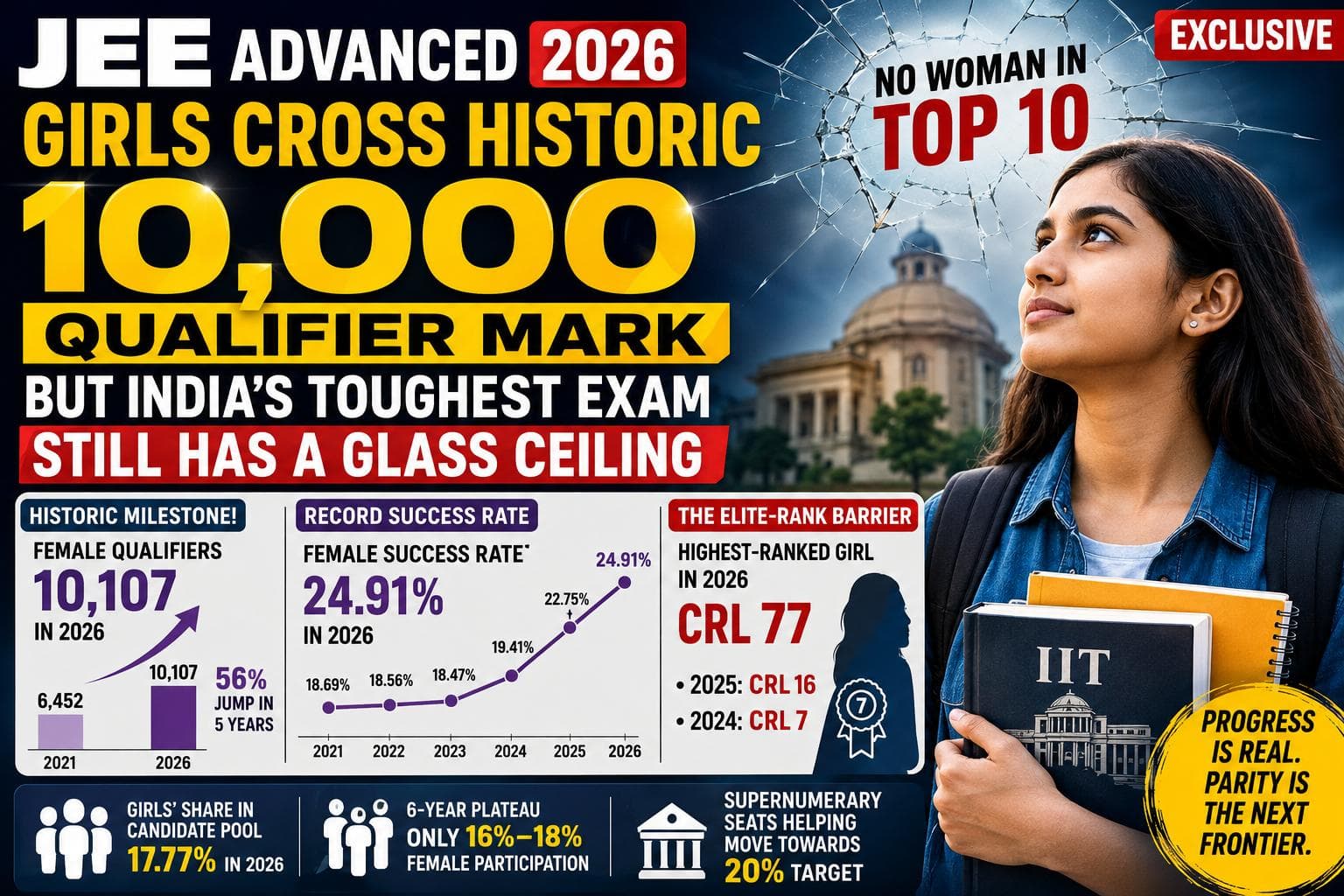
The figure – 10,107 qualified girls – marks a watershed moment in the long-running effort to improve female representation in India's most competitive engineering ecosystem.

📱 Get Argus News App
✨The achievement becomes even more striking when viewed against the backdrop of recent history. In 2021, only 6,452 female candidates qualified JEE Advanced. Five years later, that number has surged by more than 56%, signalling a structural expansion of women's presence in the IIT talent pipeline.
The Rise of the Female Merit Pool
The gains are not merely numerical.
JEE Advanced 2026 also recorded the highest-ever female conversion efficiency. Of the 40,562 girls who appeared for the examination, 24.91% qualified – meaning nearly one in every four female candidates who took the test secured a place on the national merit list.
The trend has been remarkably consistent.
Female qualification rates stood at around 18.5% between 2021 and 2023. They crossed 19% in 2024, rose to 22.75% in 2025, and have now touched almost 25%.
Education analysts view this as evidence that girls are not just participating in greater numbers but are also becoming increasingly competitive within the country's toughest engineering entrance examination.
JEE All About Boy’s World?
A glance at the data over last 5 years reveals a very uncomfortable reality.
Despite the record number of qualifiers, female participation itself appears to have hit a plateau.
For six consecutive admission cycles, women have accounted for only about 16% to 18% of the total JEE Advanced candidate pool. In 2026, girls represented 17.77% of all candidates appearing for the examination.
In other words, while more girls are succeeding, the overall gender composition of the competition remains overwhelmingly male, with more than four out of every five aspirants still being boys.
This suggests that the challenge has shifted from improving performance to expanding the participation base itself.
The Elite-Rank Barrier Remains Intact
Perhaps the most revealing statistic lies at the very top of the merit ladder.
Despite the record-breaking qualification numbers, no female candidate featured in the All India Top 10 of JEE Advanced 2026.
The highest-ranked girl candidate, Arohi Deshpande, secured a Common Rank List (CRL) position of 77.
The pattern is not entirely new.
In 2025, the top female performer finished at CRL 16. The standout exception came in 2024 when Dwija Dharmeshkumar Patel achieved an extraordinary All India Rank 7, becoming one of the rare women to penetrate the single-digit ranks in recent years.
The contrast highlights a two-speed gender story: broad-based gains at the qualification level, but continued underrepresentation in the ultra-elite segment of the examination.
Why the IITs Still Need Special Support Measures
The results also explain why IITs continue to operate supernumerary seats for women.
Introduced to improve gender balance across campuses, the policy has helped female enrolment move closer to the targeted 20% level. Without such interventions, experts argue, historical disparities in access to coaching ecosystems, mentorship networks and STEM (Science, Technology, Engineering and Mathematics) participation could continue to limit representation.
The latest JEE Advanced results indicate that the policy may be working as a bridge rather than a crutch. Female candidates are increasingly proving their merit through stronger qualification rates while gradually expanding their footprint in the national talent pool.
The Big Takeaway
JEE Advanced 2026 may ultimately be remembered not only for producing another batch of IIT-bound students but also for crossing a symbolic barrier.
The 10,000-qualifier milestone demonstrates that India's female engineering talent pipeline is deeper than ever before. Yet the numbers also show that the journey toward true parity remains unfinished.
The next challenge is no longer whether girls can qualify for IITs in large numbers – they clearly can. The challenge now is expanding participation beyond the current 18% ceiling and breaking through the final barrier that separates growing representation from dominance at the very highest ranks.
For India's
IIT ecosystem, the message from JEE Advanced 2026 is clear: the gender gap is
narrowing, but the glass ceiling has not yet disappeared.
Also Read: Plus 2 Results / CHSE 2026 Results: Why Science Records Higher Pass Percentage Than Arts Despite Tougher Curriculum | Exclusive
Related Topics
Explore more stories