



Viksit Bharat / Major Achievements of Modi Govt in Education Sector
·2 months ago·7 min read
Key Points
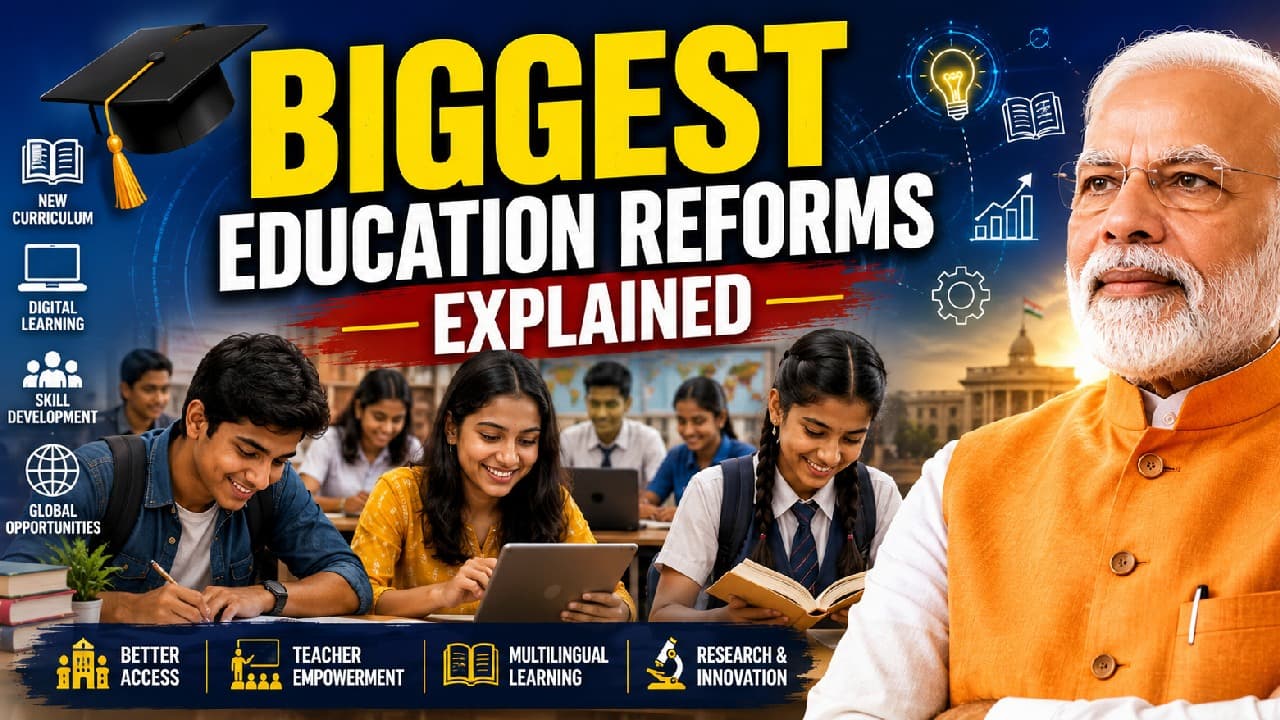
From examination reforms and digital education to multilingual learning and research initiatives, the Narendra Modi government's education agenda over the past decade has been shaped largely around the National Education Policy (NEP) 2020, with a focus on expanding access, improving quality, promoting inclusivity and preparing students for future-ready learning.
New Delhi, Jul 26: Education has been at the heart of the Modi Govt's vision of building a Viksit Bharat.
Guided by the transformative vision of NEP 2020, the Govt. has undertaken the most
comprehensive reforms in India's education system, with a strong focus on access,
equity, quality, inclusivity and future-readiness.
1. Examination Reforms
2. Improving Access To Schooling And Quality Of Learning
3. Promoting Bharatiya Bhasha And Indian Knowledge System
4. Equity and Inclusion
1. Examination Reforms
- The Government ensured the successful and transparent conduct of the NEET (UG) 2026 examination by implementing robust measures through the National Testing Agency (NTA).
- The recommendations of the Radhakrishnan Committee, constituted in 2024 to strengthen the integrity, transparency and efficiency of public examinations, have been implemented in the conduct of NEET.
- Demonstrating a zero-tolerance approach towards examination malpractices,
the Government handed over the investigation into the NEET paper leak to the
CBI, leading to the arrest of 13 people.
- To curb paper leaks, Parliament enacted the Public Examinations (Prevention of
Unfair Means) Act, 2024, India's first comprehensive anti-paper leak law,
- The Union Cabinet has approved amendments to the Public Examinations
(Prevention of Unfair Means) Act, 2024, introducing provisions for fast-track
courts and harsher penalties.
2. Improving Access To Schooling And Quality Of Learning
- Samagra Shiksha is the Government of India's flagship integrated school education scheme, aligned with NEP 2020, covering Balvatika to Class XII. It aims to ensure equitable access, quality and inclusive education through support for foundational literacy and numeracy, teacher development, digital education, vocational education, and strengthened school infrastructure.
- To ensure age-appropriate learning, the Government has implemented a minimum age of six years for Grade I admission in 30 States and Union Territories.
- The Gross Enrolment Ratio (GER) has witnessed significant improvement across school education between 2013–14 and 2025–26, increasing from 86.7% to 89.6% at the Upper Primary level, 73.8% to 81.5% at the Secondary level, and 44.5% to 61.7% at the Higher Secondary level, reflecting expanded access and improved student retention.
- NISHTHA – World's Largest Teacher Capacity Building Programme: NISHTHA
has been expanded to cover teachers at all levels of school education, with around
64 lakh teachers trained so far, significantly strengthening continuous
professional development and improving classroom practices across the country.
- In Higher Education, the Four-Year Undergraduate Programme (FYUP) has been introduced in 718 universities, promoting multidisciplinary learning, research orientation and greater academic flexibility
3. Promoting Bharatiya Bhasha And Indian Knowledge System
- The Govt. has placed Bharatiya Bhashas at the heart of education reforms under
NEP 2020, promoting multilingual learning and preserving India's rich linguistic
heritage both in school and higher education.
- Language inclusion has also been extended to national entrance examinations. The Common University Entrance Test (CUET) is now conducted in 12 Indian languages, with 242 universities participating, ensuring equitable opportunities for students from diverse linguistic backgrounds.
- To create a robust ecosystem of learning resources, the Government has launched the Bharatiya Bhasha Pustak Pariyojana and the ASMITA initiative, under which more than 22,000 textbooks are being developed in 22 Indian languages.
- One of the most transformative aspects of NEP 2020 has been the systematic integration of Indian Knowledge Systems (IKS) into mainstream higher education.
- The Government has also focused on experiential learning and capacity building.
More than 5,500 internships have been offered under IKS programmes, providing
students with practical exposure to India's knowledge traditions.
- Simultaneously, the IKS Division and UGC have trained 1,200 faculty members and 300 master trainers, with the next phase targeting the training of 10,000 faculty members and 1,000 research scholars, creating a robust ecosystem for teaching and research in IKS.
- To strengthen Vedic and Sanskrit education, the Government has established the
Maharshi Sandeepani Rashtriya Veda Sanskrit Shiksha Board, which seeks to
mainstream Veda-Sanskrit education, recognise qualifications awarded under the
Vedic education system, and facilitate seamless academic mobility across
disciplines.
4. Equity and Inclusion

📱 Get Argus News App
✨📰 60 Word News🎬 Argus Podcast📺 Live TV and Breaking News🔔 Free Notification Alerts
Download Free:
- The Government has strengthened equitable and inclusive education by ensuring
that children with special needs receive accessible, technology-enabled and
learner-friendly educational support.
- The dropout rate has declined significantly between 2013–14 and 2025–26, falling from 4.67% to 0.3% at the Primary level and from 14.54% to 9.5% at the Secondary level, reflecting improved student retention and sustained efforts to keep every child in school.
- In Higher Education, OBC enrolment has increased by 60.2%, from 1.13 crore to 1.80 crore, while OBC female enrolment has grown by 72%, from 52.3 lakh to 90.1 lakh, with women now accounting for half of all OBC enrolments
5. Digital and Technology-enabled Education
- The Govt. has leveraged technology to make quality education accessible to every learner, anywhere in the country.
- Rashtriya e-Pustakalaya - The Government has established the Rashtriya ePustakalaya to nurture a lifelong reading culture among children and youth. The national digital library provides books in 22 Indian languages, promoting inclusive access to quality reading material across the country.
- CBSE introduced the Computational Thinking and Artificial Intelligence (CT & AI) Curriculum for Classes 3 to 8, introducing structured AI education formally into the school education system at scale.
6. Skill Education
- Skill education has witnessed unprecedented expansion under NEP 2020, integrating vocational learning, career guidance, and experiential education into the school system to prepare learners for future employment and entrepreneurship.
- Empowering State Boards: To strengthen decentralised assessment and
certification, 29 State Boards have registered on the Kaushalverse portal, 9
Boards are in the process of becoming awarding and assessing bodies, and 2
Boards have already been recognised as awarding and assessing bodies.
- Career Guidance and Student Support: A Career Guidance Book featuring 500
career pathways was launched on 29 July 2024 in both physical and digital
formats to support informed career choices. The Guidelines for 10 Bagless Days
were also released on the same day to promote experiential learning.
- Government has significantly strengthened industry-academia collaboration by expanding opportunities for apprenticeship, experiential learning and skill development, ensuring that higher education is closely aligned with the evolving needs of industry.
- The National Apprenticeship Training Scheme (NATS) has emerged as a key
platform for enhancing employability by providing structured, hands-on industry
training to students and graduates across diverse sectors.
- Over the last five years, 12.94 lakh apprentices have been engaged under NATS,
creating one of the largest apprenticeship ecosystems in the country. The
momentum has accelerated significantly in recent years.
- In FY 2024–25 alone, 5.23 lakh apprentices were engaged—more than double the number in the previous year.
7. Rising National Literacy Rate
- Reflecting the impact of sustained literacy initiatives, the Periodic Labour Force
Survey (PLFS) 2025 reports that India's overall literacy rate (rural and urban
combined) has increased to 81.1%, compared to 74.04% in the Census 2011,
marking a significant improvement in educational attainment across the country.
8. Research and Innovation
- To democratize access to high-quality research resources, the Government has launched the One Nation One Subscription (ONOS) initiative with an allocation of ₹6,000 crore for 2025–2027, providing researchers, faculty and students across the country with seamless access to leading international scholarly journals and databases.
9. Internationalisation
- India is emerging as a global destination for higher education, in line with the vision of NEP 2020.
- India's growing academic excellence is increasingly reflected in global rankings. 52 Indian institutions feature in the QS World University Rankings 2027, a remarkable increase from just 11 institutions in 2015, demonstrating the rapid rise of India's higher education ecosystem on the global stage.
Related Topics
Explore more stories