



From Migrant Plumbers to Global Technicians: Union Minister Dharmendra Pradhan's Big Plan for Odisha Kendrapada’s SIPT| Special Story
Key Points
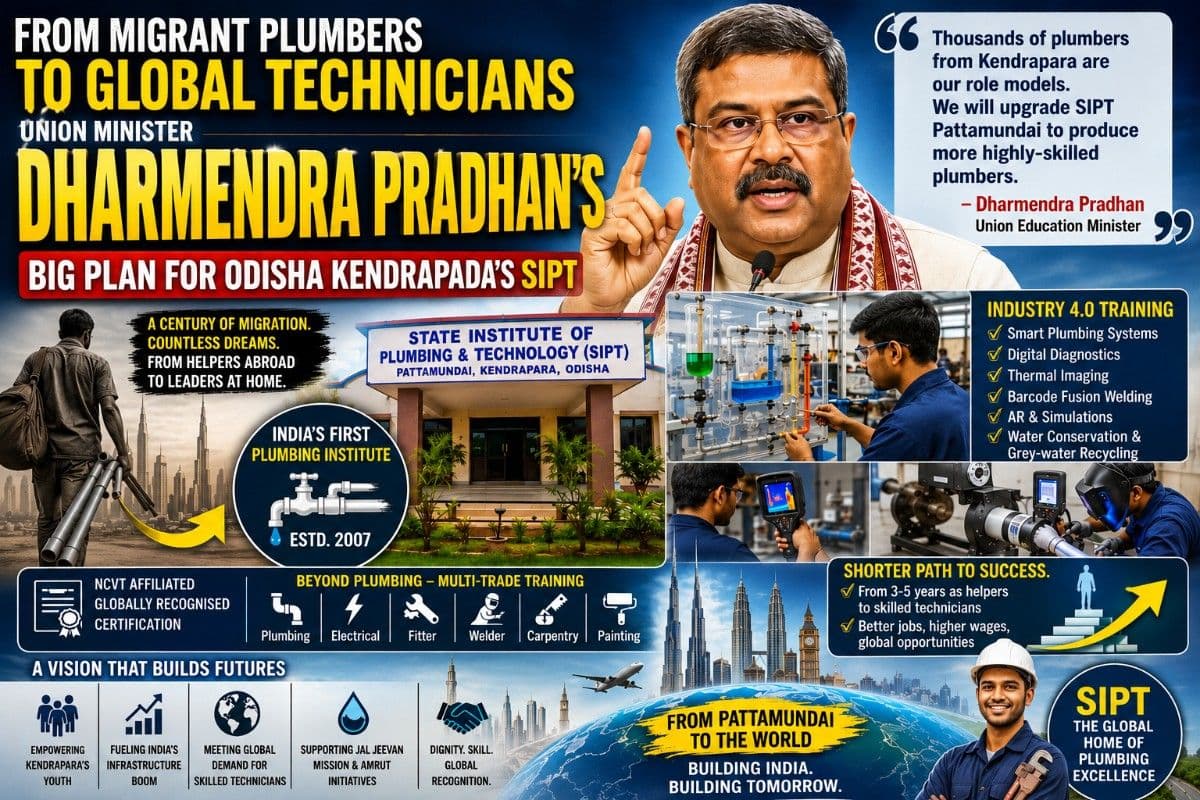
The upgrade aims to evolve Kendrapara's traditional plumbers from informal migrant workers into globally competitive, certified Industry 4.0 technicians.
The upgraded SIPT will bypass linguistic and textbook barriers by using visual interfaces, augmented reality, and hands-on simulation tools in Odia.
By providing internationally benchmarked certifications, the institute will help youth bypass years of low-paid labor and enter global jobs directly as MEP specialists.
Bhubaneswar: For over a century, the story of Kendrapara's Pattamundai has been written through migration.
Every year, thousands of young men left their villages armed with little more than inherited plumbing skills, hoping to carve out livelihoods in Mumbai, Delhi, Dubai or Doha. Many spent years as poorly paid helpers before climbing the professional ladder.
That story may now be on the verge of a fundamental rewrite.
Union Education Minister Dharmendra Pradhan's announcement to upgrade the State Institute of Plumbing and Technology (SIPT) at Pattamundai is not merely about expanding an Industrial Training Institute.

📱 Get Argus News App
✨It signals an attempt to transform India's oldest community of traditional plumbers into a globally competitive, technology-driven workforce equipped for the demands of smart cities, automated buildings and international infrastructure projects.
If implemented in its intended spirit, the move could elevate Odisha from being India's largest exporter of plumbers to becoming one of Asia's foremost producers of certified plumbing technologists.
From Informal Tradition to Institutional Excellence
Established in 2007 by the BJD-BJP led Odisha Government, SIPT occupies a unique position in India's vocational education landscape.
It remains the country's first dedicated institute focused primarily on plumbing education, created to formalise a craft that had already become synonymous with Pattamundai. The institute was launched by the then CM Naveen Patnaik when veteran BJP leader Biswabhushan Harichandan was the industry minister. The institute was inaugurated as a tribute to generations of Kendrapara plumbers whose reputation had spread across India and West Asia long before formal technical education reached the region.
Though funded and managed by the Odisha Government, its courses are affiliated with the National Council for Vocational Training (NCVT), ensuring nationally and internationally recognised certification.
Today, besides plumbing, the institute also offers courses in electrician, fitter, welder, carpenter and painting trades. Yet plumbing continues to define its identity.
More Than an Upgrade
Minister Pradhan's vision goes far beyond increasing student intake or modernising classrooms.
The proposed transformation seeks to reposition SIPT as a Centre of Excellence capable of training technicians for Industry 4.0 – where plumbing is no longer confined to laying pipes but extends to digital water management, intelligent building systems, automated fire protection, grey-water recycling and sensor-based infrastructure.
Modern construction projects – from skyscrapers and airports to hospitals and smart townships – now require technicians capable of understanding sophisticated Mechanical, Electrical and Plumbing (MEP) systems.
The future plumber is expected to work alongside architects, automation engineers and digital building managers rather than merely functioning as a skilled tradesman.
That is the niche the upgraded SIPT hopes to fill.
Breaking the Myth That Higher Education Alone Creates Skilled Professionals
Perhaps the most revolutionary aspect of the proposed upgrade lies in its educational philosophy.
Unlike conventional engineering education that relies heavily on textbooks, mathematics and English-language instruction, the upgraded SIPT model recognises that technical competence can be built differently.
Students entering the institute with an eighth-standard qualification would increasingly learn through visual interfaces, colour-coded systems, augmented reality demonstrations and hands-on simulations.
Instead of memorising complex hydraulic equations, trainees would observe coloured water flowing through transparent plumbing systems.
Instead of manually calculating heat cycles for advanced polymer welding, barcode-enabled fusion equipment would automatically determine operating parameters.
Diagnostic tools using thermal imaging and acoustic sensors would replace guesswork in leak detection.
The emphasis shifts from academic theory to practical engineering execution.
It is a recognition that modern technology itself has become intelligent enough to simplify complex calculations, allowing technicians to focus on precision, quality and operational excellence.
Turning Community Knowledge into Global Certification
Pattamundai enjoys an advantage unmatched by most vocational institutes.
For generations, plumbing has been a community profession.
Almost every aspiring trainee has grown up watching a father, uncle, neighbour or elder sibling work in metropolitan cities or overseas construction sites.
This inherited practical understanding creates an informal knowledge base long before formal training begins.
SIPT's role has been to convert this inherited skill into certified professional competence.
The proposed upgrade strengthens this bridge further by combining traditional craftsmanship with advanced technologies while continuing to teach primarily in Odia, making sophisticated engineering concepts accessible without linguistic barriers.
The result could be an educational model uniquely suited to India's rural vocational ecosystem.
Ending the Long Apprenticeship Trap
Historically, migration from Kendrapara followed a predictable pattern.
Young workers often spent three to five years as helpers under senior plumbers before earning independent wages.
The absence of recognised certification limited promotions despite years of experience.
Advanced training at SIPT could significantly shorten this pathway.
Industry-ready technicians equipped with specialised certifications may increasingly enter projects directly as junior supervisors, commissioning technicians or MEP installation specialists rather than beginning at the bottom of the labour hierarchy.
For overseas employment, internationally benchmarked certification could also reduce dependence on informal contractor networks while improving wage negotiations and career mobility.
Meeting India's Infrastructure Boom
The timing of the proposed upgrade aligns with India's expanding infrastructure ambitions.
Mega urban projects, industrial corridors, smart cities, airports and modern healthcare facilities require sophisticated plumbing systems integrating water conservation, wastewater recycling, fire safety and automated monitoring.
Simultaneously, flagship programmes such as the Jal Jeevan Mission and AMRUT are creating sustained demand for skilled technicians capable of managing increasingly complex water infrastructure.
Traditional plumbing skills alone are no longer sufficient.
The industry now demands professionals capable of reading advanced blueprints, operating digital diagnostic equipment and managing integrated utility systems.
An upgraded SIPT could emerge as a critical supplier of such manpower.
A Global Opportunity
International demand may prove even more significant.
Countries across the Gulf, Europe and parts of Southeast Asia continue to face shortages of certified skilled workers in building services.
Many destinations increasingly require competency assessments based on internationally accepted technical standards.
A world-class SIPT curriculum aligned with global certification frameworks could substantially improve employment prospects for Odisha's youth while reducing the risks of wage exploitation often faced by migrant workers.
The transition would represent more than economic mobility – it would enhance professional dignity.
Beyond a Training Institute
The significance of Pradhan's announcement extends beyond Pattamundai.
It represents a broader shift in India's vocational education philosophy – from producing workers for today's jobs to creating specialists for tomorrow's industries.
If successfully implemented, SIPT could become a national template for upgrading traditional occupational clusters through modern technology rather than replacing them.
Just as Kota became synonymous with engineering coaching and Surat with diamond polishing, Pattamundai may eventually emerge as India's undisputed capital of advanced plumbing technology.
For generations, Kendrapara's plumbers have quietly built cities across India and the Gulf.
The next
chapter aims to ensure they are no longer remembered merely as migrant workers –but
recognised as globally certified engineering professionals trained at one of
the world's most specialised plumbing institute.
Also Read: NEET 2026 New Rules Explained: How NTA's Historic Extra 15 Minutes and 4 Rough Pages Can Boost Scores, Especially for First-Time Aspirants
Related Topics
Explore more stories