



EXCLUSIVE| Odisha Student Union Polls 2026 Trend: Why the 8-Year Ban Failed to Stop Campus Violence at Habitual Hotspots
Key Points
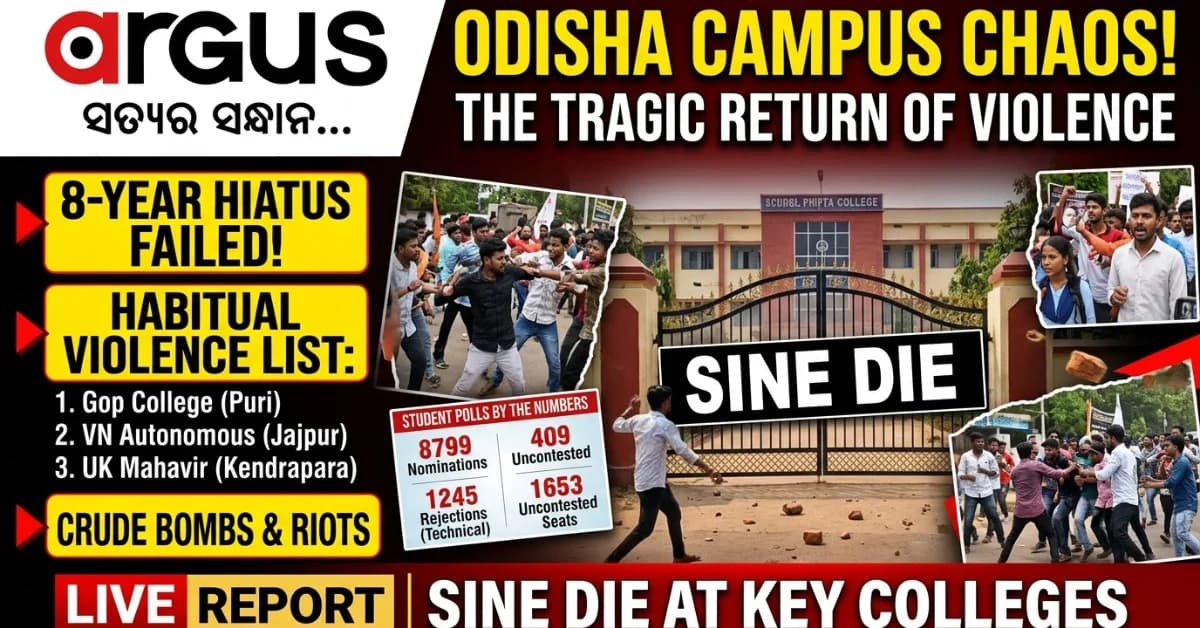
The eight-year hiatus failed to curb campus unrest as repeat-offender institutions like Gop College and Vyasanagar Autonomous College collapsed into violence and declared sine die ahead of the October 15 polls.
Disqualification under strict Lyngdoh Committee guidelines—particularly attendance rules and academic backlogs—triggered widespread student agitations and mass nomination rejections.
A total of 6,708 approved candidates remain in the active election fray across 347 colleges and 13 state universities, alongside 1,653 seats won uncontested.
Bhubaneswar: This autumn, college campuses in Odisha witnessed the vibrant return of student democracy after an eight-year hiatus. However, when the state government greenlit the resumption of student union elections for October 2026, a sharp sense of anxiety accompanied the announcement.
For eight long years, the primary justification for the ban on polls had been campus safety and the preservation of a peaceful academic environment. As the scheduled voting date draws near, those familiar gears of campus militancy have begun to grind once more.
By the time the scrutiny and withdrawal phases concluded, a tragic historical pattern reasserted itself: the colleges that forced authorities to cancel elections and declare sine die this year are the exact same institutions that have spent decades on the state’s habitual violence list.
A Structural Pattern, Not Spontaneous!

📱 Get Argus News App
✨Campus violence in Odisha is rarely spontaneous.
It is a structured, cyclical phenomenon passed down through successive generations of student cartels.
When looking closely at the list of institutions that collapsed into chaos ahead of the scheduled October 15 polls, the names read like a historical ledger of unrest from 2017 and the years preceding it.
The structural triggers remain completely unchanged: nomination disputes, the strict enforcement of attendance criteria, and the use of external muscle to intimidate rival factions.
The most glaring example of this recurring cycle is Gop College in the Puri district.
In the lead-up to the 2026 elections, the campus transformed into a virtual battle zone. Following a series of bitter disputes during the nomination scrutiny phase, rival student factions clashed openly on the streets outside the main gates. Stone-pelting, the destruction of public property, and the physical blocking of administrative blocks followed, forcing the college principal to take the ultimate step: cancelling the election completely and declaring an indefinite closure (sine die).
To those familiar with the history of Odisha’s student movement, this outcome was entirely predictable.
In 2017, the very last year elections were attempted before the ban, Gop College suffered the exact same fate.
That year, intense physical clashes between two heavily armed student groups left multiple individuals injured, forcing the local administration to scrap the polls.
Gop College is a repeat offender, an institution where the local political ecosystem views the student union not as a forum for debate, but as a territory to be captured by physical force.
A similar story of historical repetition played out in Jajpur district at Vyasanagar (VN) Autonomous College.
Days before the 2026 nomination papers could even be formalized, the campus was rocked by the explosion of crude bombs hurled near the college premises.
The incident sparked immediate panic, leading to student protests, road blockades, and a complete breakdown of internal discipline. Realizing that student safety could not be guaranteed, authorities postponed the election indefinitely.
Turning back the pages of history to 2017 reveals a striking parallel.
In that cycle, Vyasanagar College was also forced to call off its polls due to group clashes and the open brandishing of weapons inside the hostel blocks.
The eight-year hiatus did nothing to dilute the volatile political culture of the area; the local networks simply waited out the ban and resumed their violent tactics the moment the election window reopened.
In Kendrapara, UK Mahavir College in Pattamundai declared sine die following a total breakdown of law and order immediately after the nomination scrutiny step.
This campus, too, has a long history of election-related vandalism and threats directed toward faculty members, mirroring its 2017 status when elections were scrapped due to widespread student rioting.
The Contagion Effect
The contagion of unrest spread to other notorious pockets as well.
In Bhadrak, Bhadrak Women’s College saw its polls cancelled due to escalating safety concerns and extreme indiscipline.
While historically more stable than the co-educational hubs, the spillover of regional political tension onto the institution's doorsteps proved too volatile for the administration to manage.
Raw Data Trends
To understand the true scale of this phenomenon, one must look at the raw student election statistics released by the Higher Education Department following the closure of the final withdrawal window.
The hard numbers paint a picture of a deeply divided student body, where the desire for democratic participation is constantly at war with institutional instability.
Initially, across the entire state of Odisha, a massive wave of enthusiasm saw a total of 8,799 nominations filed across all universities and colleges.
This high number indicated that an entire generation of students, who had never experienced a campus vote, was eager to participate. However, the strict implementation of the guidelines – specifically the mandatory 75% attendance requirement and the disqualification of candidates with criminal antecedents or back papers – acted as a massive filter.
During the intense scrutiny phase, a staggering 1,245 nomination forms were rejected statewide due to technical errors, low attendance, or academic deficiencies.
This mass rejection of nominations was the primary spark that ignited the historical powder keg of violence.
In campuses like Deogarh Degree College, the moment a presidential candidate’s nomination was rejected during scrutiny, the student body erupted in agitation, forcing an immediate sine die declaration.
Following the rejections, the withdrawal window saw an additional 439 candidates officially pull their names from the races, often under intense pressure from rival factions looking to secure uncontested victories.
When the dust finally settled, the actual final figure of approved candidates remaining in the active fray across the state was exactly 6,708.
The statistical breakdown of these 6,708 active contestants reveals the concentration of the remaining election infrastructure:
- The College Segment: A total of 6,362 student candidates survived both scrutiny and withdrawals to face direct voting across 347 contesting colleges.
- The University Segment: A total of 346 student candidates remained on the final ballot across 13 state universities.
- The Uncontested Component: Completely separate from the active fray, a total of 1,653 individual seats across the state were swept unopposed, eliminating the need for voting in those specific slots.
The Bottomline: Why Time Changed Nothing
When we synthesize these statistics against the cancellations, a clear conclusion emerges.
Out of the total pool of institutions that initially attempted to hold elections, a distinct minority of chronically troubled campuses accounted for the vast majority of police deployments and shutdowns.
The eight-year freeze failed to alter the violent ground reality because the structural triggers of campus unrest remain completely unaddressed. The friction this year stems from two main operational flashpoints:
· The Scrutiny Filter: The strict implementation of the Lyngdoh Committee guidelines – specifically the mandatory 75% attendance rule – led to the mass rejection of popular student leaders. Instead of accepting the disqualifications, student factions routinely chose to agitate, clash with faculty, and force institutional shutdowns.
·
Territorial Control: For major student wings, specific colleges are vital grooming grounds for
future mainstream politicians. When a rival faction threatens a complete sweep,
local criminal elements and external muscle are frequently deployed to disrupt
the process entirely, preferring a cancellation over a public defeat.
Also Read: EXCLUSIVE| 1,653 Seats Won Unopposed: How Big-Ticket MLAs Are Shaping Odisha Student Union Election Battles
Related Topics
Explore more stories