



NEP / Education Must Nurture Minds, Not Burden Them
·2 months ago·4 min read
Key Points
Forcing students into highly competitive environments that do not match their abilities or interests serves neither the child nor the nation. Such an approach creates frustration, anxiety, and sometimes irreversible tragedy.
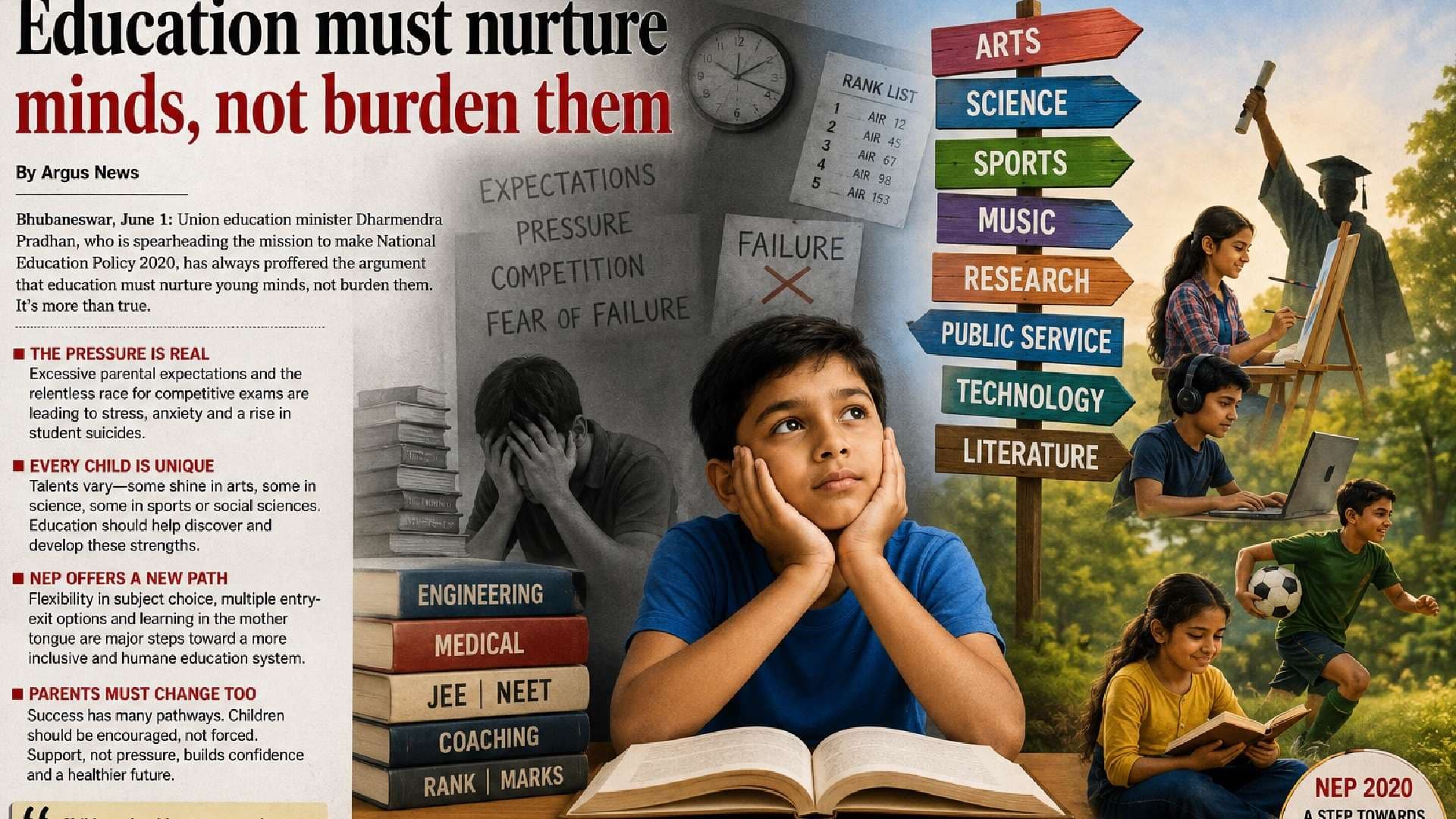
Bhubaneswar, Jun 1: Union education minister Dharmendra Pradhan, who is spearheading the mission to make National Education Policy 2020, has always proffered the argument that education must nurture young minds, not burden them. It’s more than true.
Let’s sample this.
A recent seminar on the National Education Policy (NEP) offered a thought-provoking discussion on one of the most pressing concerns of our time—the increasing psychological pressure faced by students and the urgent need to create a more humane and flexible education system.
One of the speakers made a striking observation: today's parents are becoming increasingly possessive about their children's careers. Many discourage games, hobbies, and recreational activities, believing that every waking hour should be devoted to studies and competition. From an early age, children are pushed into a relentless race to secure success in highly competitive fields such as engineering and medicine.
This excessive focus on academic achievement comes at a heavy cost. Students are often burdened with expectations that may not align with their interests, abilities, or aspirations. They are taught to view success as the only acceptable outcome and failure as a catastrophe. As a result, many develop intense psychological stress and anxiety.
The tragic rise in student suicides across the country reflects this disturbing reality. Every year, reports emerge of young aspirants preparing for competitive examinations in coaching hubs such as Kota and other cities ending their lives after failing to meet expectations. Many of these students are not unable to learn; rather, they are unable to cope with the enormous pressure placed upon them.
The problem lies in the mindset that every child must excel in a narrow set of professions. Society often measures merit solely through admission to engineering colleges, medical institutions, or civil services. This approach ignores a fundamental truth: every child is unique.
Human beings are born with different talents and aptitudes. Some possess artistic abilities, some have a flair for technology, some excel in social sciences, while others are gifted in sports, literature, research, entrepreneurship, or public service. These natural strengths constitute their competitive advantage. Education should help students discover and develop these strengths rather than force them into careers chosen by others.
A child learns best when learning becomes a source of joy rather than fear. Education should inspire curiosity, creativity, and self-confidence. Unfortunately, when learning becomes associated with anxiety, punishment, and constant comparison, it damages both mental health and intellectual growth.
This is where the National Education Policy offers a refreshing alternative. The NEP seeks to move away from rigid academic structures and provides students with greater flexibility in choosing subjects according to their interests. Students can combine science with arts, arts with technology, and pursue interdisciplinary learning without artificial barriers.
The policy also introduces multiple entry and exit options in higher education, allowing students to pause their studies and resume them later. This recognises the reality that education is not always a linear journey and that students may need flexibility to respond to personal circumstances.
Another noteworthy feature of the NEP is its emphasis on learning in one's mother tongue or local language, particularly in the foundational years. This is an important step toward educational inclusion. A student's intelligence cannot be measured by proficiency in English alone. Many learners possess exceptional understanding and creativity in their native languages. Providing educational opportunities in local languages enables them to learn with confidence and comprehension.
In essence, the National Education Policy attempts to transform education from a burdensome process into an enjoyable and meaningful experience. However, policy reforms alone cannot achieve this objective. Parents must also embrace a change in attitude.
The present generation of parents must recognise that success has many pathways. Not every child is destined to become an engineer or a doctor. Careers in politics, economics, sociology, literature, journalism, research, public administration, arts, and countless other fields contribute equally to society's progress.
Forcing students into highly competitive environments that do not match their abilities or interests serves neither the child nor the nation. Such an approach creates frustration, anxiety, and sometimes irreversible tragedy.
Children should not grow up in an atmosphere of fear. They should be nurtured in an environment that is supportive, encouraging, and conducive to their natural development. When students are allowed to pursue their interests and cultivate their inherent talents, they not only achieve personal fulfilment but also contribute more meaningfully to society.
Education should not be about producing identical success stories. It should be about helping every child discover the best version of themselves. That is the true spirit of education, and perhaps the most important message of the National Education Policy.
Let’s sample this.
A recent seminar on the National Education Policy (NEP) offered a thought-provoking discussion on one of the most pressing concerns of our time—the increasing psychological pressure faced by students and the urgent need to create a more humane and flexible education system.
One of the speakers made a striking observation: today's parents are becoming increasingly possessive about their children's careers. Many discourage games, hobbies, and recreational activities, believing that every waking hour should be devoted to studies and competition. From an early age, children are pushed into a relentless race to secure success in highly competitive fields such as engineering and medicine.
This excessive focus on academic achievement comes at a heavy cost. Students are often burdened with expectations that may not align with their interests, abilities, or aspirations. They are taught to view success as the only acceptable outcome and failure as a catastrophe. As a result, many develop intense psychological stress and anxiety.
The tragic rise in student suicides across the country reflects this disturbing reality. Every year, reports emerge of young aspirants preparing for competitive examinations in coaching hubs such as Kota and other cities ending their lives after failing to meet expectations. Many of these students are not unable to learn; rather, they are unable to cope with the enormous pressure placed upon them.
The problem lies in the mindset that every child must excel in a narrow set of professions. Society often measures merit solely through admission to engineering colleges, medical institutions, or civil services. This approach ignores a fundamental truth: every child is unique.
Human beings are born with different talents and aptitudes. Some possess artistic abilities, some have a flair for technology, some excel in social sciences, while others are gifted in sports, literature, research, entrepreneurship, or public service. These natural strengths constitute their competitive advantage. Education should help students discover and develop these strengths rather than force them into careers chosen by others.
A child learns best when learning becomes a source of joy rather than fear. Education should inspire curiosity, creativity, and self-confidence. Unfortunately, when learning becomes associated with anxiety, punishment, and constant comparison, it damages both mental health and intellectual growth.
This is where the National Education Policy offers a refreshing alternative. The NEP seeks to move away from rigid academic structures and provides students with greater flexibility in choosing subjects according to their interests. Students can combine science with arts, arts with technology, and pursue interdisciplinary learning without artificial barriers.
The policy also introduces multiple entry and exit options in higher education, allowing students to pause their studies and resume them later. This recognises the reality that education is not always a linear journey and that students may need flexibility to respond to personal circumstances.
Another noteworthy feature of the NEP is its emphasis on learning in one's mother tongue or local language, particularly in the foundational years. This is an important step toward educational inclusion. A student's intelligence cannot be measured by proficiency in English alone. Many learners possess exceptional understanding and creativity in their native languages. Providing educational opportunities in local languages enables them to learn with confidence and comprehension.
In essence, the National Education Policy attempts to transform education from a burdensome process into an enjoyable and meaningful experience. However, policy reforms alone cannot achieve this objective. Parents must also embrace a change in attitude.
The present generation of parents must recognise that success has many pathways. Not every child is destined to become an engineer or a doctor. Careers in politics, economics, sociology, literature, journalism, research, public administration, arts, and countless other fields contribute equally to society's progress.
Forcing students into highly competitive environments that do not match their abilities or interests serves neither the child nor the nation. Such an approach creates frustration, anxiety, and sometimes irreversible tragedy.
Children should not grow up in an atmosphere of fear. They should be nurtured in an environment that is supportive, encouraging, and conducive to their natural development. When students are allowed to pursue their interests and cultivate their inherent talents, they not only achieve personal fulfilment but also contribute more meaningfully to society.
Education should not be about producing identical success stories. It should be about helping every child discover the best version of themselves. That is the true spirit of education, and perhaps the most important message of the National Education Policy.

📱 Get Argus News App
✨📰 60 Word News🎬 Argus Podcast📺 Live TV and Breaking News🔔 Free Notification Alerts
Download Free:
Related Topics
Explore more stories