



Special Report|From Wildlife Smuggling to Daylight Robbery: Bichitrapur’s Mysterious Orangutan Rescue to Baliapal’s 3rd Bank Loot, Baleswar Keeps Odisha on Edge
Key Points
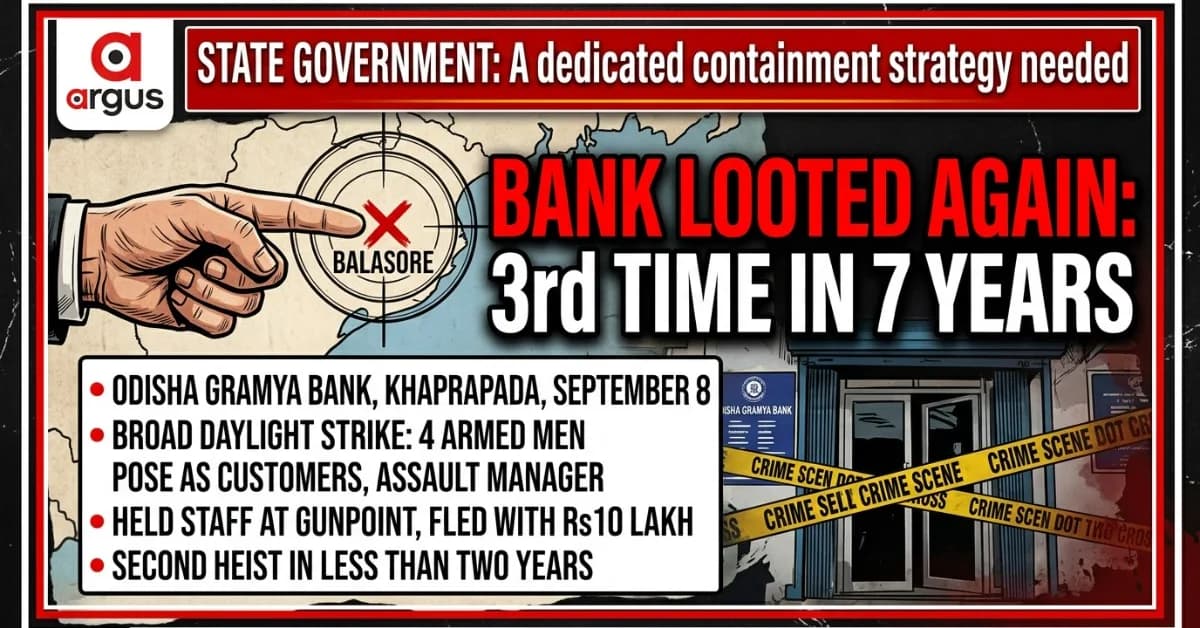
Repeated Targets: The Odisha Gramya Bank branch at Khaprapada in Baliapal faced its third robbery in seven years and the second in under two years.
Tactical Shift: Armed criminals transitioned from overnight break-ins to aggressive daylight raids, exploiting human vulnerability over physical infrastructure.
Border Vulnerability: Inter-state criminal networks leverage proximity to the West Bengal border for rapid escapes and investigative hurdles.
Bhubaneswar:The warning could hardly be starker. One banking institution in Balasore has now faced its third loot in seven years – and the second in less than two years. But this time, the criminals changed one crucial element of their playbook: they dared to strike in broad daylight.
Baleswar once again found itself at the centre of two very different but potentially connected criminal threats on Tuesday.
The district had already been in the spotlight over the shocking discovery of five orangutan infants in Bichitrapur forest, with the circumstances pointing towards the activities of wildlife smugglers operating through the Odisha–West Bengal corridor. On Tuesday, the focus shifted to organised bank crime, with Rs10 lakh looted from the Odisha Gramya Bank branch at Khaprapada in Baliapal.
The geographical reality is difficult to ignore. Balasore sits close to the West Bengal border, giving criminal networks an important logistical advantage. From wildlife trafficking to bank robberies, the district has increasingly found itself exposed to inter-state criminal networks capable of moving people, vehicles and contraband across jurisdictions.

📱 Get Argus News App
✨The pattern is particularly worrying for law enforcement because Balasore Police had arrested bank robbery suspects from West Bengal nearly two months ago in a similar case. The Rasalpur bank heist of July 14 was cracked by August 3, with three suspects arrested in West Bengal. Yet barely five weeks later, another gang chose a strikingly similar template to hit another bank in the same district.
The question now goes beyond the Rs10 lakh stolen from Khaprapada. The larger issue is whether the State Government and Odisha Police need a dedicated containment strategy to break the spine of proliferating inter-state organised crime gangs operating along the Odisha–West Bengal corridor.
A Decade of Bank Crime: Balasore’s Warning Pattern
The latest Khaprapada robbery is not an isolated incident. A look at major bank and high-value cash robberies in Balasore over roughly the last decade shows an increasingly aggressive pattern –from conventional night-time break-ins to armed daylight raids by organised groups.
|
Year |
Location |
What happened |
|---|
2026 – Sept
Odisha Gramya Bank, Khaprapada, Baliapal
Four armed men entered posing as customers, assaulted the branch manager, held staff at gunpoint and fled with around ₹10 lakh in broad daylight.
2026 – July
Odisha Gramya Bank, Rasalpur
Six masked, bike-borne men stormed the bank during the afternoon and assaulted the manager before escaping with cash.
2026 – July
Khaira ATM
A gang used a Mahindra Thar SUV to drag an entire ATM out of its kiosk before breaking it open elsewhere.
2024 – Nov
Odisha Gramya Bank, Khaprapada
Criminals carried out an overnight break-in using gas cutters to breach iron grills and windows and loot cash.
2024 – July
Bartana Bazar
Four armed men intercepted petrol-pump employees outside a government bank, shot one employee in the leg and snatched a bag containing ₹12 lakh.
2023 – April
Union Bank of India, Chandaneswar, Bhograi
Seven-eight armed robbers entered posing as customers, held people hostage and escaped with an estimated ₹45–49 lakh in cash and gold jewellery.
2019–21
Various locations
Police archives and local accounts record smaller-scale safe-breaking and night-time robbery attempts, including an earlier attack on the Khaprapada branch.
The trend is significant. The crime landscape is no longer limited to opportunistic burglars breaking into unattended premises. Professionalised groups are increasingly combining reconnaissance, motorcycles, firearms, disguises, violence and rapid escape logistics.
The 2023 Chandaneswar investigation was particularly revealing, exposing an inter-state network with links stretching across the Odisha–West Bengal border.
The Same Bank, Three Strikes in Seven Years
The most alarming part of the latest robbery is that the target was not new.
The Odisha Gramya Bank branch at Khaprapada Square has now been struck three times in roughly seven years.
The first known incident came around 2019, when miscreants broke into the building at night after smashing the rear skylight and stole computers and other office assets.
The second attack came in November 2024, when criminals returned with a far more sophisticated plan. Instead of simply breaking through a door or window, they climbed to the upper floor and used gas cutters to cut through iron grills and windows, targeting the branch under cover of darkness.
And now, on September 8, 2026, the same institution has been hit for the third time.
But the latest operation was fundamentally different.
Four masked men reportedly entered the branch posing as customers, suddenly produced weapons, assaulted the manager and held the staff at gunpoint before grabbing around ₹10 lakh and escaping on motorcycles.
That makes the latest attack the second strike on the same branch in less than two years.
The repetition raises questions over whether a branch that has already been breached twice remained sufficiently protected against another attack – and whether criminals had continued to treat it as a known soft target.
Why Did the Modus Operandi Shift from Night to Day?
The most striking change is the move from stealth to speed.
The 2024 attack was a conventional night burglary with criminals attempting to physically breach the building. The September 2026 operation was the opposite: walk through the front door, neutralise human resistance, grab readily accessible cash and disappear within minutes.
As per a senior police official, it could be that enhanced physical security following the earlier attack may have narrowed the possibility of another prolonged night operation. Reinforced grills, shutters, alarms and other security measures make a quiet overnight assault considerably more difficult.
That creates a new vulnerability.
The daylight model exploits human vulnerability rather than infrastructure. The gang does not need to spend time cutting grills, drilling walls or searching for a way inside. It simply enters as customers, pulls out weapons, creates panic and forces employees to surrender control.
Speed becomes the primary defence.
The Baliapal gang appears to have taken that logic to its extreme – relying on helmets, masks and an ultra-fast getaway rather than attempting to destroy CCTV equipment.
The Rasalpur robbers reportedly removed the CCTV hard disk, costing them valuable time. The Khaprapada attackers instead left the system intact and prioritised a rapid exit.
That is a significant tactical evolution.
July 14 vs September 8: How the Two Daylight Heists Compare
|
Feature |
Rasalpur Bank Heist – July 14, 2026 |
Khaprapada Bank Heist – Sept 8, 2026 |
|---|---|---|
|
Bank |
Odisha Gramya Bank, Rasalpur |
Odisha Gramya Bank, Khaprapada |
|
Timing |
Broad daylight / afternoon |
Broad daylight / afternoon |
|
Number of robbers |
Six |
Four |
|
Entry strategy |
Entered as customers |
Entered as customers |
|
Weapons |
Armed |
Armed |
|
Treatment of staff |
Manager assaulted when he resisted |
Manager violently assaulted at counter |
|
CCTV strategy |
CCTV DVR reportedly ripped out and stolen |
CCTV hard disk left intact |
|
Loot |
Cash worth lakhs |
Around ₹10 lakh cash |
|
Escape |
Bike-borne |
Bike-borne |
|
Police outcome |
Cracked; three suspects arrested in West Bengal by Aug 3 |
Investigation underway |
The similarities are too striking to dismiss.
Both were daylight attacks on Odisha Gramya Bank branches, both involved masked men arriving on motorcycles, both involved criminals posing as customers, and both relied on armed intimidation and violence against bank staff.
The biggest difference is what the criminals did with the CCTV system – and that difference may reveal how quickly organised gangs learn from previous police investigations.
If Rasalpur Was Cracked, Why Did Another Gang Dare the Same Tactic?
This is perhaps the most important question facing investigators.
The Rasalpur robbery took place on July 14. By August 3, Balasore Police had cracked the case and arrested three suspects in West Bengal.
Yet barely five weeks later, another gang carried out an operation strikingly similar to it.
One explanation lies in the compartmentalised structure of inter-state criminal networks.
A gang does not necessarily function as one central organisation where the arrest of one group collapses the entire network. Separate cells can operate independently, with different members, vehicles, communication channels and logistics.
The Baliapal gang could therefore have calculated that the arrests following Rasalpur had exposed one cell but not necessarily the entire network.
The second calculation may have involved speed.
The Rasalpur gang reportedly spent valuable time removing the CCTV DVR. The Khaprapada robbers appear to have drawn the opposite lesson: do not waste time destroying evidence. Keep faces concealed, grab the cash and leave.
The third calculation was geography.
Khaprapada and the wider Baliapal area offer access to rural roads and routes towards Basta, Jaleswar and the West Bengal border. That gives criminals a potential escape advantage unavailable to gangs operating deep inside the State.
The fourth calculation may have been the assumption that border jurisdiction creates investigative friction.
If criminals can move into West Bengal quickly, the initial police response has to evolve from a local pursuit into an inter-state operation. Every minute between the robbery and the establishment of a coordinated border blockade becomes valuable to the offenders.
The fifth calculation could be the branch's status as a known soft target.
A bank that has already been successfully breached contains valuable intelligence for criminal networks. The gang may know its layout, access points, surrounding roads, staffing pattern and security vulnerabilities either through direct reconnaissance or information passed through criminal contacts.
And finally, the gang may have believed that CCTV is evidence, not an immediate physical obstacle.
A camera can record a robbery, but it cannot stop four armed men from taking Rs10 lakh and leaving within minutes.
That is why the latest operation represents more than another bank robbery.
It shows criminals adapting.
The Larger Threat: Balasore as an Inter-State Crime Corridor
The bank robberies fit into a broader pattern of organised crime moving across the Odisha–West Bengal border.
Investigations into previous Balasore cases have pointed towards criminal networks involving operatives from North 24 Parganas and East/West Medinipur, working with local contacts in Balasore.
The operating model is particularly difficult for conventional policing.
Local criminals can provide reconnaissance and information about the terrain, while outsiders can execute the robbery precisely because they are less familiar to local police. Vehicles can be stolen, rented or fitted with swapped or cloned registration plates, creating further complications for investigators.
In the latest case, Balasore Sadar and Baliapal police teams are reportedly cross-checking motorcycle registration numbers captured by nearby CCTV cameras against the Vahan database.
The police have also activated heightened border checking, including vigilance at Laxmannath and Udaypur (Talasari) and temporary choke points across Baliapal, Jaleswar and Basta.
But containment cannot end with post-robbery naka checking.
What Balasore Needs Now
The recurring bank attacks suggest the need for a broader inter-state crime containment architecture rather than case-by-case policing.
That should include:
Permanent intelligence coordination with West Bengal Police in border districts.
Real-time sharing of bank robbery suspects and vehicle intelligence across the two States.
A dedicated database of repeat-targeted bank branches and ATM locations.
Mapping of rural escape corridors frequently used by inter-state gangs.
Immediate sharing of CCTV footage across police stations and border checkpoints.
Greater security audits of rural and semi-urban bank branches that have previously been targeted.
Special monitoring of gangs using stolen or cloned motorcycle registration plates.
Stronger coordination between district police, intelligence units and specialised crime teams.
Because the pattern emerging from Balasore is no longer simply about thieves breaking into banks.
It is about organised criminal cells testing the limits of a border-sensitive policing system.
And the most worrying message from Tuesday's Khaprapada robbery is this: a gang knew that a similar daylight bank heist had already been cracked, yet still believed it could pull off the same playbook again.
That confidence – more than the ₹10 lakh loot itself – is the real crime warning confronting Balasore.
Also Read: EXCLUSIVE | The 2 AM Forest Drop, Bengal Trail & 2015 Eluru Clue: Rescue of Five Baby Orangutans in Baleswar Exposes Interstate Wildlife SmugglingRelated Topics
Explore more stories