



Special Report| Naidu Commission File Missing Case: The Inside Story of How Odisha Crime Branch Outsmarted Top Bureaucrats
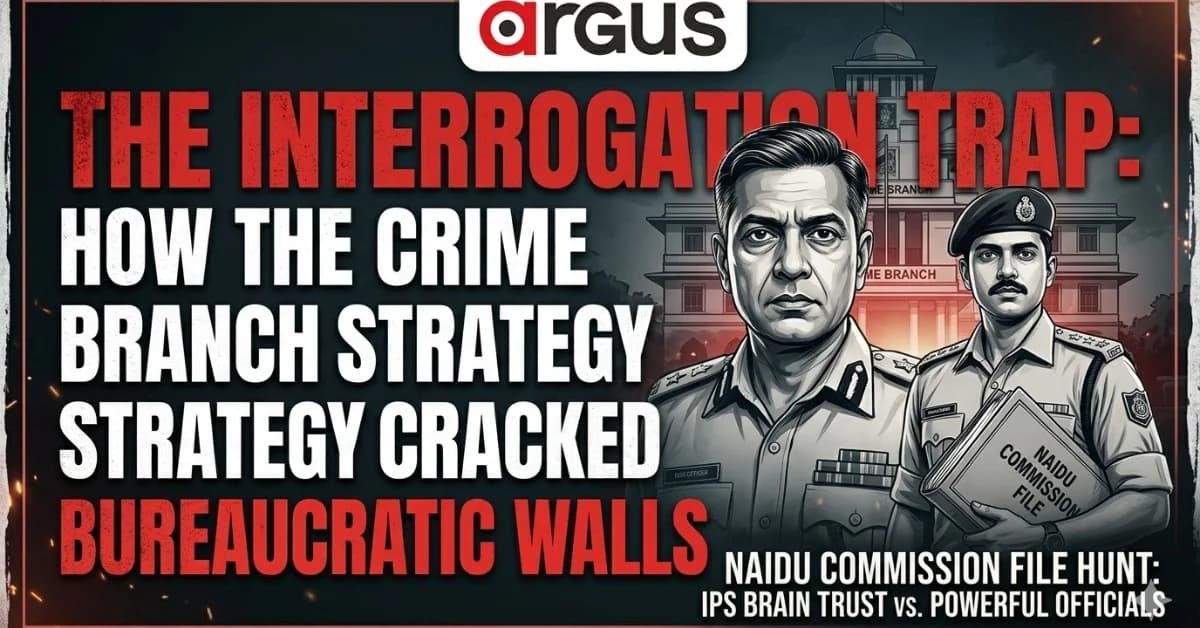
Key Points
High-Level Breakthrough: CID Crime Branch successfully records statements from three powerful former top-tier bureaucrats regarding the missing Justice Naidu Commission report.
Elite IPS Command: Led by DG Vinaytosh Mishra and SP Anirudha Routray, combining strategic institutional muscle with forensic precision to bypass bureaucratic resistance.
Methodological Trap: Utilized an airtight questionnaire built on internal CMO transit logs and dispatch registers to outmaneuver bureaucratic loopholes.
Bhubaneswar: The CID Crime Branch of Odisha has dramatically accelerated its investigation into the disappearance of the highly sensitive Justice Naidu Commission report file, registering a major breakthrough by officially recording the statements of three ultra-powerful, former top-tier bureaucrats.
This significant development has sent shockwaves through the corridors of power in Bhubaneswar.
For months, speculation ran wild regarding whether the state's premier investigative agency would truly crack down on the senior administrative framework of the previous regime. Now, official sources confirm that the Crime Branch has officially pierced that veil, putting an end to weeks of tactical delays and bringing the high-profile trio directly into the legal fold.
The case, which centers on the mysterious vanishing of a file containing explosive findings on the 2008 Kandhamal riots and the assassination of Swami Laxmanananda Saraswati from the inner sanctum of the Chief Minister’s Office (CMO), had previously reached a total standstill.

📱 Get Argus News App
✨The breakthrough follows a highly publicized failure by the Bhubaneswar-Cuttack Commissionerate Police, whose initial attempts to physically summon the seasoned officials crumbled under bureaucratic non-compliance.
In a swift, calculated pivot, the Crime Branch bypassed the administrative gridlock, establishing a quiet but unyielding process that successfully secured the depositions of the three individuals. While the agency has deliberately kept the precise mode of their interrogation – whether conducted via secure virtual channels, detailed written responses, or undisclosed physical depositions – entirely out of the public domain, the completion of this phase marks a massive operational triumph.
The Architecture of Command: The Elite IPS Brain Trust
A primary point of public debate surrounding this monumental probe is how a state police apparatus successfully commands the compliance of seasoned bureaucrats who spent decades dictating state policy.
Observers initially argued that a standard police officer would lack the authoritative leverage to break through the defensive walls of elite former IAS officers. However, the structural reality of this Crime Branch operation reveals a carefully engineered, multi-tiered hierarchy designed specifically to match-and overpower-the political weight of the subjects under investigation.
While the frontline execution of the case falls upon the designated Investigating Officer, the strategic intellect, legal immunity, and institutional muscle of the probe are driven entirely by a formidable brain trust of the Indian Police Service (IPS).
At the absolute apex of this investigation stands Vinaytosh Mishra, IPS, a highly decorated 1993-batch officer serving as the Director General (DG) of the CID Crime Branch.
Known throughout his career for architectural precision and an unyielding adherence to legal protocol, DG Mishra provides the ultimate umbrella of command.
Under his direct mandate, Supervising Officer and SP Anirudha Routray acts as the crucial operational bridge, vetting every piece of evidence, approving every procedural step, and ensuring that no bureaucratic technicality can be used to derail the state’s momentum.
By placing the full structural weight of a 1993-batch IPS officer at the helm, the state government sent an unmistakable message: this is not a routine police inquiry, but a top-tier sovereign investigation.
The senior IPS command handles the political fallout, coordinates directly with the present Chief Minister’s Office, and project-manages the legal landscape. This high-level insulation allows the ground team to operate with total independence, completely immune to the traditional spheres of influence that senior bureaucrats typically leverage.
The Frontline Specialist: DSP Ashutosh Mishra’s Unique USP
With the IPS command guarding the perimeter and steering the macro-strategy, the tactical, hands-on task of dismantling the paper trail was handed to the agency's finest forensic specialist: Deputy Superintendent of Police (DSP) Ashutosh Mishra.
In the intricate world of state police operations, a DSP is rarely chosen for a case of this magnitude based on chronological seniority alone. Instead, DSP Mishra was specifically headhunted for his unique professional Unique Selling Proposition (USP)—his unmatched expertise in auditing complex administrative workflows and tracking institutional data trails.
DSP Mishra is widely recognized within the department as an "investigative purist." He is an officer who relies entirely on cold, empirical data rather than the theatrical, high-pressure interrogation tactics often depicted in popular media.
His career profile is defined by a meticulous ability to read between the lines of government dispatch registers, tracking physical document handovers across multiple state departments. In an inquiry where the primary target is a missing piece of paper, Mishra’s specific skill set is invaluable. He does not view the subjects as untouchable political titans; he views them strictly as past custodians of an official chain of custody.
His selection as the primary Investigating Officer (IO) was a deliberate, calculated move by the Crime Branch leadership. While a senior IPS officer handles the overarching institutional authority, the physical laws of criminal procedure require an IO who can meticulously compile the case diary, document transit receipts, and cross-examine technical logs without missing a single statutory beat. DSP Mishra’s meticulous nature ensures that every statement recorded is legally airtight, providing the precise empirical foundation that the senior IPS command requires to build an unassailable prosecution.
Engineering the Interrogation: The Anatomy of a Master Questionnaire
The true masterstroke of this breakthrough development lies in how the Crime Branch formulated its line of questioning.
Knowing they were dealing with brilliant administrative minds who intimately understand the loopholes of government rules, DSP Mishra and his specialized legal-technical core team spent weeks constructing a highly methodical, airtight questionnaire. The agency explicitly avoided broad, generalized questions that could be easily deflected with vague or defensive answers. Instead, the questionnaire was built backward, using the government’s own internal documentation as the baseline.
Before a single question was drafted, Crime Branch DG Vinaytosh Mishra issued formal demands to the Chief Minister’s Office, the Chief Secretary’s Office, and the Home Department. These branches were compelled to appoint dedicated nodal officers tasked with mining internal archives. These nodal officers handed over absolute, unedited access to physical handling logs, internal transit receipts, and secret department dispatch registers.
Armed with these exact dates and signatures, DSP Mishra’s team mapped out the precise trajectory of the file. The resulting questionnaire was designed as a procedural trap, structured around three immutable pillars:
The Chain of Custody Logs: The questionnaire confronted the officials with exact historical data. It bypassed generic inquiries about the file's whereabouts, asking instead: "The file arrived at the CMO via the Chief Secretary's office on October 19, 2016. Who was the exact desk officer who signed the physical acknowledgment receipt, and under whose explicit cabinet allocation was it stored?"
The Regime Transition Window: The investigation focused intensely on the critical period of June 4, 2024 – the day the state assembly election results triggered a historic change in government. The questionnaire demanded granular details: "During the chaos of the administrative transition on June 4, what specific protocols were implemented to secure classified judicial files, and who authorized the movement of folders out of the secure CMO database?"
The Mandate of Culling: Bureaucrats routinely protect themselves by citing official orders. The Crime Branch anticipated this, framing questions to establish accountability: "Was this document misplaced, or was it systematically moved or destroyed under specific verbal or written instructions? If so, identify the authority that issued that directive."
The Catalyst: Learning from the Commissionerate Police Failure
To fully appreciate the precision of the Crime Branch’s current breakthrough, one must look back at the chaotic collapse of the initial investigation led by the Bhubaneswar-Cuttack Commissionerate Police. In July, when the case was fresh, the Capital Police Station attempted to utilize standard police protocol. Operating under the newly enacted Bharatiya Nagarik Suraksha Sanhita (BNSS), local police issued a series of blunt, physical summons notices.
These notices ordered the high-profile trio - including former Private Secretary V.K. Pandian, along with senior figures Rajesh Verma and Upendra Nath Behera – to present themselves physically at the Office of the Assistant Commissioner of Police (ACP) Zone-1 in Bhubaneswar. They were instructed to bring their personal electronic devices and any relevant physical archives to trace the file's movement.
However, the local police severely underestimated the tactical maneuvering of their subjects. Citing pre-scheduled international travel, sudden geographical displacements, and administrative commitments, the bureaucrats simply bypassed the physical appearance deadlines. This overt defiance created a massive public and political embarrassment for the local police, demonstrating that standard precinct-level pressure was entirely ineffective against individuals of such immense stature.
Seeing his local police force completely stonewalled, Chief Minister Mohan Charan Majhi took decisive action on July 27. Stripping the Commissionerate Police of the case, he officially signed the order transferring the entire probe to the CID Crime Branch. The CB immediately wiped the slate clean, re-registering the case under a fresh regular FIR (CID CB P.S. Case No. 09 of 2026) under the Bharatiya Nyaya Sanhita (BNS).
Learning
from the tactical errors of the local police, the Crime Branch
abandoned the rigid insistence on a public, physical spectacle at a
local police station. Recognizing that the primary goal was securing
legally binding statements rather than a media photo-op, the IPS
brain trust allowed for a flexible, hybrid interrogation framework.
By adapting to geographical realities while holding a firm legal
line, they successfully secured the cooperation of all three
individuals. With these critical statements now successfully recorded
and locked away in the Crime Branch vaults, DSP Ashutosh Mishra and
DG Vinaytosh Mishra are meticulously cross-referencing the
testimonies against the physical transit logs, bringing the state of
Odisha closer than ever to discovering exactly who buried the truth
of the Naidu Commission report.
Also Read: Swami Laxmanananda Report That Never Reached the Assembly: Former CMO Big Officials Under SIT Scanner; Law Ordains 5 Years' Jail| Analysis
Related Topics
Explore more stories