



Special Report| From Reels to Real Crime: Why Odisha DGP Fears Bishnoi Gang Penetration Into State
Key Points
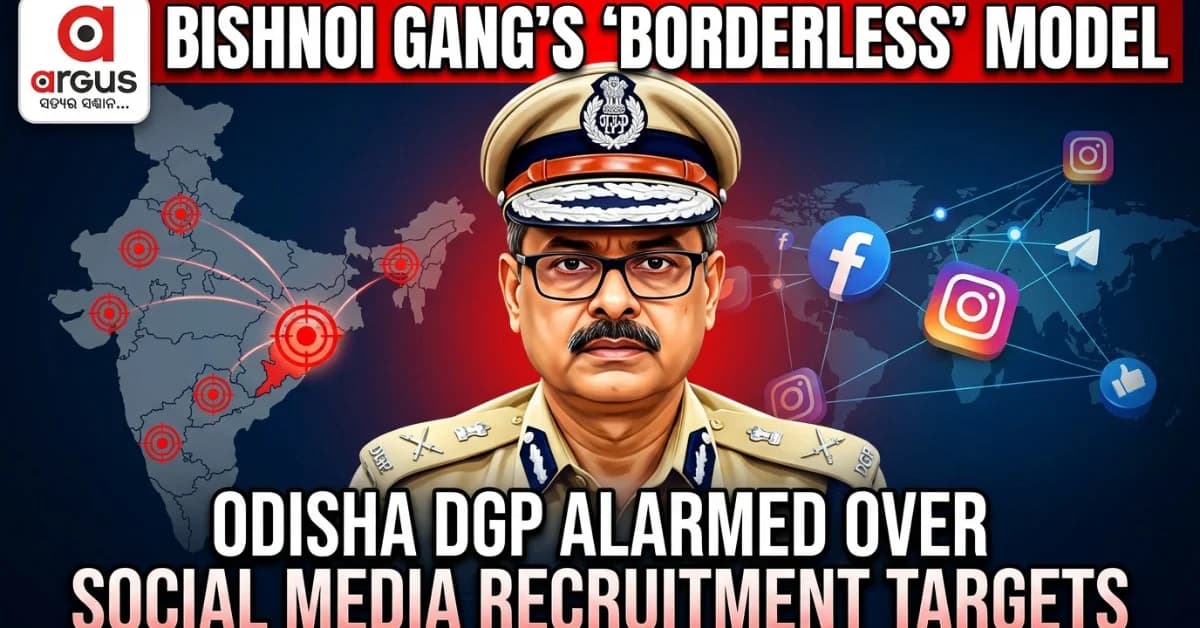
Paradigm Shift in Threat Perception: Odisha DGP Binaytosh Mishra explicitly named the Lawrence Bishnoi syndicate alongside Naxalites during the 67th Police Commemoration Day.
The Borderless Gig-Economy Model: Intelligence warns of syndicates utilizing encrypted apps and local cyber-recruitment to deploy disposable contract shooters across states.
Overhauling Odisha’s Security Apparatus: The state police are pivoting from counter-insurgency to aggressive cyber-intelligence, urban monitoring, and inter-state coordination.
When Odisha’s Director General of Police (DGP), Binaytosh Mishra, stood before the ranks at the Police Headquarters in Cuttack during the 67th Police Commemoration Day, his words carried an unusual, striking gravity.
For decades, the defining beast of Odisha’s internal security infrastructure was Left-Wing Extremism (LWE) – the deep-woods guerrilla warfare of Naxalite cadres operating along the volatile Red Corridor. Yet, in a singular, calculated sentence, the state’s top cop reoriented the horizon of threat perception.
“It may be Naxalites or the Lawrence Bishnoi gang, we will respond firmly,” the DGP declared, vowing that the police force would answer any emerging threat “in their own language.”
To seasoned crime analysts and intelligence operatives, the explicit mention of the Lawrence Bishnoi syndicate was far more than passing rhetoric.

📱 Get Argus News App
✨It was a formal acknowledgment of a paradigm shift in Indian organized crime: a public admission by the state’s police architecture that the footprint of India's most notorious, pan-India syndicate is no longer confined to the north-western badlands. Instead, there is a distinct, strategic apprehension that the gang’s highly sophisticated, borderless machinery could penetrate the coastal state of Odisha.
At the heart of this concern lies the Bishnoi gang’s revolutionary, terrifyingly effective operational blueprint – a highly decentralized, gig-economy model of hiring contract shooters that has completely blindsided traditional state-border policing.
The Borderless Syndicate Model
Historically, Indian underworld syndicates – from the D-Company of Mumbai to the local mafias of Bihar and Uttar Pradesh – relied on a rigid, hierarchical structure. Gangsters were groomed within specific neighborhoods, bound by local loyalties, and climbed a defined ladder of criminal promotion. Logistics, weaponry, and personnel moved in tandem, leaving a physical, traceable trail for state intelligence bureaus.
The Lawrence Bishnoi syndicate has entirely dismantled this legacy framework. Operating as a decentralized corporate enterprise, the gang functions through an insulated, multi-layered structure where the top leadership – often incarcerated in high-security prisons or pulling strings from safe havens in Canada, Azerbaijan, and western Europe – is completely decoupled from the ground-level executioners.
1. Top Tier Leadership
· Location / Status: Incarcerated or International Havens
· Role: Strategic command & direction
2. Mid-Level Coordinators
· Role: Sourcing logistics, funds, and weapons
3. Localized Freelance Shooters
· Role: Statewise sleeper cells & tactical execution
In this model, executioners are treated as disposable, short-term contractors. The gang does not maintain a massive, permanent standing army of shooters across India. Instead, they leverage digital platforms to scout, groom, and hire local, disenfranchised youths on a project-by-project basis, deploying them like freelance assets in the gig economy.
The Statewise Recruitment Playbook
The mechanism through which the Bishnoi network taps shooters state-by-state is a Masterclass in modern cyber-enabled crime. It relies on a three-pronged strategy of radicalization, financial lure, and absolute operational compartmentalization.
1. Digital Scouting via Hyper-Local Grievances
The syndicate’s talent acquisition begins long before a target is selected. Mid-level digital recruiters actively monitor localized social media groups, Instagram Reels, and regional messaging boards where youth glorify gun culture, regional rivalries, or specific ideological narratives. By identifying angry, impressionable, or financially desperate young men, recruiters initiate contact through encrypted applications like Signal, Telegram, or Threema.
2. The Isolation of Logistics
A shooter hired under this decentralized model operates in complete blindness. A shooter recruited from a state like Bihar or Haryana to execute a hit in Maharashtra or Rajasthan will typically not know who their co-executors are until hours before the crime.
· The Weapon Drop: Weapons are procured by a completely separate cell and dropped at a dead-letter location mapped via GPS coordinates.
· The Funding: Money is routed through intricate hawala networks or digital wallets, ensuring the shooter receives only a fraction upfront for operational costs, with the promise of a massive payout post-execution.
· The Target Profile: Detailed surveillance of the target is frequently conducted by a third, localized reconnaissance team, meaning the actual shooters simply arrive, execute, and attempt to vanish.
3. Disposable Assets
Because these shooters are recruited from disparate states and possess zero direct knowledge of the gang’s upper management, their arrest carries virtually no risk to the core syndicate. If a shooter is caught or killed in a police encounter, the network simply cuts the digital link and recruits another asset from a different geography. This makes traditional interrogation methods largely ineffective, as the foot soldiers genuinely do not know who pulled their strings.
Reading Between the Lines: Why Odisha, Why Now?
For the Odisha Police, the threat of this decentralized model hitting home is a looming logistical nightmare.
For the past twenty-five years, the state's security apparatus has been masterfully optimized for counter-insurgency. Through elite units like the Special Operation Group (SOG) and the District Voluntary Force (DVF), Odisha successfully pushed back Maoist cadres, reclaiming vast swaths of the cut-off areas in Malkangiri, Koraput, and Kandhamal.
However, the architecture required to fight a forest-dwelling guerrilla army is fundamentally different from the infrastructure needed to combat a tech-driven, urban organized crime syndicate.
An anti-Naxal operation relies on heavy territorial control, dense jungle tracking, and disrupting physical supply lines of food and local ammunition.
Conversely, intercepting a Bishnoi-style cell requires aggressive cyber-intelligence, deep monitoring of dark-web communication channels, inter-state police coordination, and specialized financial tracking to choke out-of-state hawala flows.
The Odisha DGP’s public declaration is a proactive warning shot aimed squarely at this structural vulnerability.
Intelligence reports across India indicate that as law enforcement intensifies pressure on traditional gang strongholds in Punjab, Haryana, Delhi, and Mumbai, these syndicates are aggressively searching for newer, untapped territories to recruit foot soldiers, park extorted funds, or establish sleeper modules.
With its rapidly growing urban centres like Bhubaneswar and Cuttack, alongside a booming industrial and mining sector, and when recent reels of youth glorifying gun culture have been noticed, Odisha presents an attractive, unexploited frontier for sophisticated extortion rackets.
The Tactical Shift in Police Architecture
By placing Naxalism and the Lawrence Bishnoi gang on the exact same pedestal of threat severity, DGP Mishra has signaled a massive operational axis for the Odisha Police. Insiders suggest this shift will heavily impact several key areas of the state's policing architecture:
· Overhauling the State Intelligence Wing (IW): The state’s intelligence apparatus, long focused on tribal belts and extremist movements, is heavily pivoting toward urban monitoring. This includes setting up specialized cyber-surveillance cells dedicated exclusively to tracking regional recruitment patterns on social media.
· Strengthening Inter-State Cooperation: Since the Bishnoi gang thrives on cross-border logistics – using shooters from one state, weapons from another, and safehouses in a third – Odisha is tightening its data-sharing channels with the National Investigation Agency (NIA) and the anti-gang units of Delhi, Punjab, and Maharashtra.
· Cracking Down on Local Criminal Ecosystems: The top cop's warning serves as a stern message to local history-sheeters and gang leaders within Odisha. The administration is signaling that any attempt by local criminals to act as a bridgehead or logistic provider for national syndicates will face catastrophic state retaliation.
An Unyielding Stance Against Modern Terror
The modern criminal syndicate no longer needs to physically capture territory to dominate it; it merely needs an internet connection, a local desperate youth, and a smuggled weapon. By invoking the spectre of the Bishnoi gang, the Odisha DGP did not imply that the state has already fallen prey to this menace. Rather, it was an exhibition of cold, calculating foresight.
It was an announcement to the citizens of Odisha that their police force is refusing to be caught flat-footed by the evolution of crime. As the sun sets on the era of Naxalite insurgency in the state, the police architecture is actively remodeling its walls to face an entirely different, digitally driven storm.Also Read:Special Report | Tiger Shroff Gunfire: Is Lawrence Bishnoi Gang Monopolising Bollywood Protection Payouts?
Related Topics
Explore more stories