



Special Report| End of the Dithering Era: How Odisha’s BJP Government Replaced Political Hesitation with a Surefooted Drive Against Cow Smuggling Syndicates
Key Points
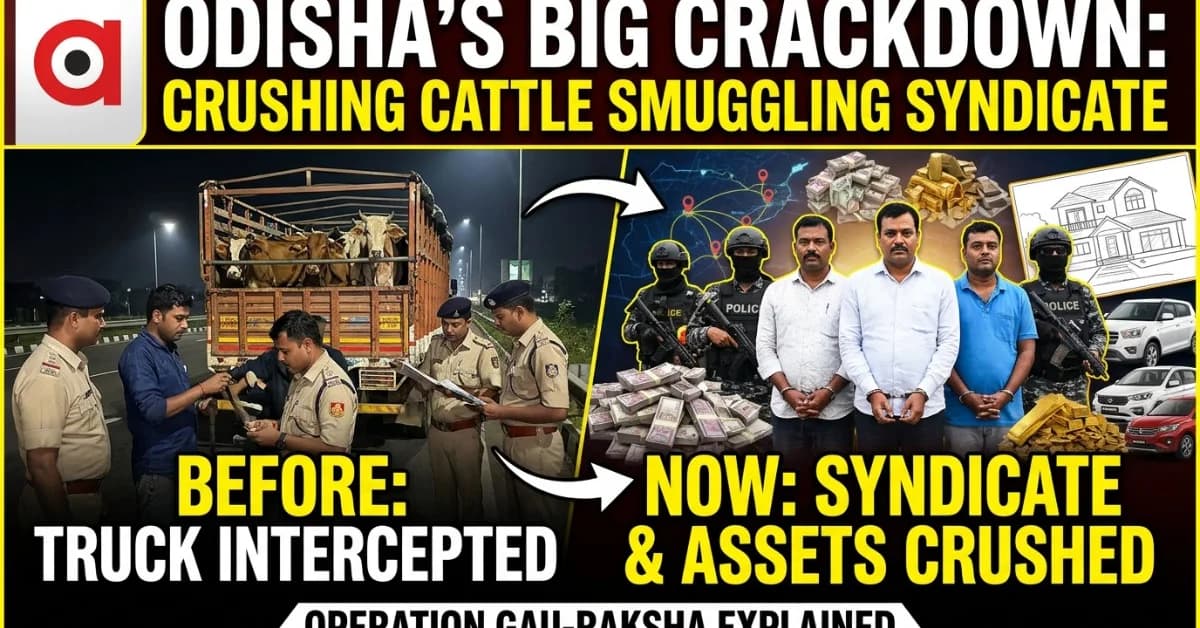
Odisha Police shifted its enforcement model from isolated truck interceptions to targeting the financial and logistical backbones of organized cattle-smuggling syndicates.
A landmark 2026 operation across 46 locations in five districts led to the freezing of ₹4.40 crore across 121 bank accounts and roughly ₹50 crore in illicit properties.
Registered cattle-trafficking cases rose sharply from 473 in 2023 to 872 in 2025, reflecting a more aggressive detection and network-mapping regime rather than lost control.
Bhubaneswar: For years, the cattle-smuggling problem in Odisha largely appeared on the police radar as a sequence of isolated interceptions: a truck stopped, cattle rescued, a driver arrested and a case registered.
That enforcement model is now being tested by a fundamentally different strategy.
Under the BJP government led by Chief Minister Mohan Charan Majhi, Odisha Police has begun treating cattle trafficking not merely as an illegal-transport problem but as a networked organised crime operation – one that can be attacked through intelligence, financial trails, property attachment and coordinated raids across multiple districts.
The difference is visible in the scale and nature of the crackdown.

📱 Get Argus News App
✨Instead of stopping at the highway, investigators have followed the money behind the highway. Instead of focusing exclusively on drivers and loaders, they have gone after vehicle owners, financiers and property holders. And instead of allowing each district to deal with the problem in isolation, major operations have been coordinated across the cattle trade's sourcing, transit and border corridors.
The most striking example came in 2026, when an investigation originating from Keonjhar's Daitari police station led to simultaneous raids across 46 locations in five districts, with investigators freezing Rs4.40 crore in 121 bank accounts and tracing roughly Rs50 crore in properties allegedly linked to the network.
That is the central shift in Odisha's enforcement story: from interception to disruption.
And it comes as the state's registered cattle-trafficking cases have themselves climbed sharply – from 473 in 2023 to 533 in 2024 and 872 in 2025.
The apparent paradox is important. A rise in cases does not necessarily mean the government has lost control of the problem. In this instance, the numbers also reflect a police system registering and pursuing a much larger share of a previously dispersed and locally handled crime.
The emerging question, therefore, is not simply why cattle-smuggling cases are rising.
It is why Odisha's police machinery is now going after the economic architecture that makes the trade possible.
From the truck driver to the syndicate: the enforcement philosophy has changed
The old model had a familiar limitation.
A truck could be intercepted, the cattle rescued and the driver arrested, but the wider commercial chain could survive. The vehicle could eventually return to the road. Another driver could be recruited. Another route could be selected.
The BJP government's enforcement approach seeks to break that cycle by putting the financial and logistical backbone of the syndicate under pressure.
Three changes stand out.
|
Enforcement parameter |
Earlier approach |
Current BJP-government approach |
|---|---|---|
|
Primary target |
Driver, transporter and immediate offender |
Wider syndicate, financiers, vehicle owners and asset holders |
|
Geography |
Local police-station jurisdiction |
Multi-district operations |
|
Intelligence |
Tip-offs and physical interception |
Intelligence-led network mapping |
|
Financial investigation |
Limited role |
Bank-account and asset tracing |
|
Property action |
Limited emphasis |
Property attachment/freezing proceedings |
|
Livestock custody |
Local/ad-hoc arrangements |
Greater institutional support through state schemes |
|
Strategic objective |
Stop individual consignments |
Disrupt the trafficking ecosystem |
This is why the government's Operation Gau-raksha has acquired significance beyond the number of FIRs.
The operation is effectively trying to change the economics of the trade.
The numbers tell a two-era story
The trajectory of registered cases provides the clearest statistical backdrop.
Annual registered pure cattle-trafficking cases
|
Year |
Registered cases |
Enforcement context |
|---|---|---|
|
2010–2018 |
No centralised yearly data |
Cases largely handled through local police jurisdictions |
|
2019 |
139 |
Centralised documentation begins |
|
2020 |
267 |
Increasing highway/transit interceptions |
|
2021 |
371 |
Expansion of checkpoint monitoring |
|
2022 |
386 |
Continued rise across interstate routes |
|
2023 |
473 |
827 arrests before the change in government |
|
2024 |
533 |
767 arrests; greater focus on network logistics |
|
2025 |
872 |
1,136 arrests; intensified enforcement |
|
2026* |
100+ organised-racket cases |
Multi-district operations and financial disruption |
*Partial-year figure as recorded till date
The jump from 473 cases in 2023 to 872 in 2025 represents an increase of about 84% in two years.
That number needs to be read carefully.
The rise can partly indicate continued criminal activity and adaptation by trafficking networks. But it also coincides with a more aggressive detection and registration regime.
In other words, the government's crackdown is producing a larger official footprint of the crime precisely because the police are looking beyond the traditional interception point.
Odisha's geography makes it more than a cattle-transit state
The state's geographical position explains why the enforcement battle cannot be confined to individual border posts.
Odisha sits astride the East-Coast cattle-trafficking corridor linking sourcing areas in southern and central India with the northern and eastern routes leading towards West Bengal and, ultimately, cross-border channels.
The broad trafficking geography can be understood through three interconnected zones.
1. The southern sourcing belt
Cattle originating in parts of Andhra Pradesh, Karnataka and Tamil Nadu can enter the Odisha network through southern corridors.
Ganjam consequently assumes importance as an entry and sourcing route.
A mid-2026 interception under the Bhanjanagar police jurisdiction, in which 100 cattle were rescued and four handlers were arrested, illustrates the scale at which consignments can move through interior routes.
2. The NH-16 highway artery
The East-Coast highway system gives traffickers an opportunity to hide illicit livestock movement inside the much larger commercial transport ecosystem.
NH-16, running through coastal Odisha, is particularly significant because legitimate freight traffic provides cover for modified trucks, container vehicles and other commercial carriers.
That places districts such as Khurda, Cuttack and Jajpur in the enforcement chain.
3. The northern exit corridor
The final Odisha-side pressure points are concentrated around Balasore and Mayurbhanj, where the state borders West Bengal and Jharkhand.
These districts are strategically important because trafficking networks can shift from formal highways to rural roads, interior villages and temporary holding points when conventional routes come under pressure.
The Raibania sector and other border pockets in Balasore have therefore emerged as particularly sensitive areas.
The geography creates a simple strategic problem for enforcement:
If
police only stop trucks, the network can change vehicles.
If
police block one road, the network can shift to another.
But if
the money, vehicles and properties behind those movements are
simultaneously targeted, the cost of continuing the operation rises
sharply.
That is the logic behind the BJP govt model.
Why Keonjhar became the centre of the crackdown
Few aspects of the operation are more politically and administratively significant than the role played by Keonjhar, the Chief Minister's home district.
Its importance is not simply political geography.
Keonjhar combines a large commercial-transport ecosystem with extensive rural and interior road networks. The district's mining economy means that thousands of heavy vehicles and commercial carriers routinely move through the region.
That creates an unusual camouflage opportunity for trafficking networks.
The investigation also identified interior pockets including Telkoi, Ghasipura, Harichandanpur and Santarapur as important collection or aggregation points.
Police records indicate more than 56 cattle-trafficking cases in Keonjhar during the 2025–26 period.
But the district's real importance lies in what happened after one case was registered at Daitari police station.
Instead of treating the case as an isolated transport offence, investigators reportedly spent about a year building the network behind it.
The result was the 2026 multi-district operation.
The 46-location operation: where the strategy changed
The scale of the operation is perhaps its most revealing feature.
Police teams simultaneously targeted 46 locations spread across five districts:
Keonjhar
Mayurbhanj
Bhadrak
Jajpur
Khurda
The operation moved through different layers of the alleged network.
Homes were searched.
Vehicles were seized.
Bank accounts were scrutinised.
Properties were traced.
Cash and precious metals were recovered.
The objective was no longer simply to ask:
“Where is the truck?”
It was to ask:
“Who owns the truck, who finances it, where does the money move, and what assets have been accumulated from the operation?”
That is the point at which a transport offence begins to be investigated as an organised economic network.
The NATGRID factor: following the network rather than the vehicle
The investigation's use of the National Intelligence Grid, or NATGRID, represents another important feature of the strategy of police in the BJP regime.
The stated objective was to move beyond conventional ground intelligence and construct a broader picture of the network.
The investigative framework involved cross-referencing information relating to vehicles, financial transactions, identities, communications and property holdings.
The conceptual shift is straightforward:
A
seized truck is evidence of one movement.
A mapped network can
reveal the organisation behind hundreds of movements.
According to Police, investigators used vehicle registration information alongside other datasets to identify relationships between apparently independent transport operators and larger financial interests.
The financial investigation then became critical.
Accounts associated with operators were examined for suspicious transactions and inter-state financial links. Property records were compared with declared financial profiles to identify alleged disproportionate holdings.
Communication patterns were also examined to establish links between handlers and higher-level operators.
This is precisely the kind of intelligence-led approach that makes a traditional highway checkpoint only one small part of the investigation.
The money trail is now the battlefield
The most consequential part of the 2026 crackdown may ultimately be the asset action.
The inputs put the value of traced illicit properties at approximately Rs50 crore.
The enforcement action also produced:
|
Asset category |
Seizure / action |
|---|---|
|
Properties traced for attachment proceedings |
~₹50 crore |
|
Bank funds frozen |
₹4.40 crore |
|
Verified bank accounts frozen |
121 |
|
Related accounts under scrutiny |
200+ |
|
Private lockers under scrutiny |
50+ |
|
Liquid cash seized |
₹1.52 crore |
|
Additional cash recovered in April raids |
₹46.01 lakh |
|
Gold seized |
2.988 kg |
|
Silver seized |
11.753 kg |
|
Vehicles seized |
109 |
|
High-value wristwatches |
21 |
|
High-end mobile devices |
13 |
Among the properties reportedly identified was a luxury residential building valued at nearly Rs2 crore in the Saraskana area.
The cash seizures provide another indication of the alleged financial scale. One raid at the residence of Bhadrak-based operator Sheikh Rajan, alias Tajuddin, reportedly yielded around Rs60–70 lakh in cash.
This is significant because it demonstrates why an enforcement strategy based only on vehicle interception has limited reach.
The truck may be worth several lakh rupees.
The financial ecosystem behind hundreds of such movements can be worth tens of crores.
Bhadrak: where logistics meets money
If Keonjhar emerged as the operational starting point of the crackdown, Bhadrak stands out in the inputs as a major financial and coordination node.
The district's importance is linked to its position on the northbound transport chain.
Its highways connect southern and central Odisha to the northern border corridor, making the district both a transit zone and a potential coordination centre.
The Basudevpur interception in December 2025, where 44 cattle were rescued from a single commercial truck, illustrates the physical scale of the problem.
But the more important development came when investigators began examining the residences and properties of alleged financiers.
The seizure of roughly ₹70 lakh from a single Bhadrak residence gave the financial investigation a very different dimension from routine highway enforcement.
The emerging picture is therefore not simply of cattle being moved through Bhadrak.
It is of a district where the logistics and financial layers of the alleged network intersect.
Five districts, five different roles
The crackdown also reveals why a statewide strategy is necessary.
|
District / belt |
Role in trafficking chain |
Enforcement significance |
|---|---|---|
|
Keonjhar |
Sourcing + network/financial investigation |
Origin of major investigation; 46-location operation |
|
Mayurbhanj |
Border transit |
Northern exit corridor; vehicle seizures |
|
Balasore |
Border transit / exit |
Jaleswar, Bhograi, Basta, Baliapal and other exit points |
|
Bhadrak |
Logistics + financial network |
Kingpin/financier-focused raids |
|
Jajpur–Cuttack–Khurda |
NH-16 transit artery |
Highway interception and vehicle tracking |
|
Ganjam |
Southern sourcing corridor |
Interior-route interceptions |
This division of labour matters because the trafficking network itself does not operate within one police-station boundary.
The state is therefore increasingly responding to the network's geography with a networked policing model.
What makes Odisha different from its neighbours
Odisha's strategy also becomes clearer when viewed against the approaches of neighbouring states.
|
State |
Position in trafficking chain |
Broad enforcement approach described in inputs |
|---|---|---|
|
Odisha |
Major East-Coast transit and network zone |
Multi-district intelligence operations, financial mapping, asset attachment and coordinated raids |
|
West Bengal |
Destination/exit hub towards international border |
Greater prominence of central-agency investigations in major syndicate/corruption cases; state-level enforcement faces political/jurisdictional friction |
|
Chhattisgarh |
Sourcing/origin state |
Severe statutory penalties and stronger direct accountability for local police |
|
Jharkhand |
Transit corridor |
Highway checkpoints and local interception tactics |
|
Andhra Pradesh |
Southern sourcing state |
Greater reliance on animal-movement, cruelty and permit enforcement |
The contrast is important.
Chhattisgarh's
strength is statutory deterrence.
West Bengal's challenge is the
complexity of the destination and border environment, but the
scenario is changing after Suvendhu Adhikari's ascent to
power.
Jharkhand and Andhra Pradesh rely more heavily on
interception and regulatory enforcement.
Odisha's emerging model attempts to combine physical enforcement with financial disruption.
That is its distinguishing feature.
The political significance: hesitation replaced by enforcement ownership
The political subtext of the crackdown is difficult to miss.
For the BJP government, cattle protection is not simply another law-and-order issue. It is an area where the administration has sought to demonstrate a sharper ideological and enforcement identity than the previous BJD/Congress governments.
The difference is particularly visible in the proposed tightening of Odisha's cattle-protection framework.
The previous legal architecture was centred on the Orissa Prevention of Cow Slaughter Act, 1960, under which enforcement historically operated around slaughter and transportation restrictions.
The BJP government has moved towards stronger amendments, drawing from stricter models elsewhere, including proposals aimed at removing existing age-related exemptions and strengthening deterrence.
The stated policy direction is therefore towards a more comprehensive prohibition and tougher consequences for those facilitating illegal cattle movement.
But legislation alone does not explain the new enforcement character.
The more important change is operational:
the government is trying to make the financial cost of participation much higher.
The driver is no longer the end of the investigation
This may be the most consequential difference between the two enforcement eras.
Under a conventional trafficking case, the driver is easy to find.
The truck is visible.
The cattle are visible.
The owner may be several layers removed.
The money is even further away.
The new strategy seeks to reverse that investigative hierarchy.
Driver → vehicle → owner → handler → financier → property
That chain is what turns a roadside interception into a syndicate investigation.
The seizure of 109 vehicles is particularly relevant here.
The fleet included trucks, SUVs, commercial vehicles and motorcycles allegedly used by scouts and handlers. Investigators also recovered an oil tanker reportedly modified with a concealed internal compartment for transporting livestock.
If such assets remain available to a network, the network can regenerate.
If those assets are seized or become subject to forfeiture proceedings, the economics change.
From rescued cattle to institutional custody
There is another side of the enforcement problem that often receives less attention: what happens after the police rescue the animals?
A truck interception can produce dozens of cattle requiring immediate shelter, food, veterinary care and legal custody.
The BJP government's Govansha Surakshya Yojana and Mukhyamantri Kamadhenu Yojana are intended to create a more institutional response, including state-supported gaushala infrastructure.
The stated plan to establish cattle-shelter support across the state's 314 blocks is important from an enforcement perspective.
It addresses a practical weakness in cattle-trafficking investigations:
Police can rescue animals much faster than they can arrange long-term custody for them.
A stronger shelter network therefore complements the policing strategy.
It turns animal rescue from a temporary endpoint into a more sustainable part of the enforcement chain.
Why the case numbers may keep rising before they fall
There is a temptation to read the 872 cases recorded in 2025 as proof that the crackdown has failed.
That would be too simplistic.
A crackdown can initially produce more cases before it produces fewer cases.
The reason is straightforward.
When enforcement becomes more aggressive:
More previously undetected consignments are intercepted.
More offences are formally registered.
More handlers are identified.
Intelligence from one case feeds another.
Financial investigations uncover connected offences.
Police begin identifying the same network across multiple jurisdictions.
The result is an expanding official crime footprint.
The real test will therefore not be whether the number of cases immediately collapses.
It will be whether the state can eventually demonstrate a sustained reduction in repeat networks, trafficking routes, vehicle fleets and financial capacity.
That is the metric that will tell whether the new model has actually worked.
The real battleground is now beyond Odisha's highways
The cattle-smuggling network is inherently adaptive.
If NH-16 becomes difficult, routes can move inland.
If Balasore becomes heavily policed, traffickers can search for alternative border crossings.
If trucks are seized, different vehicles can be acquired.
If cash transactions become risky, financial structures can be changed.
This is why the most important feature of Odisha's current strategy is not any individual raid.
It is the attempt to make the enforcement architecture adaptive at the same speed as the trafficking network.
That means combining:
border policing + highway surveillance + intelligence + financial investigation + property attachment + institutional cattle custody.
The state's challenge now is to make these elements work continuously rather than only during major operations.
The big question: can the crackdown survive beyond headline raids?
The 2026 operations have established a new template.
But a template becomes a strategy only when it is institutionalised.
For Odisha, that means several things.
First, financial investigation must become routine in major trafficking cases rather than being reserved for spectacular raids.
Second, intelligence generated in one district must move quickly to neighbouring districts.
Third, vehicle ownership and financing structures need to be examined alongside the driver and transporter.
Fourth, border districts need permanent intelligence coordination rather than periodic midnight sweeps.
And finally, asset attachment must withstand legal scrutiny. The credibility of the entire model ultimately depends on whether the state can convert investigative findings into sustainable court-backed action.
That is where the transition from political signalling to administrative performance will be tested.
Bottomline: Odisha has changed where it wants to hurt the syndicate
The most important change under the Majhi government is not simply that more cattle are being rescued or more FIRs are being registered.
It is where the state is trying to impose the cost.
The older enforcement equation was largely:
Catch the truck. Arrest the driver. Rescue the cattle.
The emerging equation is:
Map the network. Follow the money. Freeze the accounts. Attach the property. Seize the vehicles. Disrupt the supply chain.
That is a considerably more ambitious proposition.
The BJP government's Operation Gau-raksha is attempting to build precisely that architecture.
Whether it ultimately delivers a sustained decline in trafficking will depend on the durability of the investigations, the courts' treatment of asset-attachment cases and the state's ability to maintain pressure after the headline raids disappear.
But one thing is already evident from the 2025–26 crackdown:
Odisha's anti-cattle-smuggling battle is no longer being fought only on the road.
It is increasingly being fought in the bank account, the property register, the vehicle database and the financial trail behind the syndicate.
And
that marks the clearest break yet with the era of treating every
cattle-smuggling case as just another truck to be stopped.
Also Read: EXCLUSIVE| Ganjam Police Bust Illegal Gunmaking Unit In Bhanjanagar, What Big New Trend it Signals to Odisha Police?
Related Topics
Explore more stories