



Special Report| Bhubaneswar’s Emerging ‘Don Culture’: Nayagarh Youth's Armed Arrest Sparks Debate Why ‘Operation Netra’ Missing from Capital’s Policing Toolkit?
Key Points
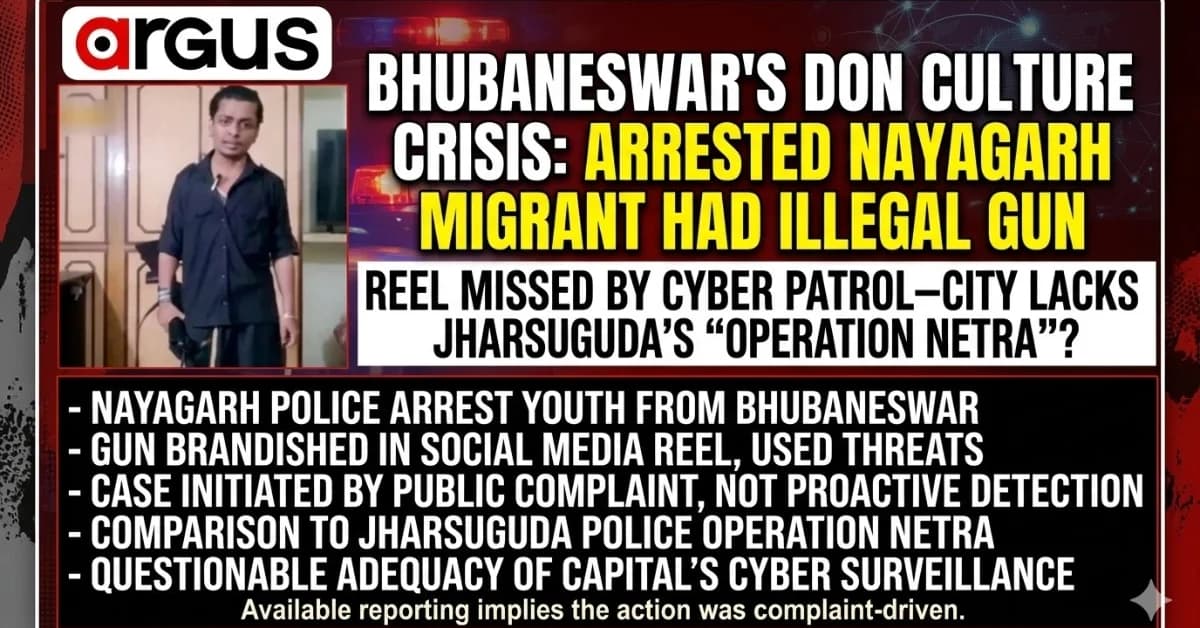
Proactive vs. Reactive Policing: The arrest of Jaitradev Jena in Bhubaneswar was driven by a formal citizen complaint rather than proactive cyber surveillance, sparking debates on institutional readiness.
The Rise of Digital Personas: Migrant youth are increasingly utilizing rented urban spaces and social media algorithms to cultivate intimidating "don" identities through illegal weapon displays.
Lessons from Operation NETRA: Jharsuguda Police's targeted digital monitoring demonstrates how law enforcement can independently trace, verify, and intercept weapon-toting online behavior before crimes escalate.
Bhubaneswar: A young migrant from Nayagarh allegedly trying to build a “don” image in Bhubaneswar with an unlicensed firearm and threatening social-media content has been arrested – but the case raises a question larger than the arrest itself: why did a weapon-wielding social-media persona operating from the capital come to police notice only after a formal complaint, when Jharsuguda Police has already demonstrated that such digital behaviour can be proactively traced?
Nayagarh Town Police arrested Jaitradev Jena on Friday after registering a complaint over a social-media reel in which he allegedly displayed an unlicensed firearm, used abusive language and issued threats intended to intimidate the public. Police traced him to a rented house in Bhubaneswar and arrested him there. The available reporting indicates that the action was complaint-driven, rather than a suo motu detection by Bhubaneswar's cyber-policing machinery.
That distinction is at the heart of the case.
Because this is not merely another story about a youth posing with a gun.

📱 Get Argus News App
✨It is about how a migrant youth from a district outside the capital allegedly attempted to manufacture a local criminal identity in Bhubaneswar – and how the city's digital policing system did not appear to intercept that effort before a citizen complained.
From Nayagarh to Bhubaneswar: the geography of the case matters
Jena's case has an important geographical element.
He is from Nayagarh, but the alleged online persona was being projected from Bhubaneswar, where he was staying in a rented accommodation.
That creates a familiar urban policing problem.
A person does not necessarily have to belong to the city to establish a presence in its criminal ecosystem. Migration into Bhubaneswar for work, business, education or other purposes also means that police intelligence increasingly has to track people who may have no prior local criminal profile but are physically present in the capital and digitally visible from it.
In Jena's case, the alleged formula appears straightforward: an out-of-district youth, a rented urban residence, an illegal firearm, social-media exposure and threatening language.
Whether this was merely an attempt at online showmanship or the beginning of something more consequential will have to be established by the investigation.
But the ingredients themselves are significant.
An unlicensed firearm changes the character of the story.
A social-media photograph or reel may ordinarily be dismissed as vanity. Possession of an illegal weapon coupled with alleged threats raises a substantially different law-and-order concern.
The police investigation therefore needs to establish not merely who Jena is, but also where the firearm came from, who supplied it, whether he had associates, whether the weapon was used elsewhere and whether the online persona was connected to any actual criminal activity.
The irony: Jharsuguda is already looking for exactly this behaviour
The contrast with Jharsuguda is striking.
On September 11, Jharsuguda Police announced action under Operation NETRA against eight people, including three juveniles, over Instagram reels allegedly showing knives and threatening gestures intended to create fear.
Five adults were arrested, three juveniles were detained, and police seized two knives and a mobile phone allegedly containing the reels. Police said their team verified the information and traced those involved.
The significance is not that Jharsuguda has somehow eliminated weapon culture.
It is that its policing model demonstrates a different starting point:
the police can begin with the digital content itself.
That is precisely where the Bhubaneswar-Nayagarh case becomes uncomfortable.
Here, according to the available case details, the chain ran in the opposite direction:
social-media content → citizen complaint → police case → tracing → arrest.
In the Jharsuguda example, the reported chain was:
social-media information → police verification → identification → raid/arrest.
That difference matters in an environment where a threatening reel can disappear, be deleted, be shifted to another account or be replicated by other users before a conventional complaint reaches a police station.
But Operation NETRA is not a statewide AI dragnet
There is an important qualification.
It would be inaccurate to suggest that Operation NETRA is a single statewide artificial-intelligence system continuously watching every Instagram account in Odisha.
The publicly reported Jharsuguda operation describes a district-level policing initiative in which police received information regarding social-media reels, conducted verification and traced those allegedly involved.
Therefore, the comparison should not be reduced to “Jharsuguda has technology while Bhubaneswar has none.”
The more important issue is whether the same philosophy of proactive digital policing is being applied consistently in the capital.
The Jharsuguda Police itself has publicly described its approach as close monitoring of social-media activity and warned that attempts to create fear or disturb public peace would invite legal action.
That makes the Jena case a useful test for Bhubaneswar's policing architecture.
The bigger question is not why Jena was arrested – but why he was not detected earlier
It is not that the Commissionerate Police are negligent.
But the case legitimately raises a systems question.
If a public social-media account is allegedly displaying an illegal firearm, coupled with direct threats and abusive language, should such content have to wait for a citizen to formally complain?
That is the question the case puts before urban cyber policing.
The distinction is particularly relevant because digital intimidation is not confined by police-station jurisdiction.
A person sitting in a rented room in Bhubaneswar can target viewers across Nayagarh, Khordha or elsewhere in Odisha without physically leaving the capital.
Conversely, a person in another district can cultivate a following among Bhubaneswar youths.
The policing challenge has therefore moved from territorial crime to networked crime.
The rented-room phenomenon: when migration meets digital identity
There is another layer that deserves attention without overgeneralising migrants as a criminal category.
Bhubaneswar's rental housing market provides anonymity of a different kind.
Someone arriving from another district does not necessarily enter the city's police intelligence system with the same visibility as a person already known to local police.
If that individual subsequently begins projecting a criminal persona online, the first indication may not be a physical crime.
It may be a reel.
A photograph.
A threat.
A weapon.
A nickname.
A group of followers.
And that is precisely why the Jena case should not be treated merely as another Arms Act arrest.
The alleged objective appears to have been image-building – creating the appearance of a person who commands fear.
Whether that image corresponded to an actual criminal network is a matter for investigation.
But the attempt to construct such an identity through social media is itself significant because digital reputation can precede physical criminality.
From ‘show-off’ to law-and-order problem
Odisha has seen similar episodes before.
In October 2021, Bhubaneswar police arrested a youth after he posted a photograph holding a pistol; reports then has said that the firearm had allegedly been stolen from a vehicle and that the photograph was used to cultivate a “don” persona.
In Cuttack, police subsequently acted in cases involving social-media videos showing firearms and weapons.
What has changed is not necessarily the existence of the behaviour.
It is the speed and scale with which such content can travel.
A decade ago, a young man attempting to establish street credibility might have had to physically cultivate a neighbourhood.
Today, a reel can perform part of that work.
The weapon becomes a prop.
The threat becomes a caption.
The background becomes proof of urban presence.
The audience becomes the neighbourhood.
And the algorithm becomes the amplifier.
That does not automatically make every weapon reel evidence of organised crime.
But when the weapon is real and unlicensed and the content allegedly contains threats, the distinction between online posturing and a potential public-order problem becomes much thinner.
What Jharsuguda's experiment exposes
Operation NETRA's recent action offers an interesting policing template precisely because it did not stop with watching the reel.
Police said they verified the information, traced the persons involved and then conducted the arrests, with weapons and the recording device seized.
Earlier in 2026, Jharsuguda police also used the NETRA initiative in an illegal-arms case, with reporting stating that an arms network sourcing firearms from Bihar for distribution in Jharsuguda and nearby areas was disrupted.
That suggests that the initiative is being used as more than a publicity label: at least in reported cases, it has been linked to digital monitoring, verification and physical enforcement.
The Bhubaneswar case consequently throws up an obvious operational question:
Can a similar mechanism identify weapon display and intimidation before a complaint is filed?
The capital cannot police the reel only after it becomes a complaint
This is perhaps the central lesson from the case.
Complaint-driven policing will always remain necessary. Citizens are often the first to encounter threatening content, and human intelligence cannot be replaced by technology.
But digital crime presents a different opportunity.
The evidence is often already public.
The account exists.
The video exists.
The upload time exists.
The digital trail exists.
And sometimes, the person behind it is sitting inside the very city that is supposed to be monitoring emerging threats.
That means the challenge for Commissionerate Police is not simply more arrests after complaints.
It is whether its cyber-policing architecture can increasingly move towards early identification of weapon displays, intimidation and criminal-image building, followed by human verification.
Jharsuguda has shown one district-level model of that approach.
The irony of the ‘don’
The most revealing irony may therefore be this:
A man allegedly attempting to create a “don” image through a gun and threats ultimately did not demonstrate control over the city.
He demonstrated something else – a gap between digital visibility and institutional visibility.
The police response, according to the available case details, began only after someone formally complained. Nayagarh police then traced the accused to Bhubaneswar and made the arrest despite the cross-district element.
But it leaves an uncomfortable question for the capital's cyber-policing system:
If Jharsuguda can actively look for weaponised social-media content under Operation NETRA, should Bhubaneswar wait for the public to point it out?
The case has already exposed the new geography of intimidation: a Nayagarh-origin youth, a rented Bhubaneswar address, an illegal gun and a digital audience.
The challenge for policing is no longer simply to find the gun.
It is to spot the persona being built around it before that persona acquires a real-world constituency.
Key takeaways
|
Issue |
What the case indicates |
|---|---|
|
Accused |
Jaitradev Jena, from Nayagarh |
|
Location |
Arrested from a rented house in Bhubaneswar |
|
Trigger |
Formal complaint over alleged threatening social-media content |
|
Weapon |
An allegedly unlicensed firearm |
|
Alleged online behaviour |
Weapon display, abusive language and threats |
|
Policing model in this case |
Complaint-driven |
|
Jharsuguda contrast |
Operation NETRA used to identify, verify and trace weapon-related reels |
|
Larger question |
Whether proactive digital monitoring can be strengthened in the capital |
|
Next investigative priority |
Establish firearm source, associates and whether any wider criminal activity exists |
Related Topics
Explore more stories