



Special Report| ACF Soumya Ranjan Death Probe Under Fire: SC Setback Triggers Cook’s Arrest, Exposing Crime Branch’s ‘Clerical’ Murder Probe
Key Points
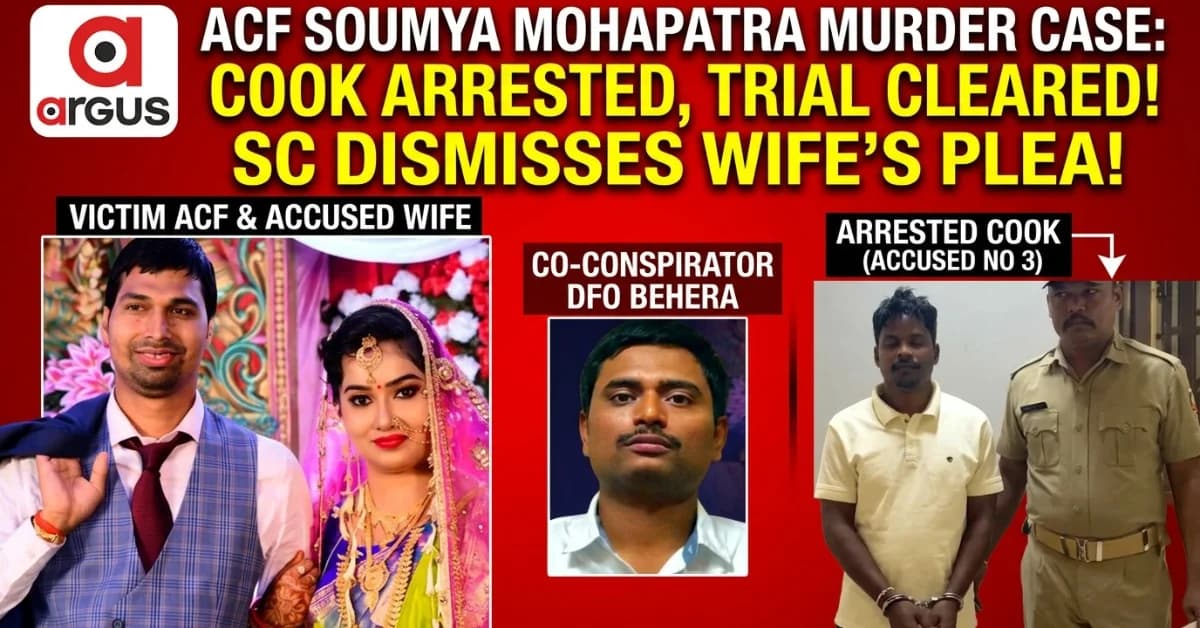
Supreme Court Ruling: The apex court dismissed the petition challenging the Orissa High Court's order, clearing the path for the murder trial to proceed.
Key Arrest Made: Gajapati district police arrested Manmath Kumbha, the household cook and one of the accused, following the lifting of legal protections.
Unresolved Gaps: The trial will now rigorously examine disputed medical evidence, a controversial dying declaration, and forensic inconsistencies left unaddressed by the initial Crime Branch probe.
Bhubaneswar: Supreme Court’s refusal to quash proceedings clears the way for trial, and thereby, the glaring gaps in the accidental-death investigation, disputed dying declaration and unanswered forensic questions return to focus.
The arrest of Manmath Kumbha, the cook in the household of deceased Assistant Conservator of Forests (ACF) Soumya Ranjan Mohapatra, by Gajapati district police on Wednesday has brought a crucial turn in the four-year-old case, coinciding with the Supreme Court’s dismissal of a petition filed by the officer’s widow, Bidya Bharati Panda.
With the apex court declining to interfere with the Orissa High Court’s order refusing to quash the criminal proceedings, the legal protection that had shielded the accused from arrest has fallen away, opening the way for the trial to proceed.
Kumbha, who was working at the ACF’s official residence in Paralakhemundi when Mohapatra suffered severe burn injuries in July 2021, is named alongside Panda and the then Divisional Forest Officer (DFO), Sangram Keshari Behera, in the murder complaint filed by the deceased officer’s family.

📱 Get Argus News App
✨The twin developments mark more than a procedural breakthrough. They have brought renewed attention to the fundamental question that has shadowed the investigation:
* How did the Odisha Crime Branch, entrusted with unravelling a high-profile death, arrive at an accidental-death conclusion despite a series of disputed circumstances that subsequently persuaded the trial court to take cognisance of murder and criminal conspiracy?
The courts have not pronounced any of the accused guilty. But by allowing the prosecution to proceed, they have ensured that questions left unresolved by the original investigation will now have to be tested through judicial scrutiny.
From accidental death to murder trial: How the case changed course
Mohapatra sustained extensive burn injuries at his official residence in Paralakhemundi on July 11, 2021, and died two days later. His family alleged that the death was the result of a conspiracy involving his wife, the then DFO and the household cook.
The state government handed the investigation to the CID Crime Branch, which subsequently filed a chargesheet treating the incident as accidental. While Panda faced allegations relating to negligence and the circumstances surrounding the incident, Behera and Kumbha were given a clean chit in the agency’s findings.
The family, however, rejected the investigation’s conclusion and moved the Paralakhemundi Sub-Divisional Judicial Magistrate (SDJM) Court through a protest petition. In April 2023, the court took cognisance of the murder and criminal conspiracy allegations under Sections 302 and 120-B of the Indian Penal Code (IPC), summoning all three accused to face proceedings.
The accused challenged the order before the Orissa High Court, seeking to terminate the criminal proceedings.
In July 2025, the High Court refused to quash the case, holding that the disputed factual issues required examination at trial rather than being conclusively decided at the preliminary stage.
The Supreme Court’s dismissal of Panda’s subsequent petition on September 30, 2026, has left that position undisturbed.
The significance of this judicial trajectory lies in the distinction between an investigative agency’s conclusion and a court’s assessment of whether the available material warrants a trial.
The Crime Branch’s accidental-death theory did not end the matter because the family’s allegations and the material placed before the magistrate raised questions that could not be disposed of merely by accepting the final police report.
The Crime Branch’s ‘compiler job’: Where the investigation faced questions
The central criticism emerging from the case records is that the Crime Branch’s investigation appears to have relied heavily on documentary statements and official procedures without adequately resolving the contradictions between them.
The issue is not simply whether investigators collected evidence, but whether they independently tested its credibility against the physical, medical and chronological circumstances of the incident.
1. The dying declaration and the medical contradiction
The purported dying declaration became a significant element of the accidental-death theory. The investigation relied on the statement recorded by an Executive Magistrate to support the account that Mohapatra had accidentally caught fire while handling kerosene.
However, the post-mortem report reportedly recorded carbon particles in the mucosa of the deceased’s larynx, trachea, bronchus and bronchioles.
This medical finding raises questions about the extent of respiratory injury and the circumstances in which the statement was recorded.
The case records also raise questions about the absence of a treating doctor’s explicit fitness certification, the person who actually scribed the declaration and the deceased’s ability to make and sign a detailed statement. Although extensive burns do not automatically render a person incapable of making a dying declaration, the particular medical condition and recording process require careful examination.
A thorough investigation would need to establish how the medical observations, hospital records and the declaration fit together. The existence of a signed statement, by itself, cannot resolve every question about its reliability.
2. The unexplained timeline
The chronology surrounding the recording of the declaration presents another area requiring scrutiny.
According to materials found mention in the HC judgement in the case, it shows a request for a Magistrate was made at around 8.30 pm, when the police officially received information about the hospital admission at around 9.30 pm. The declaration was reportedly recorded at 11.05 pm, although the documents also refer to a formal requisition at 11.10 pm.
These timings call for an explanation of the sequence of communications between the police, hospital and Executive Magistrate.
Who initiated the process,
on what information, and
when did each authority receive the relevant communication?
Such discrepancies do not independently establish fabrication or criminal conspiracy. But reconciling them through original records and testimony is an essential part of determining whether the investigation established a reliable chronology.
3. The physical evidence at the scene
The accidental-fire account also requires examination against the reported condition of the room.
The case material refers to a kerosene bottle found capped on a wooden table, with some liquid remaining inside, and the absence of identifiable burnt-book remnants or ash.
It also raises questions about the reported lack of significant soot deposits, blackening or fire damage to surrounding surfaces.
These circumstances need to be assessed through the seizure records, scene photographs, forensic evidence and testimony of the personnel who inspected the residence.
The absence of a particular physical trace does not, in isolation, establish that an accident was impossible. Nevertheless, where a death involves extensive burns inside a residential room, investigators are expected to examine whether the proposed sequence of events is consistent with the physical evidence.
The larger question is whether the Crime Branch sufficiently tested the accidental-fire explanation against these reported circumstances before reaching its conclusion.
4. Polygraph tests and the limits of investigative conclusions
The Crime Branch reportedly subjected Panda, Behera and Kumbha to polygraph examinations. Such tests, however, are investigative aids, not conclusive proof of innocence or guilt.
The Supreme Court has held that involuntary administration of these tests raises constitutional concerns, while the results themselves cannot be treated as substantive evidence of guilt.
Even where a polygraph examination does not provide a clear investigative lead, that outcome cannot substitute for corroboration of the competing versions of events. The evidentiary value of witness accounts, forensic findings, communications and the conduct of individuals before and after the incident must be examined independently.
The question, therefore, is whether the investigation pursued all relevant leads or treated the absence of a direct forensic link as sufficient to close the possibility of a wider criminal conspiracy.
Why the courts refused to end the proceedings
The Orissa High Court’s refusal to quash the proceedings is particularly significant in the context of the disputed evidence.
While considering the challenge to the SDJM Court’s order, the High Court held that the competing versions involved questions of fact that were unsuitable for final determination under the court’s inherent powers at that stage.
The distinction is fundamental to criminal procedure. A court deciding whether proceedings should continue does not conduct the full evidentiary exercise of a criminal trial. Nor does the rejection of a quashing petition amount to a finding that the allegations are true.
The High Court also preserved the accused’s right to seek discharge at the appropriate stage. The Supreme Court’s latest decision leaves the criminal proceedings intact, rather than determining the merits of the murder allegations.
For the prosecution, the challenge will now be to establish the evidentiary basis of the allegations through admissible evidence and witnesses. For the defence, the trial provides the opportunity to contest the family’s allegations, challenge the reliability of the evidence and advance the accidental-death explanation.
Trial must answer what the investigation left unresolved
The arrest of Kumbha is an important development in the enforcement of the trial court’s process.
The more consequential development is the opportunity for the disputed evidence to be examined in open court. The dying declaration, medical records, forensic findings, police communications and statements of the deceased’s family members will have to withstand scrutiny, including cross-examination wherever applicable.
The Crime Branch’s accidental-death conclusion and the family’s murder allegation represent sharply different accounts of the same incident. The courts have so far declined to allow either version to foreclose the other at the threshold of trial.
The case also raises a wider institutional question about the quality of investigations into suspicious deaths.
An investigation entrusted to a specialised agency must do more than assemble statements and official documents. It must actively reconcile contradictions, verify the physical circumstances and distinguish between evidence that supports a theory and evidence that challenges it.
The
central test of the ACF death case will now be whether the trial can
establish, through legally admissible evidence, what actually
happened inside the Paralakhemundi residence in July 2021. The
Supreme Court’s latest order and Kumbha’s arrest have brought the
case closer to that test. Whether the Crime Branch’s original
conclusion withstands judicial examination, or whether the questions
raised by the family and the courts lead to a different finding,
remains for the trial court to decide.
Also Read: Special Report| Is the Utkal University Paper Leak an Insider Job? Inside the Political Modus Operandi as Rahul Gandhi’s “Chatron Ki Goonj' Odisha Edition Nears
Related Topics
Explore more stories