



Odisha’s Sex-Racket Map Explodes: When Bhubaneswar occupies dubious No 1 spot, Balangir emerging fast; Check your cities rank | Special Report
Key Points
Bhubaneswar: The very recent busting of sex racket by Police in Balangir is not another crime story. It tells much more. The police crackdown over the years are rising in the State. The bigger question is hoe come, the clandestine sleaze show keeps continuing in different cities of the State.
As the police pressure piles up, the trade seems keep evolving in the State.
From high-rise apartments and premium spas in Bhubaneswar to rented houses near industrial belts, highway-side properties and ordinary residential premises in smaller towns, commercial sexual exploitation appears to be spreading beyond the traditional hotel-and-lodge ecosystem.
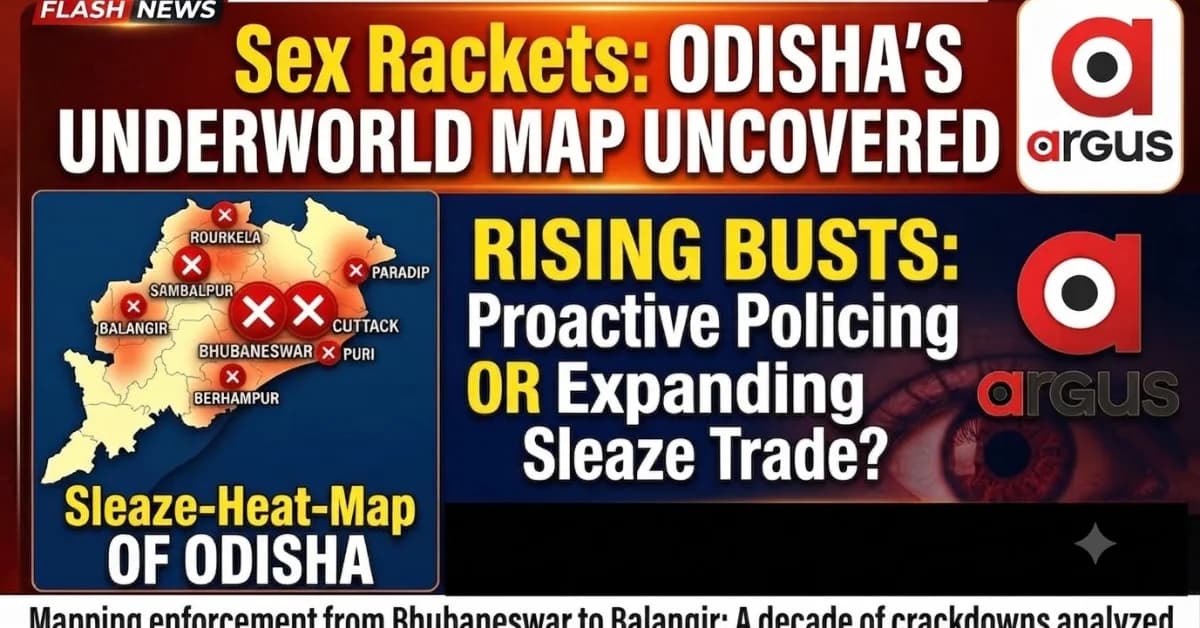
A mapping of police actions and crime records between 2016 and 2026 shows Bhubaneswar and Cuttack at the top of Odisha’s enforcement burden, followed by industrial and tourism centres such as Paradip, Puri, Rourkela and Sambalpur. Smaller districts such as Balangir, Malkangiri and Jagatsinghpur are emerging as localised pockets.
But there is a crucial distinction: the apparent rise in busts does not automatically mean the underlying crime has increased by the same magnitude. Criminologists and law-enforcement agencies attribute the numbers to two simultaneous developments – an expansion of cyber-enabled trafficking networks and a more aggressive policing regime.

📱 Get Argus News App
✨From hotel rooms to WhatsApp and high-rises
The old model of a fixed brothel or a hotel-based racket is increasingly giving way to a fragmented network.
In Bhubaneswar, police actions have moved into upscale neighbourhoods, spas, salons and residential apartments. The inputs identify Nayapalli, Laxmisagar and Chandrasekharpur among the areas where enforcement operations have repeatedly surfaced.
The operational advantage for racketeers is anonymity.
A rented apartment does not necessarily look like a commercial establishment. A salon or wellness centre can provide a legitimate front. Digital communication allows handlers to connect customers, intermediaries and women without maintaining a visibly permanent establishment.
Police sources inform that they get clues, specifically, from escort websites, encrypted messaging networks and digital UPI payments. Such tool now form as major components of the new operating model. That has made it possible for smaller rings to emerge quickly and operate from otherwise ordinary residential neighbourhoods.
The result is a crime that is becoming harder to map simply by watching hotels.
The Sleaze Map in Odisha:
|
City / Location |
Estimated Absolute Volume Matrix (2016–2026) |
Primary Target Venues |
Burden Level |
|
Bhubaneswar |
180+ Rackets Busted |
Luxury Spas, Salons, High-Rise Apartments, Escort Portals |
Critically High |
|
Cuttack |
60+ Rackets Busted |
Budget Lodges, Residential Houses, Private Guest Houses |
High |
|
Rourkela |
25–30 Rackets Busted |
Transit Hotels, Commercial Lodges |
Moderate-High |
|
Sambalpur |
20–25 Rackets Busted |
Highway Dhabas, Rented Outskirts Property |
Moderate |
|
Balasore |
15–20 Rackets Busted |
Coastal Lodges, Inter-State Border Hubs |
Moderate |
|
Berhampur |
15–20 Rackets Busted |
Railway Transit Points, Low-Tier Lodges |
Moderate |
|
Balangir |
10–15 Rackets Busted |
Localized Hotels, Rented Houses |
Emerging |
A glance at the table leads to the following inferences.
Bhubaneswar-Cuttack: Odisha’s biggest burden
The Twin City remains the state’s principal concentration point.
The 2016–2026 media-and-raid mapping estimates more than 180 racket busts in Bhubaneswar and over 60 in Cuttack, placing the two cities in the highest-burden category. The recorded venues range from luxury spas and salons to high-rise apartments, budget lodges, houses and private guest houses.
The character of the crime has also evolved.
The available data trace the Twin City trajectory from cases involving foreign nationals and upscale wellness establishments in 2017–18 to budget hotels and rented apartments in the following years, and more recently to hyper-localised operations allegedly facilitated through WhatsApp and online escort platforms.
That shift matters because it changes the policing challenge.
A conventional raid can close a room. It cannot necessarily dismantle the network behind the room.
The industrial economy creates a second market
The next major pressure point is emerging around Odisha’s industrial economy.
Paradip and Rourkela are identified as steep-upside locations, with the inputs linking the trend to the influx of contractors, logistics workers, temporary migrant labour and other transient populations. Rackets are increasingly reported from rented properties in semi-urban areas surrounding industrial belts rather than only from established commercial centres.
Paradip’s recent cases illustrate the trend.
Police inputs cite multiple 2026 cases from Paradip and neighbouring Jagatsinghpur, including arrests following raids in August and May. The broader pattern is a movement from urban hotel-based operations towards rented homes and semi-rural properties close to highways and industrial corridors.
Rourkela and Sambalpur show a similar transition.
Rourkela’s industrial economy creates a transient population and disposable income that can attract organised exploitation networks, while Sambalpur has seen enforcement move towards roadside dhabas and rented properties along transportation corridors.
Puri’s tourism economy adds another layer
The coastal tourism belt has a different vulnerability.
In Puri, the availability of budget hotels and guest houses creates a relatively fluid accommodation ecosystem. The inputs identify beachside lodges and guest houses as recurring locations where intermediaries allegedly target tourists and facilitate commercial sexual exploitation.
This makes tourism-heavy areas fundamentally different from industrial hubs -but both create the same policing problem: large, constantly changing populations and temporary accommodation.
When a source district becomes a destination
Perhaps the most significant change is visible in western and southern Odisha.
Historically, districts such as Balangir were more commonly associated with distress migration and trafficking vulnerability. Data suggests that some locations are now developing their own local consumption and distribution networks.
The September 2026 Balangir sex racket bust resulted in seven arrests and nine women being rescued, indicating the emergence of a localised commercial exploitation network rather than merely a source-to-destination trafficking pattern.
That is an important structural shift.
It suggests that the trafficking ecosystem is not simply moving vulnerable women out of Odisha. In some places, the demand-and-supply chain is beginning to form locally.
Why fewer raids may not mean less crime
The map also contains apparent contradictions.
Berhampur and Balasore, for example, show a stabilising or declining trend in visible city-centre racket busts. But sources caution against reading this as an automatic decline in the crime itself.
Both are important transit points. Balasore sits on the West Bengal border, while Berhampur connects southern Odisha with neighbouring states. The assessment is that intensified railway and border monitoring may have displaced operations rather than eliminated them.
This produces an important policing paradox:
The fewer the visible hotel raids, the more difficult it may become to know where the network has gone.
Police sources describe this as tactical displacement – from hotels, spas and other commercial venues into encrypted digital channels and less visible residential locations.
Odisha is arresting the problem – but is it dismantling it?
Odisha’s enforcement architecture has expanded.
A glance at the measures State police initiated point to 37 Integrated Anti-Human Trafficking Units (IAHTUs) and the use of Section 18 of the Immoral Traffic (Prevention) Act for property sealing as factors behind increased enforcement activity.
Yet the central challenge is what happens after the raid.
An arrest-and-rescue model can generate impressive numbers without necessarily reaching the financial and digital infrastructure of the racket.
The need of the hour, therefore, is moving towards an evidence-led model: preserve digital communications, server information and online transaction trails, while tracing the organisers rather than stopping with the immediate handlers.
The logic is straightforward.
Raid
the room, and another room can replace it.
Break the network and
the business model collapses.
The money trail may be the missing weapon
The emerging digital model also offers police a new vulnerability: the money trail.
Online escort networks increasingly depend on digital payments. The inputs propose systematic financial investigation of UPI handles, bank accounts and digital wallets associated with suspected networks, drawing on the approach attributed to Hyderabad police.
This could potentially transform the investigation from a local crime case into a network investigation.
Instead of asking only “Where is the racket?”, investigators can ask:
Who
owns the account?
Who receives the payments?
Who books the
properties?
Who recruits the women?
Who controls the digital
advertisements?
And where does the money finally go?
That is where the real kingpins are more likely to surface.
What Odisha can learn from Kerala and Hyderabad
A study of how Police across deal with the menace to crack the source point and cripple the flesh trade points to two different models.
Kerala's approach emphasises community surveillance, accommodation databases, guest KYC and cyber patrols to reduce the anonymity that allows networks to operate from residential properties.
This is important because, in Balangir, Police tracked the sleaze run from a residential house after popping up of a pregnancy case of a minor girl in the locality.
Hyderabad's model focuses on dedicated anti-human-trafficking units and financial forensics, with investigators following digital money trails rather than concentrating only on physical raids.
For Odisha, the suggested response is therefore broader than another round of raids.
It is high time for stronger use of property-sealing provisions, financial asset tracing, preservation of electronic evidence and mandatory digital registration of spas, massage parlours and wellness centres.
The new Odisha sex-racket map
The emerging geography can now be broadly divided into three layers.
Tier 1– Critical: Bhubaneswar and Cuttack, where digital, apartment-based and spa/salon-linked operations dominate the enforcement burden.
Tier 2 — High: Paradip, Puri, Rourkela and Sambalpur, where tourism, industry, migrant labour and transportation corridors create demand and mobility.
Tier 3 — Emerging: Balangir, Malkangiri and Jagatsinghpur, where smaller localised networks are increasingly appearing in ordinary houses and town properties.
The geography is therefore no longer simply urban versus rural.
It is increasingly connected versus invisible.
The most vulnerable locations are those where people, money and accommodation move quickly, and where technology allows a racket to exist without a permanent physical address.
For Odisha, that makes the next phase of the fight less about counting raids and more about mapping networks, tracking money, securing digital evidence and preventing trafficking before victims enter the chain.
Because the biggest change in the state’s sex-racket ecosystem may not be that the crime has suddenly appeared everywhere.
It is that the racket is learning how to disappear.
Related Topics
Explore more stories